
Calcium sulphate grades on Fleet new build specifications
Under the European screed standard, calcium sulphate screed is named by its strength class. The two numbers, C and F, are compressive and flexural strength in N/mm2. Fleet specifications usually name one of these three:
CA-C20-F4, meant for homes with light foot traffic;
CA-C25-F5, for the majority of houses, apartments and offices;
CA-C30-F6, where use is heavier.
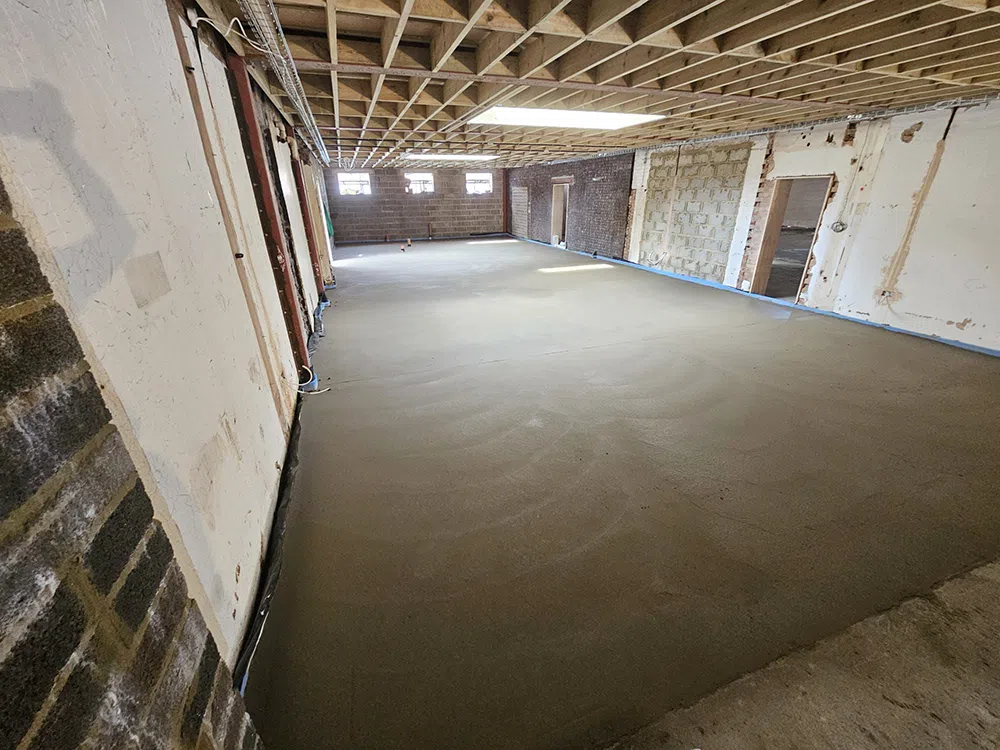
The grade on the drawings is the grade we lay, and we set out bays and joints ahead of the pour. Because the material shrinks so little, a large open ground floor can often be poured in big bays, which suits heated floors.
Purpose-built flats account for 16% of Fleet's homes. At Hartland Village, Edenbrook and Crookham Park, apartments commonly include acoustic and heated screeds, so where calcium sulphate is specified it usually floats on an acoustic layer and insulation with heating pipes inside it. Our own team prepares the full build-up, since the layers underneath matter as much as the grade.
Alpha hemihydrate products appear on some specifications where faster drying or a reduced depth matters. Each has its own product sheet, and that sheet, not a general rule, is what we follow.
In any room that may get wet, we use a flowing screed with a cement base in place of calcium sulphate. What anhydrite screed is has more on the material itself.
Laitance and moisture testing on Fleet anhydrite floors
Calcium sulphate needs two steps that cement screed does not.
Laitance comes first. Curing leaves a weak, powdery skin on the surface. Neither primer nor adhesive holds to that skin, so when the floor is dry we sand the laitance off down to clean, sound screed. A primer made for calcium sulphate follows. Skip it, and tiles and LVT are liable to come away.
Moisture testing is the second. Calcium sulphate is often held to a lower moisture limit than cement by flooring makers, so a hygrometer reading has to be checked against the figure your own flooring maker sets. Days on a calendar are only a rough guide; the drying guide explains why.
Heating helps. With heating pipes inside the screed, force drying can usually start at about 7 days, turning the temperature up gradually. On a heated Fleet ground floor that can shorten the wait before flooring considerably.
For the pumping side of the job, including hose access on driveways and sites, see pumped liquid screed in Fleet. Where the floor needs levelling after sanding, our floor levelling service in Fleet follows on.
Anhydrite & Flow Screed prices in Fleet
Liquid flowing screed (which includes anhydrite): £24 to £31 per m² supplied and laid (MyJobQuote, August 2026), so £960 to £1,240 for 40 m². MyJobQuote does not say whether these figures include VAT. See our floor screeding cost guide or screed calculator.
Who lays your anhydrite and flow screed in Fleet
K & B Screeding’s own team, led by director Donatas Bardisevicius. Founded 2019, company 12298780.
See what customers say in our Google reviews and on our testimonials page.
Anhydrite & Flow Screed from Slough to Fleet
As the crow flies, our yard in Slough is about 19.4 miles from Fleet, which lies to the south-south-west. Postcodes here include GU51 and GU52, and Farnborough (3.9 miles), Aldershot (4.1 miles), Yateley (4.3 miles) and Sandhurst (4.9 miles) are close by.
More on anhydrite screed, part of our screeding services.