
Latex under vinyl and LVT in Fleet refits
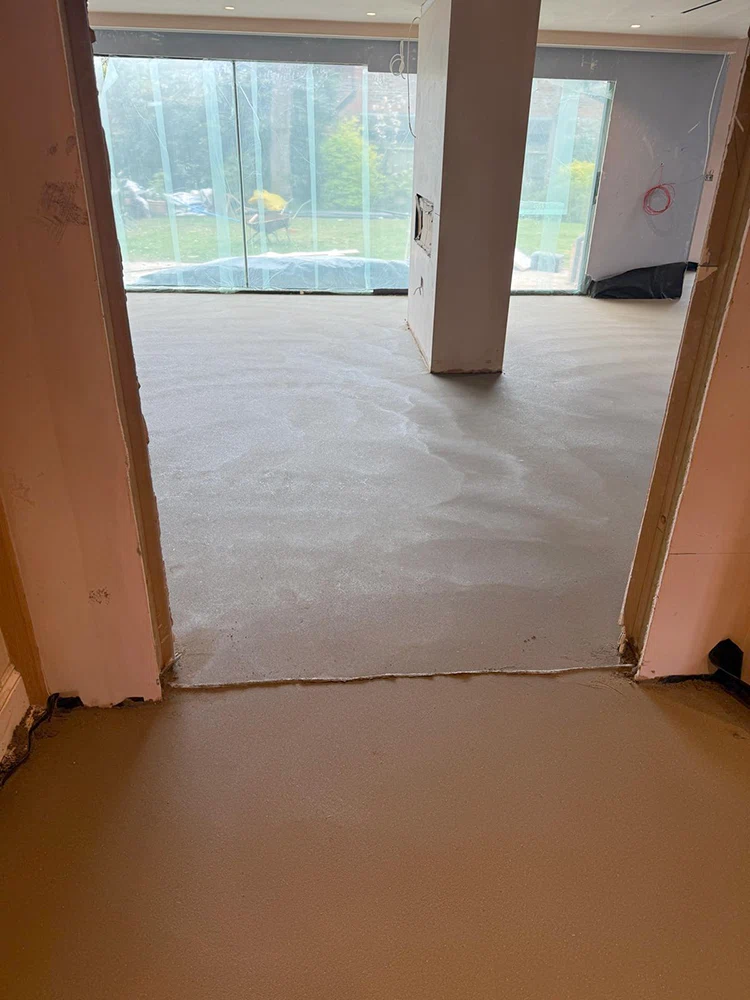
A latex screed starts as a cement based powder and a container of latex. Mixed together, with no water added, they make a pourable coat that grips hard and copes with a small amount of movement. That bond is the reason it is chosen over an ordinary compound on difficult surfaces.
Picture a Fleet refit in a house of the 1970s or 1980s. The kitchen and family room may be getting a new screed with heating, but the cloakroom, utility and upstairs en suites keep their existing floors. Those rooms are where latex fits.
Upstairs floors in houses of this era are usually timber, either boards or chipboard sheets. Latex is never laid straight onto them. The floor is screwed down to stop any squeak or bounce, then covered with flooring grade plywood fixed at tight centres, and the latex goes on top of the ply.
Downstairs, a cloakroom may still have ceramic tiles from the original build. If they are all firmly bonded, they can stay: we clean off soap and polish residues, prime, and latex over them, which avoids chiselling out tiles next to a finished hallway.
Semi-detached houses make up 23% of Fleet's homes, and the same approach works in their smaller kitchens and bathrooms.
The finishes that need this most are thin and flexible: LVT, lino, sheet vinyl, rubber, carpet and safety flooring. Without a smooth bed, every joint in the plywood or tile below shows through. If you are weighing compound against a new screed more generally, see floor levelling in Fleet.
Checks before latex goes down in Fleet homes
Latex has clear limits, and finding them before the flooring is ordered saves a second visit.
A soft or bouncy floor is the first. If the timber moves, the thin coat on top will crack. That is solved with fixings and proper overboarding, not with a thicker layer.
Damp is the second. Latex does not hold back moisture coming through a slab, so every ground floor gets a moisture reading before we price. In the older houses around Fleet Pond and the Blue Triangle, any extra preparation those floors need is done before latex is considered.
Big dips are the third. A floor that is badly out of level needs a screed repair or a new screed, because latex laid deep to hide the problem will crack.
Primers come next. Every base takes its own primer. Calcium sulphate screed must be sanded to remove laitance and primed before latex. Old adhesive is assessed: sound residue can sometimes be primed over, but soft or patchy glue is removed by grinding the concrete floor.
Flats are 17% of Fleet's homes. In an apartment, latex over the existing concrete or screed is a straightforward way to prepare for a change from carpet to vinyl or LVT, though the building may set its own rules on sound insulation under hard floors.
How we price latex screed in Fleet
A fixed written price within 24 hours, once we know the area and the base. See our floor screeding cost guide.
Who lays your latex screed in Fleet
K & B Screeding’s own team, led by director Donatas Bardisevicius. Founded 2019, company 12298780.
See what customers say in our Google reviews and on our testimonials page.
Latex Screed from Slough to Fleet
As the crow flies, our yard in Slough is about 19.4 miles from Fleet, which lies to the south-south-west. Postcodes here include GU51 and GU52, and Farnborough (3.9 miles), Aldershot (4.1 miles), Yateley (4.3 miles) and Sandhurst (4.9 miles) are close by.
More on latex screed, part of our screeding services.