
Latex over boards and tiles in Godalming refits
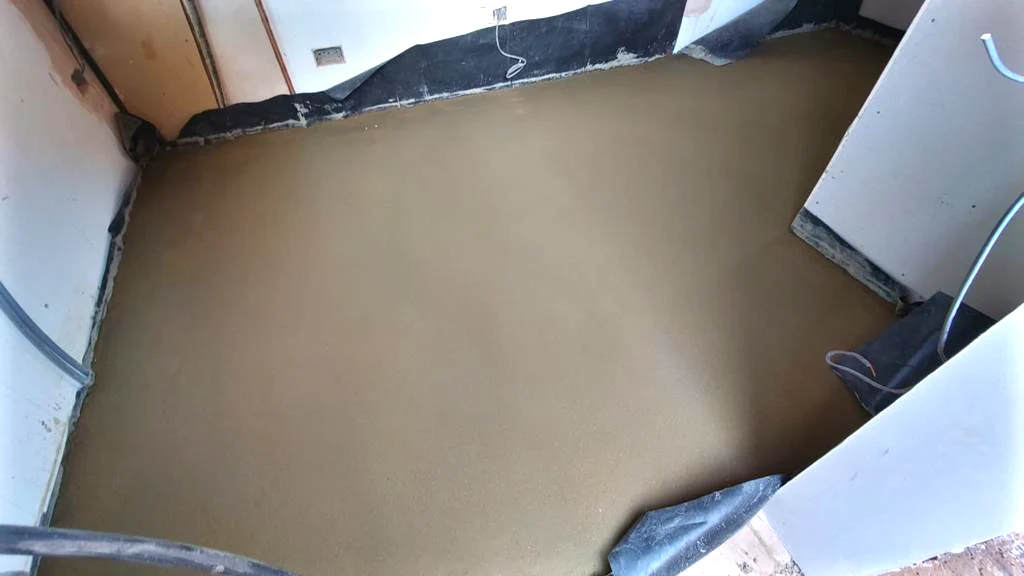
Latex screed takes its name from the liquid in the pack. Instead of mixing the cement based powder with water, the installer stirs it into a latex emulsion, which helps it bond to bases such as plywood and glazed tile. It goes down thin, normally a few millimetres, and its only job is to give the new covering a smooth face to sit on.
Timber is the usual starting point in the town's older streets. Some of the Victorian houses at Crownpits still have their old timber ground floors, and anyone refitting a kitchen or bathroom there must choose between keeping the boards and taking them out. If the joists and boards are sound, the normal route is to screw down flooring grade plywood and lay latex over that. Bare floorboards are never a suitable base on their own, because each board moves independently and the compound would crack along every gap.
Old tiles are the second case. A quarry or ceramic floor that is still firmly bonded can stay where it is, which saves a noisy and dusty strip out. We clean and degrease it, tap across it to find hollow tiles, and prime before the latex goes on.
Detached houses make up 30% of homes in Godalming, and a bigger house tends to bring more kitchens, utility rooms and cloakrooms where sheet vinyl, LVT or rubber is planned. Those thin finishes show every board joint and grout line, which is exactly what latex is there to hide. If the base turns out to be badly out of level rather than just rough, our page on levelling compound and flatness classes covers the other route.
When latex is not enough in Godalming homes
Latex hides a rough surface. It does not cure the reason a surface is rough. Before pricing, we look for three warning signs in any Godalming house.
Movement comes first. Boards that spring underfoot, or plywood fixed too sparsely, will crack a thin compound within weeks. Those floors need extra fixings, fresh ply or joist repairs before anything is laid.
Damp is the second. A Victorian solid floor laid without a membrane can push moisture up through any thin coating, and latex will lose its grip. That floor needs digging out and rebuilding with a membrane, insulation and hand-laid screed for older houses.
The third is level. If a floor drops away by more than a thin compound can make up, latex is the wrong product, and a new screed is the honest answer.
Primer is the step we never skip. Plywood, tiles, concrete and old adhesive each take a different one, and a calcium sulphate screed in a newer flat must have its laitance sanded off and be primed before latex touches it. About 27% of Godalming homes sit in council tax bands F to H, and in a larger house where earlier refits have left different bases in different rooms, each room may need its own approach. Our floor preparation service covers the groundwork when a base needs more than a clean.
How we price latex screed in Godalming
A fixed written price within 24 hours, once we know the area and the base. See our floor screeding cost guide.
Who lays your latex screed in Godalming
K & B Screeding’s own team, led by director Donatas Bardisevicius. Founded 2019, company 12298780.
See what customers say in our Google reviews and on our testimonials page.
Latex Screed from Slough to Godalming
Godalming is about 24 miles south of our Slough base as the crow flies, with postcodes including GU7 and GU8. The nearest towns to it are Guildford (4.1 miles), Aldershot (7.8 miles), Haslemere (7.9 miles) and Farnham (8.3 miles).
More on latex screed, part of our screeding services.
