
Where pumped liquid screed fits Woking's newer floors
Liquid screed suits large, open floors and floors that need to be flat without a lot of labour. It flows out under its own weight, settles to a dense surface, and reaches SR1 or SR2 flatness readily, which is what tile and LVT fitters want to find. Shrinkage is slight as well, so a wide kitchen and family room gets by with much less jointing than a hand-laid floor that size.
Woking has plenty of floors like that. Regeneration at Sheerwater is bringing new homes on the old athletics track site, the sort of build where a flowing screed is often drawn into the floor design from the start. The towers at Victoria Square and the other central blocks show how much of the town now lives in flats: 26% of homes are in purpose-built blocks. On an upper floor, pumping beats carrying sand and cement up the stairs by a long way.
Extensions on older houses are the third fit. When a rear wall comes out and a kitchen runs the width of the house, a liquid screed covers the whole area in a few hours.
Depth is modest. In a house, a floating liquid floor can be as thin as about 35mm, while sand and cement wants about 65mm, and that difference counts when an extension has to meet an old door threshold. The product comes in two families, calcium sulphate or cement based, and the grades of the first are covered on our Woking anhydrite screed page. If you are weighing up pumped against hand-laid, our guide comparing the two screeds sets them side by side.
Running the pump hose into Woking flats and houses
All the machinery stays out on the drive or the road, with only a hose coming indoors. From a driveway to a ground floor room, that hose run is short and easy. In the town centre it takes more planning. A block may have a loading bay with time limits, a lift that has to be booked, or a route through communal corridors that must be protected, so tell us about any of that when you ask for a price.
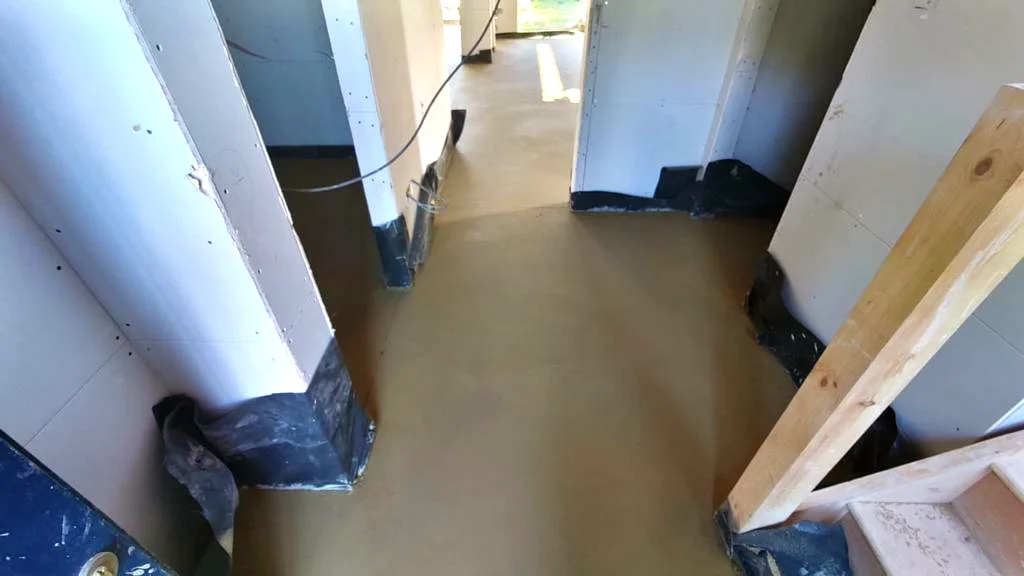
Before the pump turns up, the room has to be prepared. Edge strip goes round every wall, the membrane over the insulation is taped at each joint so nothing leaks through, and doorways are dammed to hold the screed in place. On pour day we go round and confirm all three are right.
Stepping on it the next day or the one after does not mean the floor has dried. As a rule of thumb, budget one day for each millimetre up to 40mm, then longer for any depth past that, before most finishes are laid. Good ventilation helps; sealing the room up does not.
If you only need the pumping, for example on a site where another team is laying, our screed pumping service covers that. Liquid screed in Guildford follows the same process.
Liquid Screed prices in Woking
Liquid screed: £24 to £31 per m² supplied and laid (MyJobQuote, August 2026), so £960 to £1,240 for 40 m². MyJobQuote does not say whether these figures include VAT. See our floor screeding cost guide or screed calculator.
Who lays your liquid screed in Woking
K & B Screeding’s own team, led by director Donatas Bardisevicius. Founded 2019, company 12298780.
See what customers say in our Google reviews and on our testimonials page.
Liquid Screed from Slough to Woking
As the crow flies, our yard in Slough is about 15.2 miles from Woking, which lies to the south-south-east. Postcodes here include GU21, GU23 and GU22, and Addlestone (4.6 miles), Guildford (5.5 miles), Chertsey (5.6 miles) and Weybridge (5.7 miles) are close by.
More on liquid screed, part of our screeding services.
