
Pumped screed for Egham semis and extensions
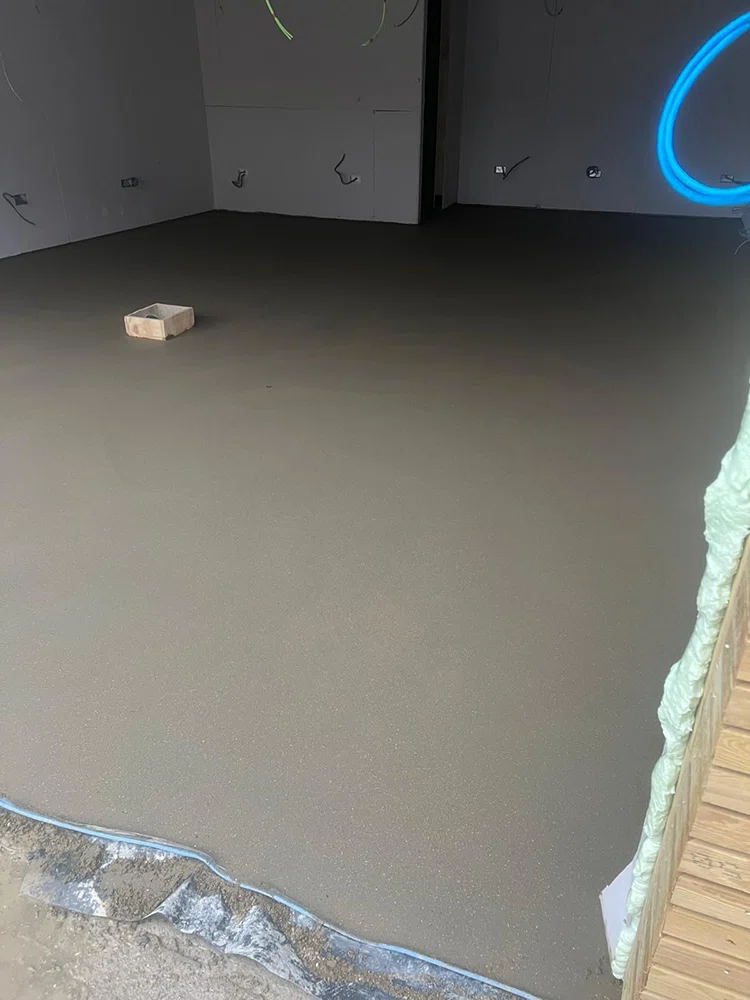
On a post-war or 1970s semi, an extension usually means opening the back of the house into one kitchen and living space. Once the walls are down, the floor becomes one large area with an old section and a new one side by side. Liquid screed covers that in a single pour, pumped from the mixer through a hose and levelled as it flows, with no hand compaction and very few joints.
Flatness is the main gain. A surface regularity of SR1 or SR2 is readily achievable, so a tiler laying large format porcelain or a fitter laying LVT starts from a good base. Shrinkage is low, which is why large bays need far fewer joints than a sand and cement floor would.
How thick? Floated on insulation, a domestic liquid floor can be as thin as about 35mm, and commercial floors start at about 40mm. Add heating pipes and 25mm of cover is the least it needs, for an overall depth of 45 to 50mm. If you are weighing up the two materials, our guide comparing pumped and hand-laid screed sets them side by side, point by point.
There is a calcium sulphate version of liquid screed and a cement based one. Keep calcium sulphate out of rooms that could get wet, and if your drawings call up a CA grade, the sanding and testing that comes with it is covered on our Egham anhydrite page. Homes built since 2015 make up 14% of Egham's housing, and new build floors like those are often designed around a flowing screed from the start.
Reaching Egham flats and terraces with the pump hose
How the pump gets to the room is settled before the pour date. Both the mixer and the pump park as near the house as they can, and the hose goes in by the front door, through a side gate or up the stairs. If your semi has a driveway, the setup is easy. A terrace with no side access, or a flat above shops in the town centre, needs a route agreed in advance, including parking and any loading restrictions.
Upper floors are within reach. A hose can run up several flights of stairs, so a flat being refurbished can take a liquid screed without material being carried up by hand. The management company usually needs to approve the route and protect the common parts.
The pour itself is quick. Most house floors take hours to pour, and light walking can start 24 to 48 hours on. The wait for flooring is longer, since each of the first 40 millimetres takes around a day to dry, and the rest of the depth takes longer. On a calcium sulphate screed with underfloor heating, the heating can usually help it dry from about 7 days.
For contractors who only need the pumping, see screed pumping. The same pumped service is available in nearby Staines-upon-Thames.
Liquid Screed prices in Egham
Liquid screed: £24 to £31 per m² supplied and laid (MyJobQuote, August 2026), so £960 to £1,240 for 40 m². MyJobQuote does not say whether these figures include VAT. See our floor screeding cost guide or screed calculator.
Who lays your liquid screed in Egham
K & B Screeding’s own team, led by director Donatas Bardisevicius. Founded 2019, company 12298780.
See what customers say in our Google reviews and on our testimonials page.
Liquid Screed from Slough to Egham
Egham is about 8.1 miles south-south-east of our Slough base as the crow flies, with postcodes including TW20, TW18 and GU25. The nearest towns to it are Staines-upon-Thames (1.6 miles), Chertsey (3.4 miles), Ashford (3.8 miles) and Windsor (4.3 miles).
More on liquid screed, part of our screeding services.
