
Pumped floors for Kingston Road extensions and kitchens
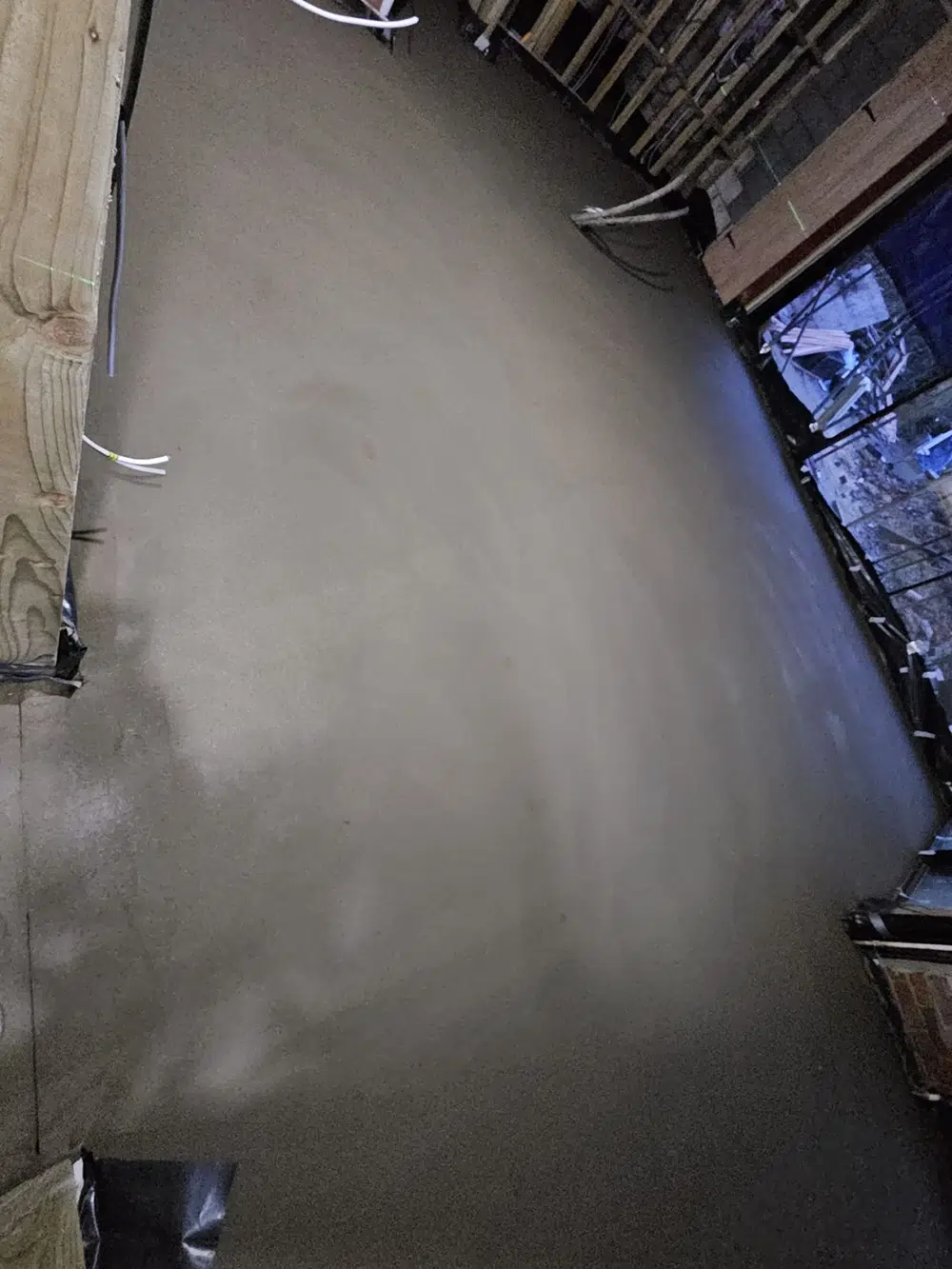
Extend the back of a Kingston Road semi and you normally end up with a single big room for cooking, eating and sitting. That shape suits liquid screed, especially when the extension is wider than the original kitchen. From the end of the hose it spreads itself flat from wall to wall, gets to SR1 or SR2 without a struggle and barely shrinks, so a hand-laid floor of the same size would need many more joints.
Often the old kitchen floor comes up at the same time, so that new insulation and one continuous screed run from the original house into the extension. That removes the step or ridge where floors of different ages would otherwise meet, and it gives a single base for tiles, LVT or engineered wood throughout.
It is also thinner than the traditional alternative. In a house, floating liquid screed can go down from about 35mm where sand and cement would need about 65mm, and on commercial work the starting point is about 40mm. On a ground floor where the membrane and insulation must be generous, those saved millimetres can go into insulation instead.
Heating is a common addition, because a flowing screed surrounds the pipes completely. Two families exist, one based on calcium sulphate and one on cement; anhydrite screed in Staines-upon-Thames deals with the former, while our liquid against traditional comparison sets the two methods side by side.
Pump access to Staines-upon-Thames streets and flats
Nothing heavy comes inside: the screed arrives through a hose from the mixer and pump on the road or drive. For a semi with a drive, it is a short run through the front door or side gate. Where parking is controlled, or the house has no side access, mention it when you send the details so the arrangements are fixed with the price.
Pumping also makes sense in flats. Purpose-built blocks hold 27% of homes in Staines-upon-Thames, and for an upper storey, running a hose up the stairs saves hauling heavy bags by hand. The managing agent should agree the date and the route through communal areas.
On the day we check the preparation: perimeter edge strip fitted, the membrane on top of the insulation taped at every joint, and doorways dammed to keep the screed in. For the kit itself, see how our screed pumping works.
Walkable and dry are different things. A 50mm extension floor, for example, needs around 40 days for its first 40mm and then a slower stretch for the last 10mm, so test it before any finish goes on. Why screed takes time to dry explains the reasons.
Liquid Screed prices in Staines-upon-Thames
Liquid screed: £24 to £31 per m² supplied and laid (MyJobQuote, August 2026), so £960 to £1,240 for 40 m². MyJobQuote does not say whether these figures include VAT. See our floor screeding cost guide or screed calculator.
Who lays your liquid screed in Staines-upon-Thames
K & B Screeding’s own team, led by director Donatas Bardisevicius. Founded 2019, company 12298780.
See what customers say in our Google reviews and on our testimonials page.
Liquid Screed from Slough to Staines-upon-Thames
Staines-upon-Thames is about 8.9 miles south-east of our Slough base as the crow flies, with postcodes including TW18. The nearest towns to it are Egham (1.6 miles), Ashford (2.2 miles), Chertsey (2.9 miles) and Sunbury-on-Thames (4.2 miles).
More on liquid screed, part of our screeding services.
