
Specifying anhydrite grades for Staines-upon-Thames apartments
Calcium sulphate screed grades follow a European coding. After CA, the C value is the compressive strength; the F value is the flexural strength, both quoted in N/mm2. Three cover most housing: CA-C20-F4 where domestic traffic is light, CA-C25-F5 for typical houses, flats and workplaces, and CA-C30-F6 for floors that work harder.
For new flats or houses on a plot, the structural engineer chooses the grade and the truck brings that grade, nothing else. Some specifications go for an alpha hemihydrate product where speed of drying or a slimmer section is the priority, as on a tight build programme; its own data sheet then fixes depth and drying, and that sheet overrides general rules.
Because the material hardly shrinks, big bays go down with very few joints, which helps in long corridors and open-plan apartments. Where joints are unavoidable, at a doorway say, or where two heating zones meet, their positions are agreed on a bay plan before anything is poured.
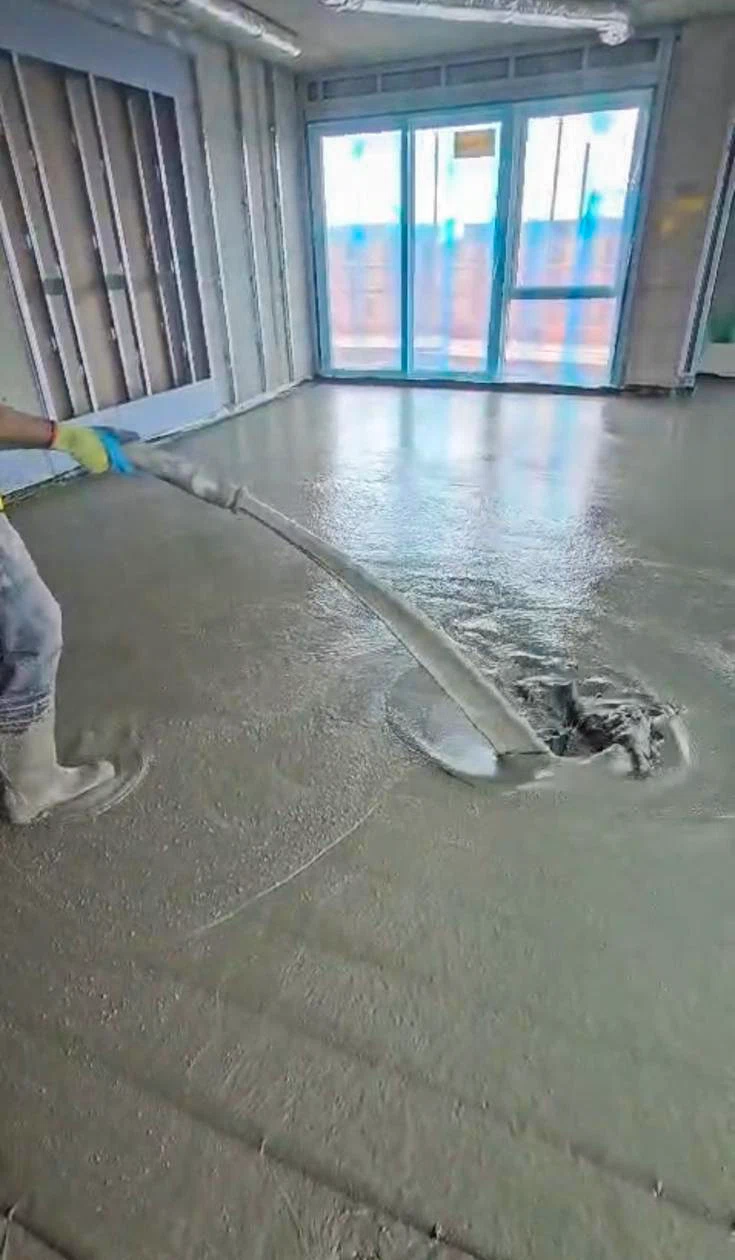
Apartment floors are a common fit: a broad, single level area over insulation, often with heating, poured in one visit. Flats make up 31% of the town's homes, so there are plenty of floors of this kind. For more on the material, and how it compares with flowing screeds made from cement, read what anhydrite screed is.
Why anhydrite stays out of wet areas in Staines-upon-Thames
There is one rule we do not bend: calcium sulphate stays out of anywhere that can get wet. Wet rooms, utilities with a risk of leaks and walk-in showers all need a cement based alternative, either a flowing cement screed or sand and cement laid by hand. Any ground floor that might be exposed to water should be planned with that in mind.
The rest is about the finish. Drying leaves a soft film on the surface, the laitance. Once it is dry enough to work on, we sand that film off and apply a calcium sulphate primer, so the adhesive grips solid screed and not a weak skin.
Moisture testing comes next. Flooring suppliers commonly set a tighter moisture threshold for calcium sulphate bases than for cement ones, so we measure with a hygrometer instead of guessing. Underfloor heating, where fitted, can usually start drying the floor from about 7 days. You receive the laitance and drying guidance in writing, and if the base needs attention first, preparing the floor is part of what we offer.
Anhydrite & Flow Screed prices in Staines-upon-Thames
Liquid flowing screed (which includes anhydrite): £24 to £31 per m² supplied and laid (MyJobQuote, August 2026), so £960 to £1,240 for 40 m². MyJobQuote does not say whether these figures include VAT. See our floor screeding cost guide or screed calculator.
Who lays your anhydrite and flow screed in Staines-upon-Thames
K & B Screeding’s own team, led by director Donatas Bardisevicius. Founded 2019, company 12298780.
See what customers say in our Google reviews and on our testimonials page.
Anhydrite & Flow Screed from Slough to Staines-upon-Thames
Staines-upon-Thames is about 8.9 miles south-east of our Slough base as the crow flies, with postcodes including TW18. The nearest towns to it are Egham (1.6 miles), Ashford (2.2 miles), Chertsey (2.9 miles) and Sunbury-on-Thames (4.2 miles).
More on anhydrite screed, part of our screeding services.