
Anhydrite grades for Ashford flats and larger buildings
Every calcium sulphate screed gets a short code under the European screed materials standard, with C standing for compressive and F for flexural strength in N/mm2. CA-C20-F4 is the light domestic grade; for most homes, apartments and office floors in Ashford the code is CA-C25-F5; and for heavier use there is CA-C30-F6.
Ashford has some large buildings, such as Ashford Hospital, HMP Bronzefield and the Brooklands College campus beside Thomas Knyvett College. Buildings like these are designed to a full specification, and the engineer decides the grade. On an apartment floor or a new house plot the principle is the same. We pour the grade that is specified rather than something close.
Sometimes an alpha hemihydrate product is named instead, when a quicker dry or thinner pour is wanted, and then we follow that maker's sheet on depth and drying.
Very little shrinkage while it cures means wide bays and few joints, a real benefit on open-plan apartment floors. Where doorways or separate heating zones call for a joint, its position is marked on our bay drawing ahead of pouring.
Around 8% of Ashford's homes were built between 2000 and 2014, and plots of that age usually have floating floors over insulation, where a flowing screed is often specified. What anhydrite screed is covers the material in more depth.
Sanding, testing and priming Ashford anhydrite floors
A dry anhydrite floor is still not a finished one, though. Laitance, a thin weak skin, forms on top and must be sanded away. If it stays, adhesives and compounds bond to that layer and can lift with it.
Sanding is followed by a calcium sulphate compatible primer, and the covering only goes on after that. Miss out either step and finishes tend to lift.
Testing for moisture is stricter here than on cement. Flooring makers often cap calcium sulphate at a lower reading, which is why a hygrometer goes on every floor before handover. A floor can look pale and dry on the surface while still holding too much moisture lower down. If heating has been laid in, it can normally start force drying the screed at around 7 days.
Wet floors are the one real exception. Shower areas, wet rooms and leak-prone utility rooms take a cement based flowing screed, or a traditional screed for Ashford wet rooms, in its place. For heated plots, see underfloor heating screed.
Anhydrite & Flow Screed prices in Ashford
Liquid flowing screed (which includes anhydrite): £24 to £31 per m² supplied and laid (MyJobQuote, August 2026), so £960 to £1,240 for 40 m². MyJobQuote does not say whether these figures include VAT. See our floor screeding cost guide or screed calculator.
Who lays your anhydrite and flow screed in Ashford
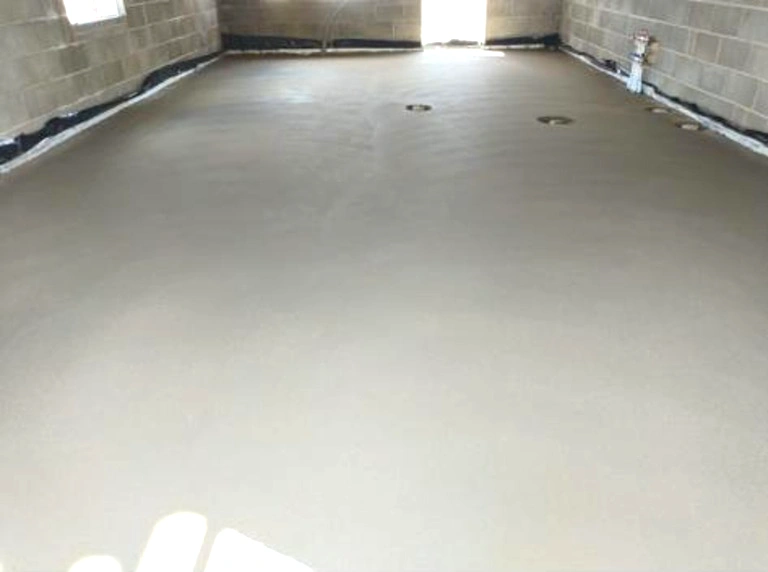
K & B Screeding’s own team, led by director Donatas Bardisevicius. Founded 2019, company 12298780.
See what customers say in our Google reviews and on our testimonials page.
Anhydrite & Flow Screed from Slough to Ashford
Ashford is about 10.5 miles south-east of our Slough base as the crow flies, with postcodes including TW15. The nearest towns to it are Sunbury-on-Thames (2.1 miles), Staines-upon-Thames (2.2 miles), Chertsey (3.3 miles) and Egham (3.8 miles).
More on anhydrite screed, part of our screeding services.
