
Old adhesive and paint on Ashford floors
Solid concrete floors in Ashford's interwar and early post-war houses have often been covered and re-covered over the years, each time with something glued down. When the last covering is lifted, what remains is a patchwork of adhesive, some hard, some soft, sometimes with floor paint in between. Compound and new adhesive will not bond reliably to that, so it has to come off.
A grinder does that job with diamond heads that spin against the floor and take the surface down in thin passes. It strips glue left by old coverings, painted surfaces and worn thin coatings, cuts off trowel ripples and bumps, and takes away any laitance, leaving clean, sound concrete or screed that a primer can soak into.
Extensions add a second task. Plenty of Ashford's 1930s and 1950s semis have gained a single storey rear extension, and the new floor seldom finishes at exactly the height of the old one. Where the new side sits a few millimetres high along the join, grinding the lip down lets a bonded screed or compound carry on across both. Garages being turned into rooms often have painted or coated slabs that need the same treatment before insulation and screed.
Shop units follow a similar pattern. Before a fit-out on Church Road, the main shopping street, gets its levelled or repaired floor, old glue and coatings usually have to be ground away. Once ground, the floor is ready for the next trade, or for latex screed in Ashford where a smooth skim is needed.
Large floors, dust and limits in Ashford
The biggest floors in Ashford are institutional: HMP Bronzefield, Ashford Hospital and the Brooklands College site next to Thomas Knyvett College. On floors that size, refurbishment can mean removing coatings over a wide area, and shot blasting or scarifying is sometimes quicker than grinding; our floor preparation service covers those options. Grinding remains the better tool for edges, ridges, joints and smaller rooms.
Whatever the size, the dust is controlled. Concrete, screed and tile all contain silica, and grinding them creates respirable crystalline silica dust. We grind only with extraction attached, and we screen off adjoining areas so the rest of the building can carry on.
Two limits apply. Grinding removes local high points but will not correct a floor that falls across a room or sags in the middle; for that, the high spots are ground and the floor is then levelled or screeded. It must also stop before a screed is thinner than its minimum depth, about 65mm for a domestic floating sand and cement screed or 75mm in a commercial one.
Resin and polished concrete finishes are outside our work, and we have no grinders or diamond tooling for sale or hire.
How we price floor grinding in Ashford
A fixed written price within 24 hours, once we know the area and what has to come off. See our floor screeding cost guide.
Who grinds your concrete floor in Ashford
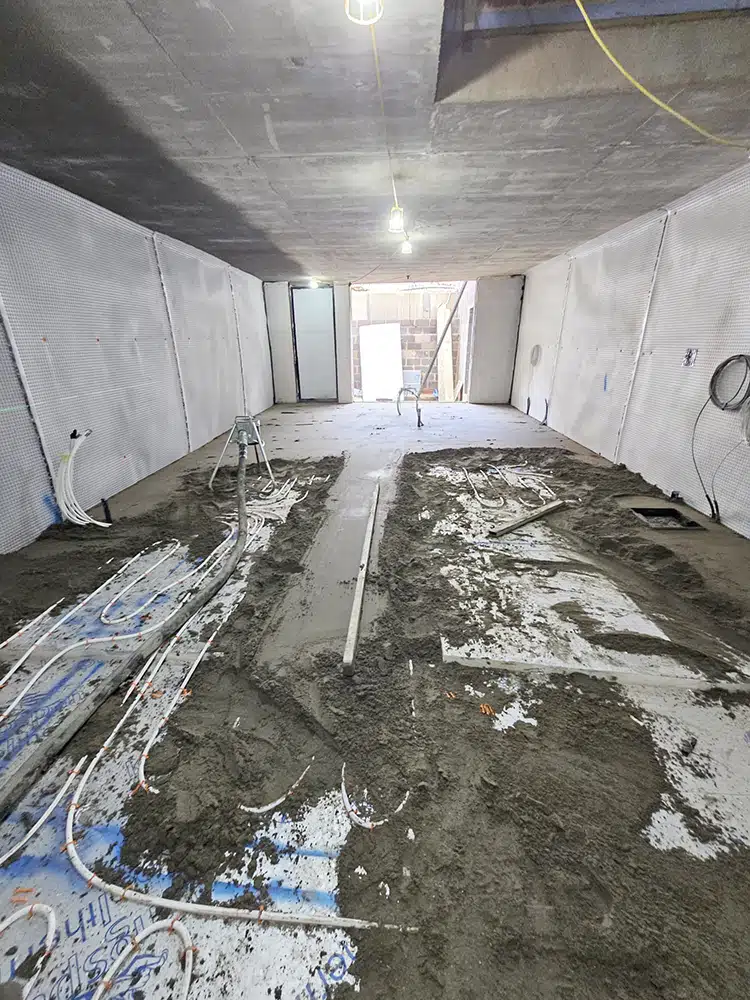
K & B Screeding’s own team, led by director Donatas Bardisevicius. Founded 2019, company 12298780.
See what customers say in our Google reviews and on our testimonials page.
Concrete Floor Grinding from Slough to Ashford
Ashford is about 10.5 miles south-east of our Slough base as the crow flies, with postcodes including TW15. The nearest towns to it are Sunbury-on-Thames (2.1 miles), Staines-upon-Thames (2.2 miles), Chertsey (3.3 miles) and Egham (3.8 miles).
More on floor grinding, part of our screeding services.
