
Specifying anhydrite grades for Chertsey flats
Calcium sulphate screed carries a designation that states its strength. Read C as how much load it takes in compression and F as how much it takes in bending, each in N/mm2. A lightly used room at home can be CA-C20-F4. Typical houses, flats and offices are poured in CA-C25-F5. CA-C30-F6 is kept for heavier use, such as busier commercial floors where trolleys, equipment or constant foot traffic will load the surface.
Where an engineer or developer has set the grade, we pour that grade and do not swap it. If a Longcross plot or a flat refit needs a quicker dry or a shallower floor, the drawings may list an alpha hemihydrate product. Its own data sheet then sets the depth and drying, and that is what we follow.
Calcium sulphate barely shrinks as it cures. That lets an open-plan flat, or a new ground floor running through several rooms, go down in wide bays with hardly any joints. The few that are needed, across doorways and where heating zones change, are marked out with the site team ahead of the pour.
Apartment floors bring one more consideration in Chertsey: flat owners replacing floors need the acoustic layers under the screed kept intact, so the build-up is checked before anything is pumped. Our anhydrite screed guide gives more background on the material, and for heated floors see screed over underfloor heating in Chertsey.
Before flooring goes down in Chertsey: laitance and moisture
Setting is not the end of a calcium sulphate floor. Drying leaves a soft film across the top, known as laitance. Glue and compound will not hold to that film properly, so when the floor is dry enough we sand it away and seal it with a primer made for calcium sulphate. Leave the film in place and tiles or LVT may later work loose.
Moisture is the next check. Flooring makers often allow less moisture in calcium sulphate than in a cement floor, so a reading that would clear sand and cement for tiling can still be too high. A hygrometer, not the calendar, tells us where it stands. If pipes run through it, the heating can normally speed the drying from around day 7 on a slow, stepped programme.
Calcium sulphate is not for anywhere that may stay wet. Showers you step straight into, full wet rooms and utilities where a machine might leak get a cement based flowing screed, and on a Chertsey plot poured in anhydrite elsewhere we do those rooms on their own.
For older bases needing work before a new pour, see our floor preparation service. We also pour anhydrite screed in Staines-upon-Thames for projects in the neighbouring town.
Anhydrite & Flow Screed prices in Chertsey
Liquid flowing screed (which includes anhydrite): £24 to £31 per m² supplied and laid (MyJobQuote, August 2026), so £960 to £1,240 for 40 m². MyJobQuote does not say whether these figures include VAT. See our floor screeding cost guide or screed calculator.
Who lays your anhydrite and flow screed in Chertsey
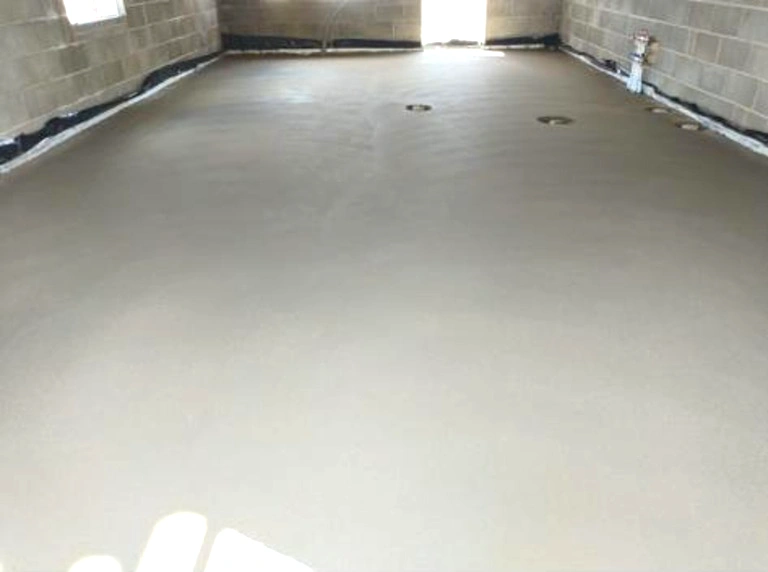
K & B Screeding’s own team, led by director Donatas Bardisevicius. Founded 2019, company 12298780.
See what customers say in our Google reviews and on our testimonials page.
Anhydrite & Flow Screed from Slough to Chertsey
As the crow flies, our yard in Slough is about 11.4 miles from Chertsey, which lies to the south-south-east. Postcodes here include KT16, and Addlestone (1.6 miles), Weybridge (2.4 miles), Staines-upon-Thames (2.9 miles) and Ashford (3.3 miles) are close by.
More on anhydrite screed, part of our screeding services.
