
Heated screed on Longcross and newer Chertsey plots
Longcross is planned as a garden village of around 5,000 homes and has been growing within the KT16 postcode since the late 2010s. In the town as a whole, 17% of homes date from 2000 to 2014, and building has carried on since. On plots like these the heating pipes and the screed are designed together, and liquid screed is the usual choice.
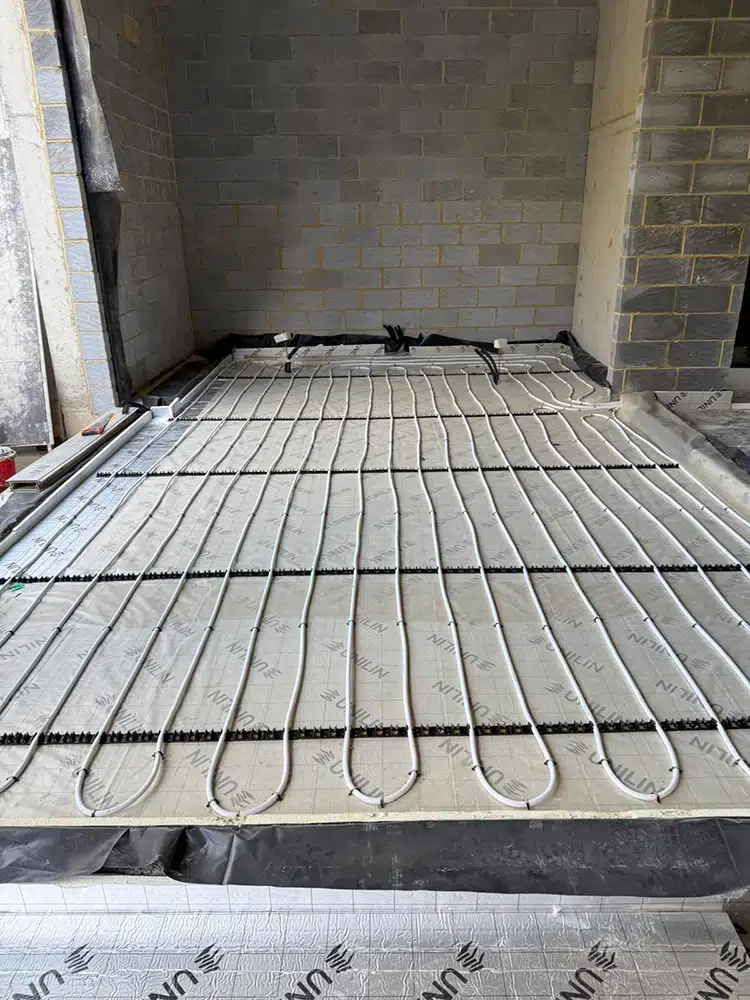
Start with how much screed sits over the pipes. Pumped screed has to clear them by 25mm or more, so a new heated floor finishes at around 45 to 50mm. A hand-laid mix wants roughly 45mm on top of the pipes, which builds a thicker floor. Skimp on it and the screed may crack along the pipe runs; overdo it and the room is slow to warm.
Encapsulation is the second. Next comes how tightly the pipes are wrapped, since any pocket of air left around them holds back the warmth. Pumped screed runs into every gap without help. That is one reason heated floors laid with it warm up faster and run more efficiently.
On pour day we look over the insulation boards, the membrane and the edge strip (or bring our own), and need the pipes clipped tight, filled and tested so nothing shifts. On a new build plot, the screed grade and depth are usually on the drawings already. The screed drying guide explains how long to allow before flooring, and calcium sulphate products are covered on the anhydrite screed page for Chertsey.
Retrofitting heat in older Chertsey semis
Some 20% of Chertsey's homes were built between 1945 and 1972, and semis from the interwar and post-war years are where extensions and kitchen diners are most often added. Adding a heated floor to one of those is a retrofit, and the finished floor has to meet existing doors and thresholds. If the old floor is coming up regardless, the dig makes space for the whole heated build-up. If it stays, the thinner cover of a liquid screed often decides the matter.
After the pour comes commissioning. With calcium sulphate, the system can normally be switched on after about a week. A sand and cement floor has to be left 21 days or longer. That first warm-up should creep: cool water at the start, a little warmer each day for several days, then held, because full heat on day one can crack the floor or curl its edges. We leave a written schedule with the homeowner and heating engineer.
Fitting the pipes is not part of our work. Your builder or heating engineer puts the system in, and we screed on top. For the traditional option in a smaller room, see sand and cement screed in Chertsey, and for projects in the next town, we lay underfloor heating screed in Weybridge.
Underfloor Heating Screed prices in Chertsey
Liquid screed over underfloor heating: £20 to £35 per m² supplied and laid (trade2base, June 2026), so £700 to £1,230 for 35 m². trade2base gives these figures excluding VAT. See our floor screeding cost guide or screed calculator.
Who lays your underfloor heating screed in Chertsey
K & B Screeding’s own team, led by director Donatas Bardisevicius. Founded 2019, company 12298780.
See what customers say in our Google reviews and on our testimonials page.
Underfloor Heating Screed from Slough to Chertsey
As the crow flies, our yard in Slough is about 11.4 miles from Chertsey, which lies to the south-south-east. Postcodes here include KT16, and Addlestone (1.6 miles), Weybridge (2.4 miles), Staines-upon-Thames (2.9 miles) and Ashford (3.3 miles) are close by.
More on underfloor heating screed, part of our screeding services.
