
Heated kitchen floors in Staines-upon-Thames semis
Underfloor heating is simplest to add in a new kitchen extension, where the whole floor is new and its layers can be designed from the slab up. Where the existing kitchen floor is broken out at the same stage, the heating and screed can run through the whole open-plan space without a join.
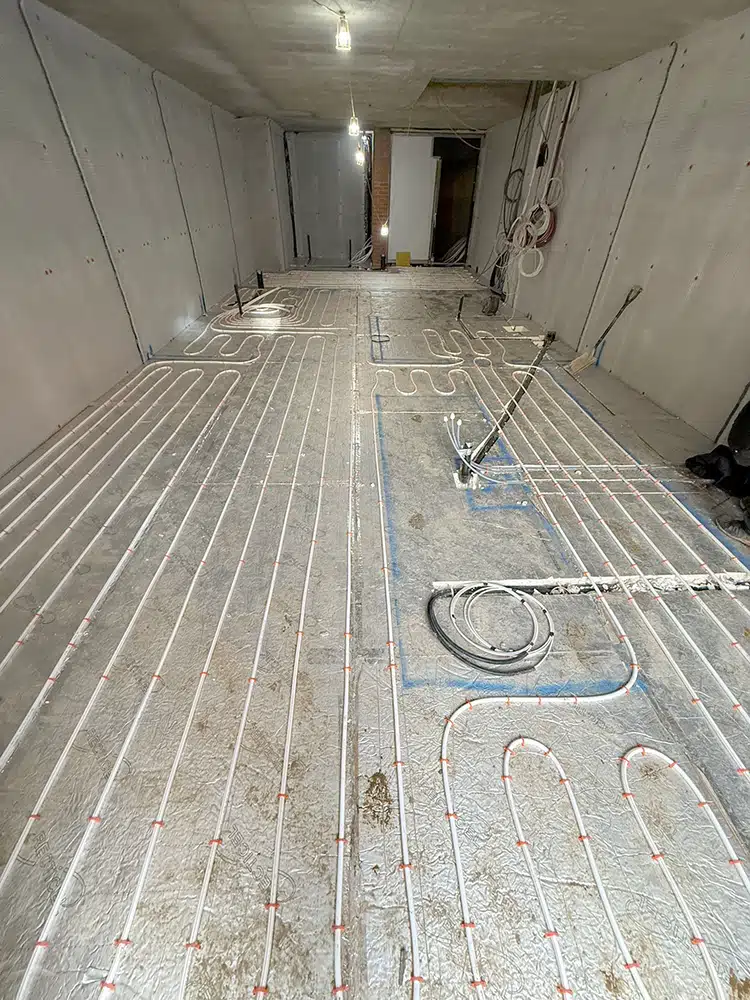
Cover over the pipes sets the depth. With liquid, 25mm over the pipes is the minimum, and the finished layer comes out at 45 to 50mm. Sand and cement needs closer to 45mm of screed on top of them, so the floor ends up thicker. In a semi with fixed thresholds at the back door and hall, the thinner option often leaves room for more insulation, which makes the heating more efficient.
Liquid has a second point in its favour. Because it is poured, it fills every gap around the pipes, so warmth spreads evenly and the room heats up sooner. A hand-laid screed can do the job too, provided it is compacted carefully along each run.
With 31% of homes in Staines-upon-Thames being semi-detached, this kind of layout is common. Before the pour, the pipes should be clipped, filled and pressure tested, and edge strip fixed to every wall so the warm screed can expand. Our liquid screed page for the town explains the pour itself, and the screed thickness guide covers depths in more detail.
Insulation beneath heated floors on the Staines-upon-Thames floodplain
Heat goes where it can. Without enough insulation beneath the pipes, a good share of it moves down into the ground rather than up into the room, so the layer under the heating is as important as the screed over it. On a floodplain town, that insulation must sit on a continuous damp proof membrane, lapped and taped, and linked to the wall's damp course.
After the pour, the heating stays off for a while. The earliest the system should run is around 7 days for calcium sulphate and 21 days or more for sand and cement. Commissioning is gradual, beginning at a low flow temperature and stepping up over several days. Your heating engineer runs it, following the written schedule we leave. Switching straight to full heat is a classic cause of cracking and debonding, so patience in the first fortnight protects the floor for years.
If you need the layers beneath the pipes as well, our insulation and membrane supply covers the insulation, the membrane and the edge strip, or we can simply check what is there. A pumped screed over heating pipes is published at £20 to £35 per m², and what a screed costs explains what pushes that up or down.
Underfloor Heating Screed prices in Staines-upon-Thames
Liquid screed over underfloor heating: £20 to £35 per m² supplied and laid (trade2base, June 2026), so £700 to £1,230 for 35 m². trade2base gives these figures excluding VAT. See our floor screeding cost guide or screed calculator.
Who lays your underfloor heating screed in Staines-upon-Thames
K & B Screeding’s own team, led by director Donatas Bardisevicius. Founded 2019, company 12298780.
See what customers say in our Google reviews and on our testimonials page.
Underfloor Heating Screed from Slough to Staines-upon-Thames
Staines-upon-Thames is about 8.9 miles south-east of our Slough base as the crow flies, with postcodes including TW18. The nearest towns to it are Egham (1.6 miles), Ashford (2.2 miles), Chertsey (2.9 miles) and Sunbury-on-Thames (4.2 miles).
More on underfloor heating screed, part of our screeding services.
