
Where liquid screed suits Walton-on-Thames houses
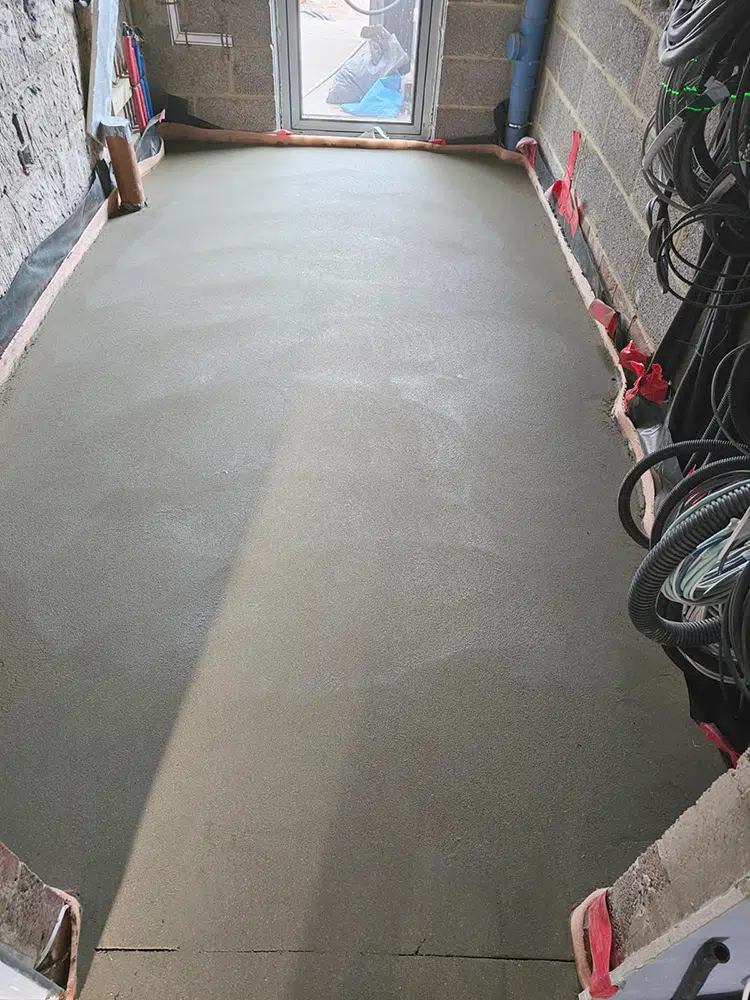
Liquid screed pays off most on floors that are large, open and new. An extension that knocks a kitchen and dining room into one space is the obvious case, and it is a typical project on Walton's suburban semis. The screed flows under door frames, round pipes and into corners, so a big floor comes out flat and dense with very few joints. Because it is pumped rather than barrowed, there is no stream of wheelbarrows through the house either.
Newer homes are a natural fit too. In Walton-on-Thames, 22% of homes were built since 2000, and 10% since 2015 alone. Many of those were planned for flowing screed at drawing stage, and an extension added now can copy the existing build-up.
Laid on insulation alone, a house floor can start at roughly 35mm, and shops or offices at 40mm. Pipes change the sum: 25mm minimum has to sit over them, so the screed comes to around 45 to 50mm. Surface regularity to SR1 or SR2 is readily achievable, which saves on levelling before tiles or LVT.
There are two broad types. Calcium sulphate based liquid screeds are widely used for heated domestic floors, and cement based flowing screeds suit areas that may get wet or where the specification calls for cement. The specification side of calcium sulphate is covered on our Walton anhydrite flow screed page. Still deciding? Our comparison of pumped liquid screed and traditional sand and cement sets the two side by side.
Pumping to Walton-on-Thames flats and side returns
The pump is the part people do not picture. A mixer lorry and pump unit park as near the property as the road allows, and a hose carries the screed into the room. On a typical semi the hose runs up the side return or through the house, with the hall protected. We look at the access when we price, not on the morning of the pour.
Flats need more planning. With the 279 apartments at The Heart and other blocks in the centre, the hose may need to climb a stairwell or reach an upper window, and the building's management will usually set the times. Acoustic layers and edge strips must be in before the pour, so the new floor floats free of the walls.
After the pour, keep the room free of draughts at first, then ventilate. As for drying, allow around 24 hours for each millimetre of the first 40mm. Our screed pumping service explains the equipment, and the same service across the river is on the Sunbury-on-Thames liquid screed page.
Liquid Screed prices in Walton-on-Thames
Liquid screed: £24 to £31 per m² supplied and laid (MyJobQuote, August 2026), so £960 to £1,240 for 40 m². MyJobQuote does not say whether these figures include VAT. See our floor screeding cost guide or screed calculator.
Who lays your liquid screed in Walton-on-Thames
K & B Screeding’s own team, led by director Donatas Bardisevicius. Founded 2019, company 12298780.
See what customers say in our Google reviews and on our testimonials page.
Liquid Screed from Slough to Walton-on-Thames
As the crow flies, our yard in Slough is about 14.1 miles from Walton-on-Thames, which lies to the south-east. Postcodes here include KT12, TW17 and KT10, and Weybridge (2 miles), Sunbury-on-Thames (2.3 miles), Addlestone (3.4 miles) and Chertsey (3.7 miles) are close by.
More on liquid screed, part of our screeding services.
