Awkward bases under Havant kitchen and bathroom refits
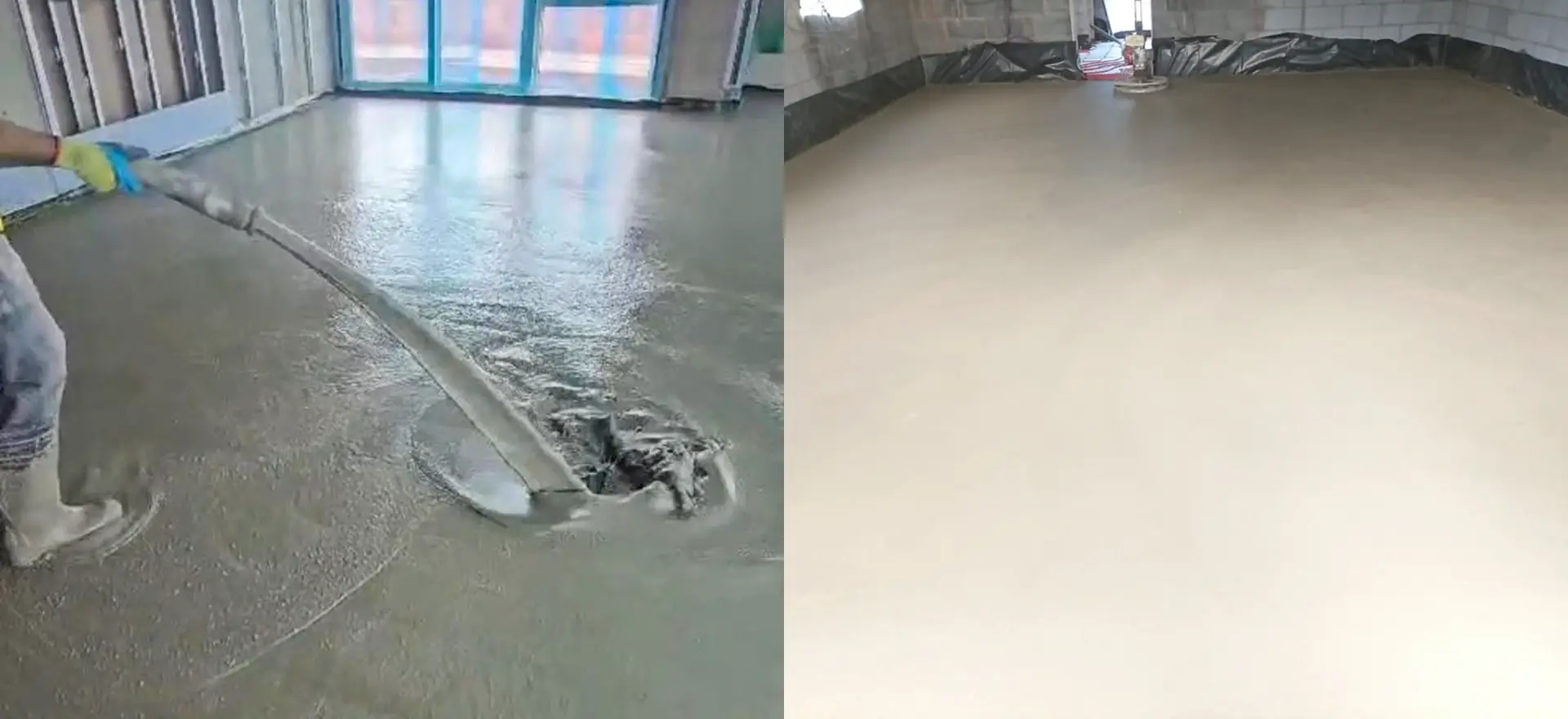
Latex screed starts as two parts: a cement based powder, and a latex liquid that takes the place of water in the mix. The polymer gives the set compound grip and a degree of give, which is why it copes with surfaces an ordinary water mixed compound may not. We spread it to a few millimetres, enough to bury small faults so a thin finish does not show them.
Early post-war houses here went up in a variety of ways. When one of them is refitted, the kitchen or bathroom floor can turn out to be one of several things. Old ceramic or quarry tiles that are still firmly stuck can be cleaned, primed and covered, so nobody has to break them out. Original concrete that is sound but pitted can be skimmed smooth. A layer of well bonded old adhesive can often stay, given the right primer.
Upstairs bathrooms in most houses sit on timber. Latex is never laid straight onto boards, because they flex and shift with the seasons. Instead the floor is overboarded with flooring grade plywood, screwed down firmly, and the latex goes on the plywood. That gives safety flooring or sheet vinyl in a family bathroom a surface with no board lines showing. Fixing loose boards and laying the ply is part of preparing the base first.
The finishes this suits are the thin ones: sheet vinyl, LVT, lino, rubber, safety flooring and carpet.
Checking a Havant floor before latex goes down
Latex is only as good as the floor under it, so three checks come before any mixing.
Moisture. If the meter shows moisture in the old slab of a Havant house, latex will not hold that moisture back, and under sealed vinyl it can lose its grip. In that case the floor needs taking out and replacing with a membrane, insulation and new screed, which our page on hand-laid relays in Havant describes.
Movement. Boards that bounce underfoot will crack a thin compound within weeks. They are screwed down, repaired or overboarded first.
Level. A floor that runs well out of level across the room needs more depth than latex is designed for. Our floor levelling service in Havant explains when a thicker compound or a new screed is the better route.
Then comes the primer, matched to the base: one product for glazed tiles, another for porous concrete, another for old adhesive. Calcium sulphate screeds always have their laitance sanded off and are primed before latex. Get the primer wrong and even a well mixed latex can peel away from the base.
Latex screed prices for Havant floors
Latex has no separate rate in the trade2base guide; a thin levelling layer over concrete is £10 to £20 per m² (trade2base, June 2026), so £200 to £400 for 20 m². trade2base does not say whether these figures include VAT. See our floor levelling cost guide.
Who lays your latex screed in Havant
K & B Screeding, led by director Donatas Bardisevicius. Founded 2019, company 12298780.
See what customers say in our Google reviews and on our testimonials page.
Latex screed from Slough to Havant
On the map, Havant sits south-south-west of Slough, about 49 miles from our base in a straight line (postcodes including PO7 and PO9), next to Emsworth (2.2 miles), Horndean (3.7 miles), Portsmouth (6.2 miles) and Gosport (7.4 miles).
More on latex screed, part of our screeding services. For every screed we lay locally, see floor screeding in Havant.
Further reading: which screed primer to use and latex, self levelling compound or screed.