
Pipe cover for heated floors in Havant extensions
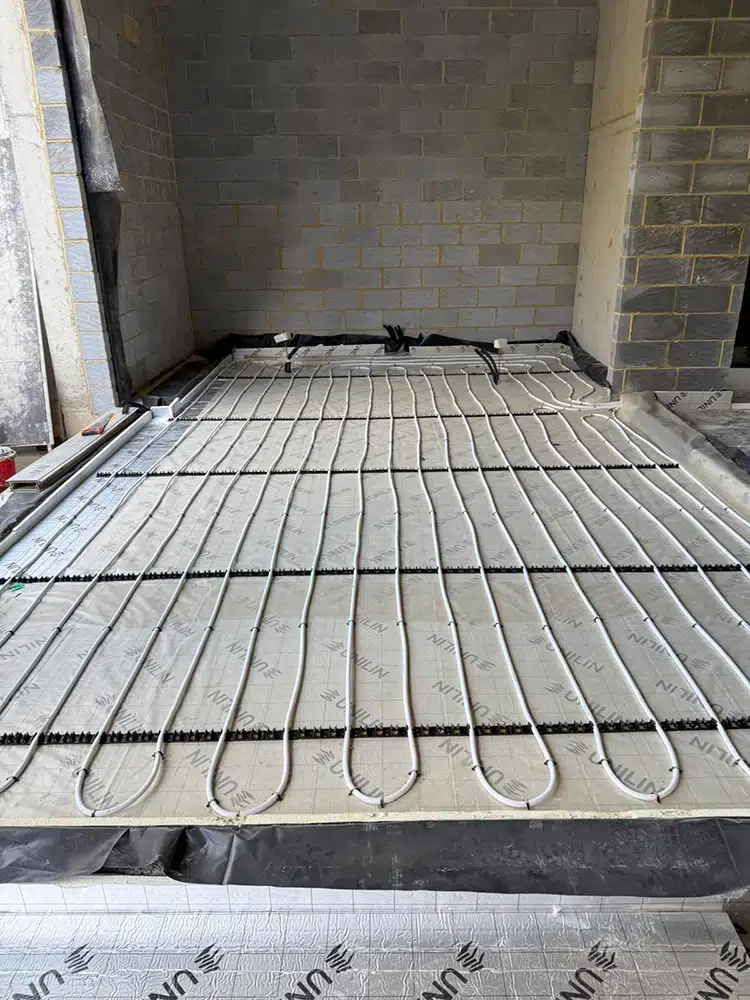
Only 15% of Havant's homes date from 2000 or later. In the rest, a heated floor usually arrives with an extension or a rebuilt ground floor, and the screed has a precise job over the pipes. Pumped screed has to sit 25mm or more proud of the pipes, so the finished build is roughly 45 to 50mm; a hand-laid sand and cement floor needs about 45mm of cover. Both figures are there for strength and for an even spread of heat: too thin and the floor can crack along the pipe runs, too thick and the room responds slowly.
Because a pumped screed wraps each pipe completely and traps no air, the room warms faster and the system wastes less heat. A hand-laid screed works too, compacted carefully so it leaves no voids around the pipes. Whichever is chosen, we inspect the insulation boards, the membrane and the perimeter strip before pouring and provide anything not already there. The edge strip matters more than it looks, because without it the screed locks against the walls and can crack as it heats and cools.
Building out the back of a Havant semi, the heated floor still has to line up with the rooms you already have. Insulation, pipes, screed and floor finish all stack up, and that stack should be settled before the foundations are dug, so there is no step at the doorway. Depths for each build-up are listed in how thick screed should be, and the pumped route is on Havant liquid screed.
Commissioning underfloor heating in a Havant home
Heating a new screed too early, or too hard, is a quick way to crack it. Calcium sulphate floors can generally have warmth put through them after about 7 days. Sand and cement is different, and asks for 21 days or longer with the heating off. After that the system is commissioned gradually: a low water temperature to start, raised in small steps over several days, held, and brought down again before the floor finish is laid. We hand over clear guidance on this, and your heating engineer runs it to the system's own instructions.
On calcium sulphate floors, running the heating like this is also the usual way to force dry the screed before flooring. It helps, but a moisture test still decides when tiles or engineered wood go down.
Retrofit in the post-war houses is possible, but floor height is usually the limit. Adding insulation and a heated screed on top of an old slab can leave a step at every door, so the original floor often comes out first. Sand and cement screed for Havant refits covers that relay. Published 2026 figures for underfloor heating with liquid screed range from £20 to £35 per m².
Underfloor Heating Screed prices in Havant
Liquid screed over underfloor heating: £20 to £35 per m² supplied and laid (trade2base, June 2026), so £700 to £1,230 for 35 m². trade2base gives these figures excluding VAT. See our floor screeding cost guide or screed calculator.
Who lays your underfloor heating screed in Havant
K & B Screeding’s own team, led by director Donatas Bardisevicius. Founded 2019, company 12298780.
See what customers say in our Google reviews and on our testimonials page.
Underfloor Heating Screed from Slough to Havant
On the map, Havant sits south-south-west of Slough, about 49 miles from our base in a straight line (postcodes including PO9 and PO7), next to Emsworth (2.2 miles), Horndean (3.7 miles), Portsmouth (6.2 miles) and Gosport (7.4 miles).
More on underfloor heating screed, part of our screeding services.
