
Calcium sulphate grades for new Shoreham-by-Sea apartments
On a riverside block's drawings, the screed will be written as a code like CA-C25-F5. That code comes from the European standard for screed materials: C stands for compressive strength, F for flexural strength, and both are given in N/mm2.
Three grades cover most residential work. A lightly used domestic floor can take CA-C20-F4. For most houses, apartments and offices the grade is CA-C25-F5, so that is what an ordinary flat is likely to show. Communal areas and ground floor commercial space, which take harder wear, may call for CA-C30-F6.
Some specifications use alpha hemihydrate screeds instead. They are chosen where faster drying or a thinner section matters, which can help on a tight apartment programme or an acoustic build-up with limited height. Their depth and drying times are set by each maker's product sheet, not by the usual rules.
Flats suit it because it hardly shrinks. We can pour big bays with few joints and finish an entire apartment floor in a single visit. Joints are still planned at door thresholds, between heating zones and where the building itself has movement joints, and we agree the bay layout before pouring.
With the Western Harbour Arm allocated for new homes, more apartment floors of this kind are likely in the town. For a broader introduction to the material, read anhydrite screed explained. Where the base needs grinding or cleaning first, our floor preparation service handles it.
Laitance, primers and testing beside the River Adur
Pouring calcium sulphate is only the start. During drying, a thin and weak surface skin forms, known as laitance. Before adhesive or compound goes anywhere near it, that skin is sanded away, otherwise the flooring is only bonded to a crust. A primer suited to calcium sulphate then goes on the sanded floor.
Moisture testing comes next. Plenty of flooring makers allow less moisture in calcium sulphate than in cement, which means a result that passes on sand and cement can fail on anhydrite. A hygrometer reading decides when the floor is ready, not the calendar. If the flat has underfloor heating, it can normally be run from about 7 days to force the drying on.
No floor that may end up wet should have calcium sulphate on it. Bathrooms with level access showers, bin stores and some ground floor commercial units need a cement based flowing screed instead. Where a building needs both, we can pour the two materials on the same job.
Where a wet room needs hand-shaped falls, see sand and cement screed in Shoreham-by-Sea. For comparable apartment specifications along the coast, see anhydrite screed in Littlehampton.
Anhydrite & Flow Screed prices in Shoreham-by-Sea
Liquid flowing screed (which includes anhydrite): £24 to £31 per m² supplied and laid (MyJobQuote, August 2026), so £960 to £1,240 for 40 m². MyJobQuote does not say whether these figures include VAT. See our floor screeding cost guide or screed calculator.
Who lays your anhydrite and flow screed in Shoreham-by-Sea
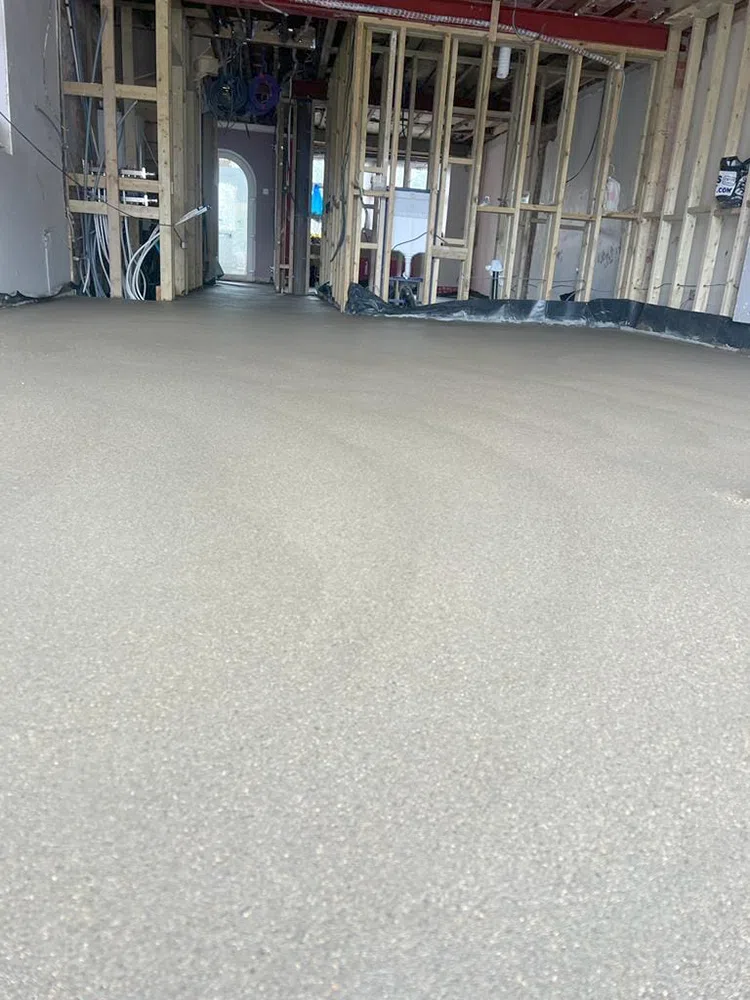
K & B Screeding’s own team, led by director Donatas Bardisevicius. Founded 2019, company 12298780.
See what customers say in our Google reviews and on our testimonials page.
Anhydrite & Flow Screed from Slough to Shoreham-by-Sea
On the map, Shoreham-by-Sea sits south-south-east of Slough, about 50.9 miles from our base in a straight line (postcodes including BN43 and BN15), next to Southwick (1.5 miles), Worthing (4.5 miles), Brighton and Hove (5.7 miles) and Burgess Hill (10.5 miles).
More on anhydrite screed, part of our screeding services.
