
Matching old floors in Shoreham-by-Sea semis
Put a rear extension on an inter-war semi and its floor must line up exactly with the old one inside. Sometimes the old floor is suspended timber with a void beneath. Sometimes it is an early concrete slab, which may have no insulation or damp protection. Either way, the new floor is built up to suit: base, insulation, membrane, then screed.
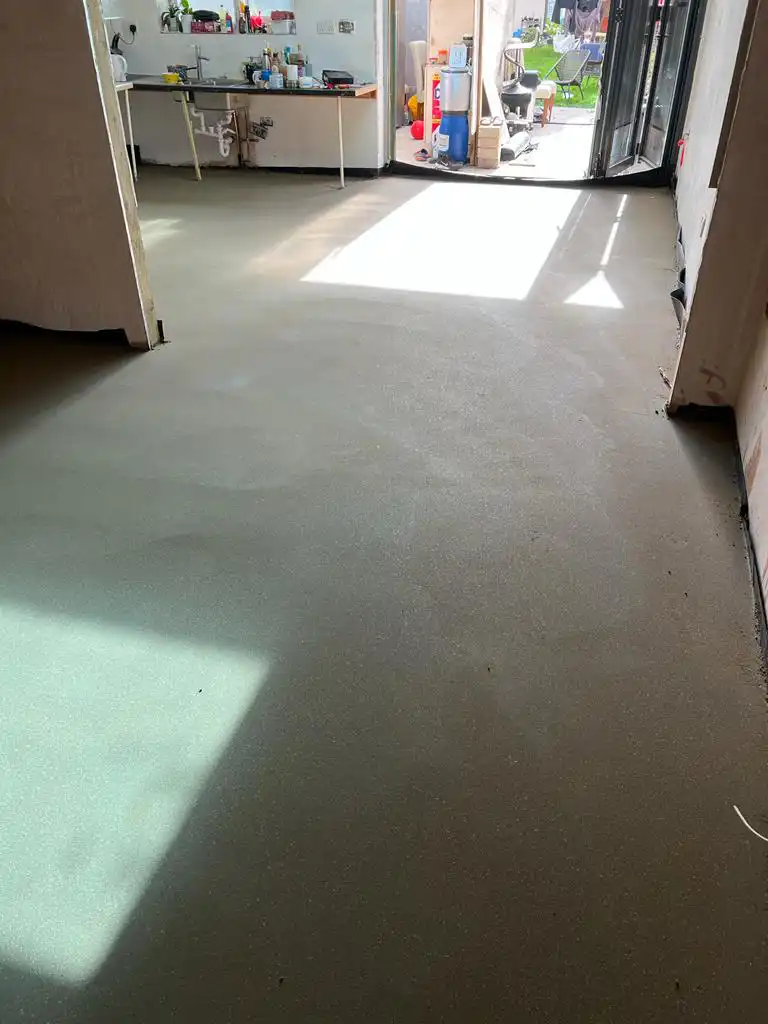
That is work a hand-laid screed handles well. The screed can be laid to a precise level against existing thresholds and feathered into tight corners, door openings and bay windows. The mix is adjusted on site to suit each area.
How thick it goes depends on what sits beneath. Floating on insulation, it is 65mm in a house or 75mm on commercial work. Bonded to a sound concrete slab it can drop to 25 to 40mm, useful when an old semi's floor leaves little gap under the doors. Our screed thickness guide covers the options.
Where an old solid floor has failed, the answer is often to dig it out completely and rebuild it the same way. That is slower than a pour, but it lets insulation and a membrane go in properly.
Going by published 2026 UK figures, plan on £18 to £25 per m². Fibres, which reduce surface cracking, add about £1 to £3 per m². Rapid drying additives are available when the programme is tight.
Wet rooms, garages and older Shoreham-by-Sea flats
Some floors in the town simply need cement. A wet room or walk-in shower must be laid to falls so water reaches the drain, and that shaping is done by hand. Calcium sulphate screeds are weakened by prolonged moisture, so a cement base is the safer choice under tanking and tiles.
Garage conversions are similar. The floor is raised to meet the house, insulated, fitted with a membrane and screeded. A cement screed also suits a room that will take load early, such as a workshop or utility room with heavy appliances.
Older blocks of flats bring their own work. Damaged sections of screed may need cutting out and relaying, and acoustic build-ups have to be respected so sound does not travel to the flat below. Our screed repairs service covers patches and failed areas.
What sand and cement costs you is time spent drying. It is slower than liquid screed, so allow for that before flooring goes down. If a finished floor is sound but uneven, levelling compound over the new screed can bring it to SR1. For similar renovation work along the coast, see sand and cement screed in Worthing.
Sand and Cement Screed prices in Shoreham-by-Sea
Sand and cement screed: £18 to £25 per m² supplied and laid (MyJobQuote, August 2026), so £450 to £630 for 25 m². MyJobQuote does not say whether these figures include VAT. See our floor screeding cost guide or screed calculator.
Who lays your sand and cement screed in Shoreham-by-Sea
K & B Screeding’s own team, led by director Donatas Bardisevicius. Founded 2019, company 12298780.
See what customers say in our Google reviews and on our testimonials page.
Sand and Cement Screed from Slough to Shoreham-by-Sea
On the map, Shoreham-by-Sea sits south-south-east of Slough, about 50.9 miles from our base in a straight line (postcodes including BN43 and BN15), next to Southwick (1.5 miles), Worthing (4.5 miles), Brighton and Hove (5.7 miles) and Burgess Hill (10.5 miles).
More on sand & cement screed, part of our screeding services.