
Hand-laid screed in Burgess Hill's older houses
Between 1850 and 1880, Burgess Hill grew from a rural settlement into a town of 4,500, and homes built before 1919 are now a small part of the stock. When an original ground floor in a house of that age fails, it is broken out and rebuilt: the ground consolidated, a slab laid, a damp proof membrane and insulation added, and a new screed on top.
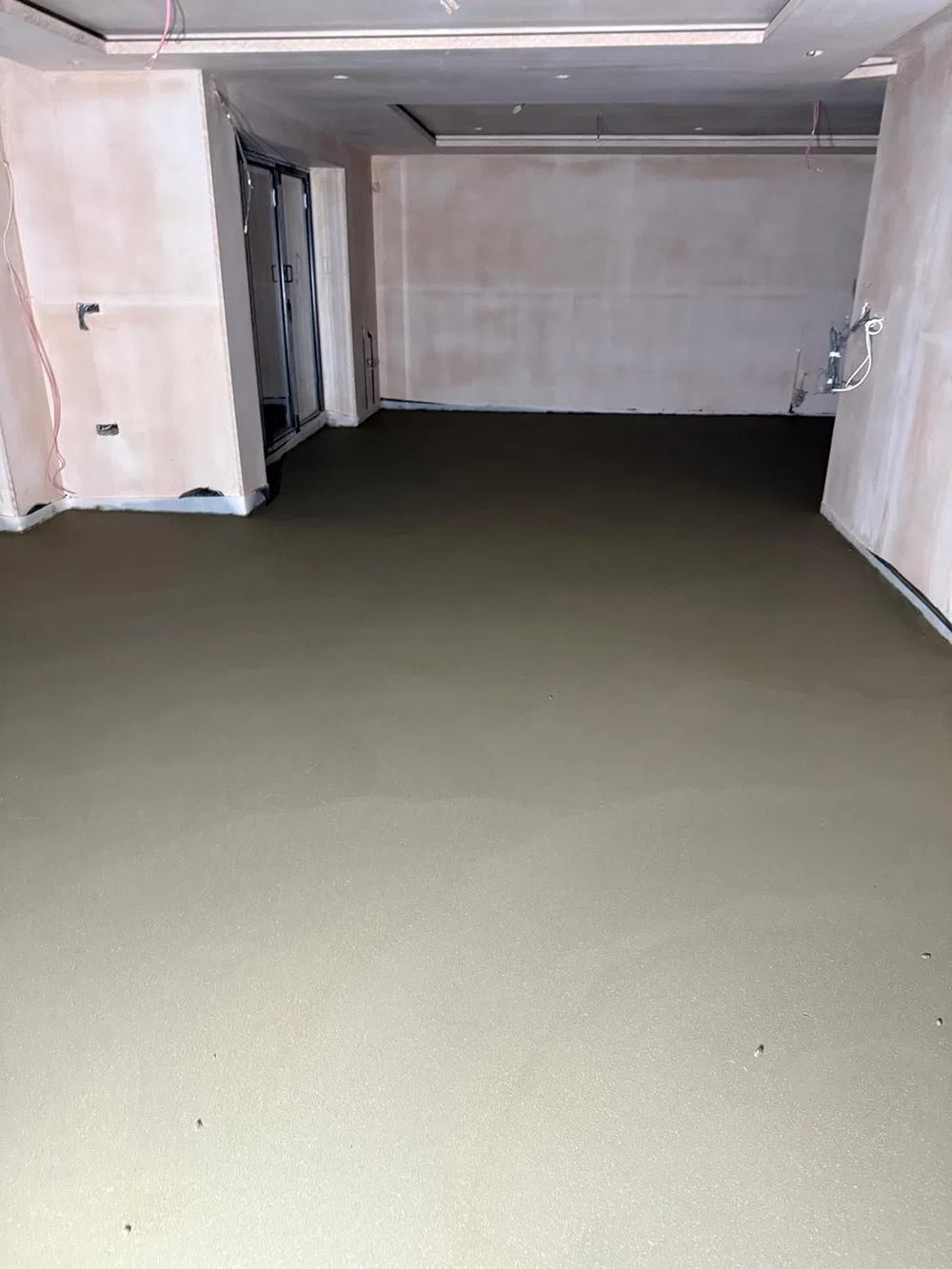
For that kind of rebuild, a screed laid by hand fits well. We mix it on site, lay it in bays to the depth each part of the room needs, tamp it down by hand and float it to a dense, level finish. Because it is placed by hand, the depth can be adjusted across the room to meet an existing threshold or the bottom step.
Over insulation, as a floating floor, it goes in at 65mm for a house and 75mm for commercial use. It can also be bonded straight onto a sound slab at just 25 to 40mm. Drying is slower than with liquid screed: allow roughly one day for each mm up to 40mm, and longer per mm beyond. Our guide to screed thickness shows which build-up applies where.
In a terraced house the practical advantage is scale. A single back room or a hallway does not justify a pump, and sand and cement can be carried through in barrows and laid in a day. Adding fibres, at £1 to £3 per m², helps the screed resist cracking where that is a worry.
Wet rooms, garages and quick drying mixes in Burgess Hill
Any floor that might see water, whether a bathroom, a utility or a shower area, should have a cement based screed, since water does not weaken it. Being hand-laid, it can be sloped towards a drain, so it is the usual base under a wet room or level-access shower. The drain position and finished level are set first, and tanking goes on once the screed is dry.
Then there are garage conversions. When an integral or attached garage becomes a study, playroom or bedroom, the floor has to be raised, insulated, protected with a membrane and screeded to meet the rest of the house, usually in one visit once the base is ready. Read the garage conversion floor guide for the build-up.
If the flooring date is close, a faster drying sand and cement mix cuts the wait. That costs £20 to £28 per m² on published 2026 figures, compared with £18 to £25 for an ordinary mix. Our Lewes sand and cement screed page covers that town.
Sand and Cement Screed prices in Burgess Hill
Sand and cement screed: £18 to £25 per m² supplied and laid (MyJobQuote, August 2026), so £450 to £630 for 25 m². MyJobQuote does not say whether these figures include VAT. See our floor screeding cost guide or screed calculator.
Who lays your sand and cement screed in Burgess Hill
K & B Screeding’s own team, led by director Donatas Bardisevicius. Founded 2019, company 12298780.
See what customers say in our Google reviews and on our testimonials page.
Sand and Cement Screed from Slough to Burgess Hill
On the map, Burgess Hill sits south-south-east of Slough, about 45.5 miles from our base in a straight line (postcodes including RH15 and BN6), next to Haywards Heath (3.1 miles), Lewes (8.5 miles), Brighton and Hove (9.2 miles) and Southwick (9.6 miles).
More on sand & cement screed, part of our screeding services.
