
Refit floors at Victoria Business Park and the Martlets
A shop or office refit starts with stripping the old finish, and that often reveals a floor that is patched, ridged or out of level. Thin finishes such as LVT, sheet vinyl and carpet tiles will show every fault, so the base has to be corrected first.
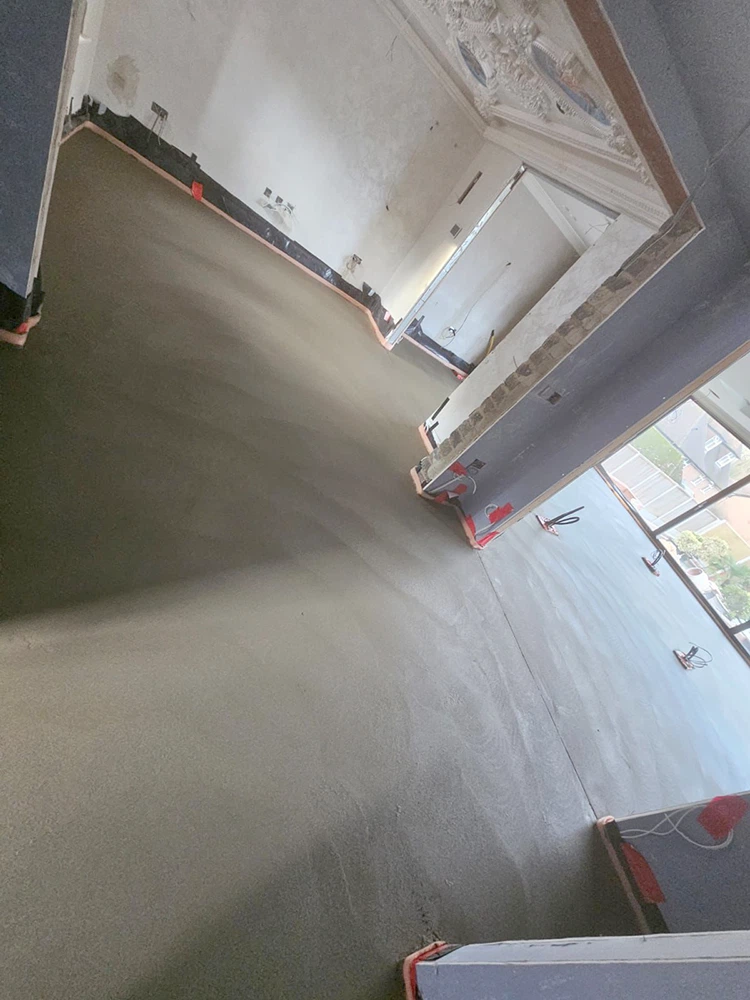
Self levelling compound is mixed, poured and spread across the prepared floor. It flows into low spots and dries to a smooth, flat surface. Layers normally run from about 2mm to around 10mm, though some products are made for deeper fills. On a fit-out, fast drying compound stops the floor holding up the shopfitters.
BS 8204 sets the flatness classes. Under SR1, a 2m straightedge should show no gap above 3mm, and many thin sheet finishes ask for that. SR2 allows 5mm. Retail units with LVT usually need SR1. An office on a business park might need SR1 for vinyl or accept SR2 for carpet tiles, depending on the manufacturer.
Preparation decides how long the result lasts. Paint, old adhesive and anything else on the surface has to be removed, by grinding if needed, and the primer matched to whether the base is concrete, sand and cement or calcium sulphate. That stage is covered by our floor preparation work. For units with damaged slabs, our concrete floor repair service deals with the base first. Tell us about trading hours and access rules for retail units when you ask for a price.
Making older Burgess Hill floors flat for new flooring
Homes built between 1945 and 1972 make up 31% of Burgess Hill, and a concrete floor of that age may have been patched, retiled or partly replaced more than once. When new LVT or engineered wood goes down across a whole ground floor, those patches show. A skim of compound brings the floor to one flat plane.
The other usual job is where a rear extension meets the original floor. Even when both floors are sound, a slight lip or slope where they meet will show under a continuous floor, and compound can feather them together.
There are limits. A floor more than about 10mm out, or one that is damp, loose or cracked, needs something else. Thick layers of compound used in place of a screed can crack and lose their bond. We would tell you that, and suggest a fresh sand and cement floor laid by hand as the repair. Haywards Heath, 3.1 miles away, has its own floor levelling page. We do not sand wooden floors or advise on DIY products.
How we price floor levelling in Burgess Hill
A fixed written price within 24 hours, once we know the area and the base. See our floor screeding cost guide.
Who levels your floor in Burgess Hill
K & B Screeding’s own team, led by director Donatas Bardisevicius. Founded 2019, company 12298780.
See what customers say in our Google reviews and on our testimonials page.
Floor Levelling from Slough to Burgess Hill
On the map, Burgess Hill sits south-south-east of Slough, about 45.5 miles from our base in a straight line (postcodes including RH15 and BN6), next to Haywards Heath (3.1 miles), Lewes (8.5 miles), Brighton and Hove (9.2 miles) and Southwick (9.6 miles).
More on floor levelling, part of our screeding services. Not sure whether you need a thin compound or a full flowing screed? See self levelling screed explained.
