
Heated extensions on Burgess Hill semis
Semis are 34% of Burgess Hill homes, and a single storey rear extension on a 1970s or 1980s semi is a typical heated floor here. The existing ground floor is concrete, and the extension slab, insulation, pipes and screed must all fit beneath the same finished level.
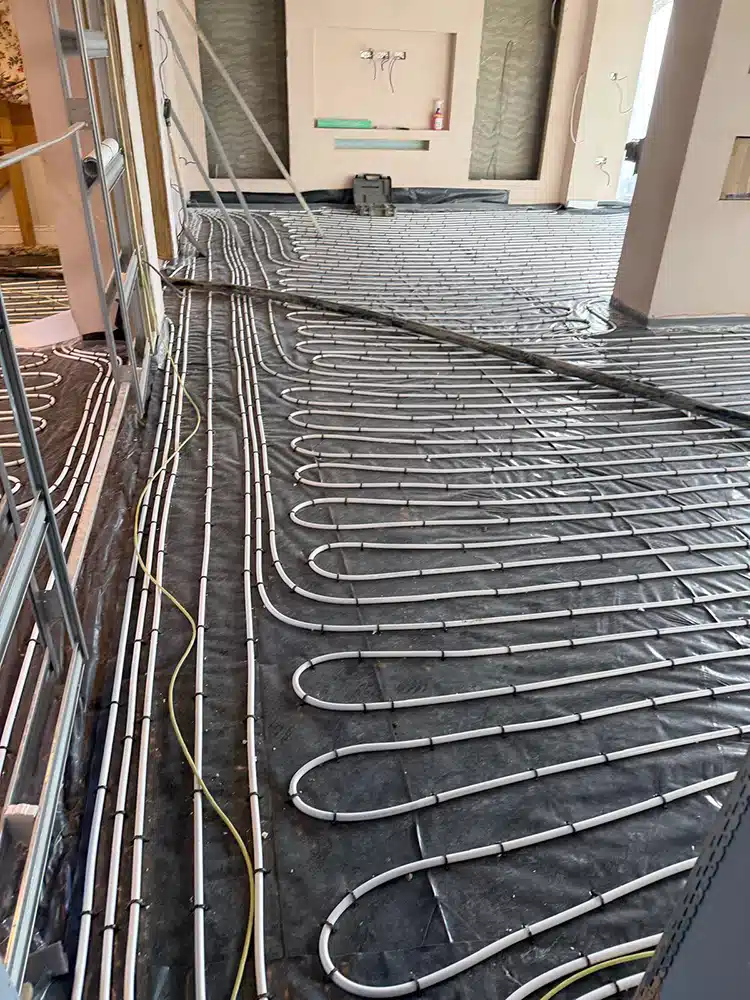
The screed type changes the arithmetic. Over the pipes, liquid needs 25mm at least, for a floor of roughly 45 to 50mm in total. With sand and cement the figure is about 45mm, which makes the floor deeper. A liquid mix also closes around each pipe without trapping air, spreading the heat evenly and warming the room sooner.
That is why a pumped liquid screed for a heated floor is often chosen for an extension: it saves depth, and the large open area is poured in one visit. Sand and cement remains a good option for a small room or where there is depth to spare.
We check the insulation, membrane and edge strip ahead of the pour and can provide whichever are needed. The pipes must be laid, fixed and pressure tested by your heating engineer beforehand, as K & B does not install underfloor heating. We then make sure the pipes are fully covered to the correct depth. For the insulation and membrane side of the job, see our insulation and membranes page.
First heat-up for a new Burgess Hill floor
The first time the heating goes on is where a new screed is most at risk. Warm it too quickly and cracks can appear.
When you can start depends on what the screed is made of. Calcium sulphate normally allows the heating on from about 7 days after pouring. For sand and cement, give it at least 21 days. With either, the water starts cool and is raised a little at a time over several days, following a written schedule we give you for your heating engineer.
If you are adding heating to a room in an existing house rather than an extension, the old concrete floor usually has to come up to make room for insulation, pipes and screed. We measure the levels at doorways first so you know the build-up fits before committing.
Once commissioning is complete, the heating also helps dry the screed before the flooring goes down. For how long that takes, see our guide to drying times. Heading down towards the coast? We also cover heated floor screeding in Brighton and Hove.
Underfloor Heating Screed prices in Burgess Hill
Liquid screed over underfloor heating: £20 to £35 per m² supplied and laid (trade2base, June 2026), so £700 to £1,230 for 35 m². trade2base gives these figures excluding VAT. See our floor screeding cost guide or screed calculator.
Who lays your underfloor heating screed in Burgess Hill
K & B Screeding’s own team, led by director Donatas Bardisevicius. Founded 2019, company 12298780.
See what customers say in our Google reviews and on our testimonials page.
Underfloor Heating Screed from Slough to Burgess Hill
On the map, Burgess Hill sits south-south-east of Slough, about 45.5 miles from our base in a straight line (postcodes including RH15 and BN6), next to Haywards Heath (3.1 miles), Lewes (8.5 miles), Brighton and Hove (9.2 miles) and Southwick (9.6 miles).
More on underfloor heating screed, part of our screeding services.
