
Heated floors at Forge Wood and Kilnwood Vale
Homes built from 2015 onwards make up 10% of Crawley's housing. Forge Wood, started in 2014, is the latest neighbourhood in the borough, with Kilnwood Vale just over the boundary. A house of that age is more likely than a New Town terrace to have liquid screed laid over its heating. That floor may need repair after a leak or a pipe alteration, or extending when a conservatory or rear room is added.
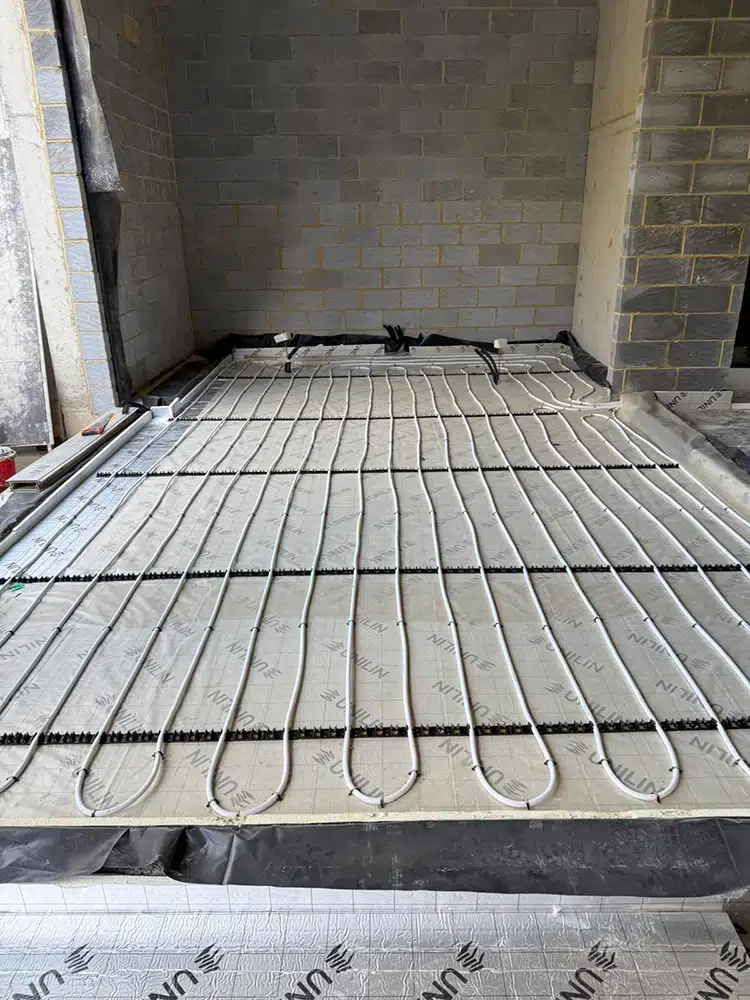
Work on an existing heated floor starts with what is already there. Calcium sulphate and cement screeds need different primers, and where new screed meets old, the joint has to line up with the heating zones. Pipes exposed during a repair must be pressure tested by your heating engineer before we cover them again. Smaller damaged areas can sometimes be cut out and patched through our screed repairs service, while a new room needs a full pour.
Pipe cover is a fixed requirement. With liquid screed that means 25mm or more over the pipes, typically a 45 to 50mm floor. Hand-laid sand and cement takes about 45mm over the pipework, so that build-up sits deeper. Too little cover leaves a weak floor that can crack over the pipes; too much slows the system's response.
Because liquid screed flows round every pipe with no voids, it is the usual choice for heated extensions here. Our page on liquid screed in Crawley explains how the pour itself runs, from the pump to the first day on the floor.
Retrofitting underfloor heating in older Crawley homes
Most of Crawley's houses were built long before underfloor heating was usual, so a retrofit means finding room for insulation, pipes and screed without leaving a step at every door. The floor height is measured first, then the build-up is worked out from the finished level downwards. Sometimes the old screed has to come out to make space.
Once the screed is down, the heat-up waits. Calcium sulphate lets the heating come on from around day 7. For sand and cement it is three weeks, day 21, before the heating runs. Start the water cool and lift the temperature a little each day, so the young screed is never shocked. Your heating engineer commissions the system following the schedule we hand over in writing.
Flooring then needs a dry base. A hygrometer reading confirms when that point is reached, and calcium sulphate also has its laitance sanded away before it is primed. The screed thickness guide shows typical build-ups, and our insulation and membranes service can supply what goes below the pipes. Over underfloor heating, liquid screed is priced between £20 and £35 per m² in 2026 UK figures.
Underfloor Heating Screed prices in Crawley
Liquid screed over underfloor heating: £20 to £35 per m² supplied and laid (trade2base, June 2026), so £700 to £1,230 for 35 m². trade2base gives these figures excluding VAT. See our floor screeding cost guide or screed calculator.
Who lays your underfloor heating screed in Crawley
K & B Screeding’s own team, led by director Donatas Bardisevicius. Founded 2019, company 12298780.
See what customers say in our Google reviews and on our testimonials page.
Underfloor Heating Screed from Slough to Crawley
Crawley is about 35 miles south-east of our Slough base as the crow flies, with postcodes including RH10 and RH11. The nearest towns to it are Horley (4.1 miles), Horsham (7.1 miles), East Grinstead (7.9 miles) and Reigate (8.5 miles).
More on underfloor heating screed, part of our screeding services.