
Pipe cover and floor height in older Reigate houses
Adding heating to a house that never had it is mainly a question of height. Insulation, pipework and screed together must finish below the front door sill and the first tread of the staircase you already have. In an older Reigate house, where the floor is being broken out for a new membrane anyway, that height has to be won by digging rather than by raising.
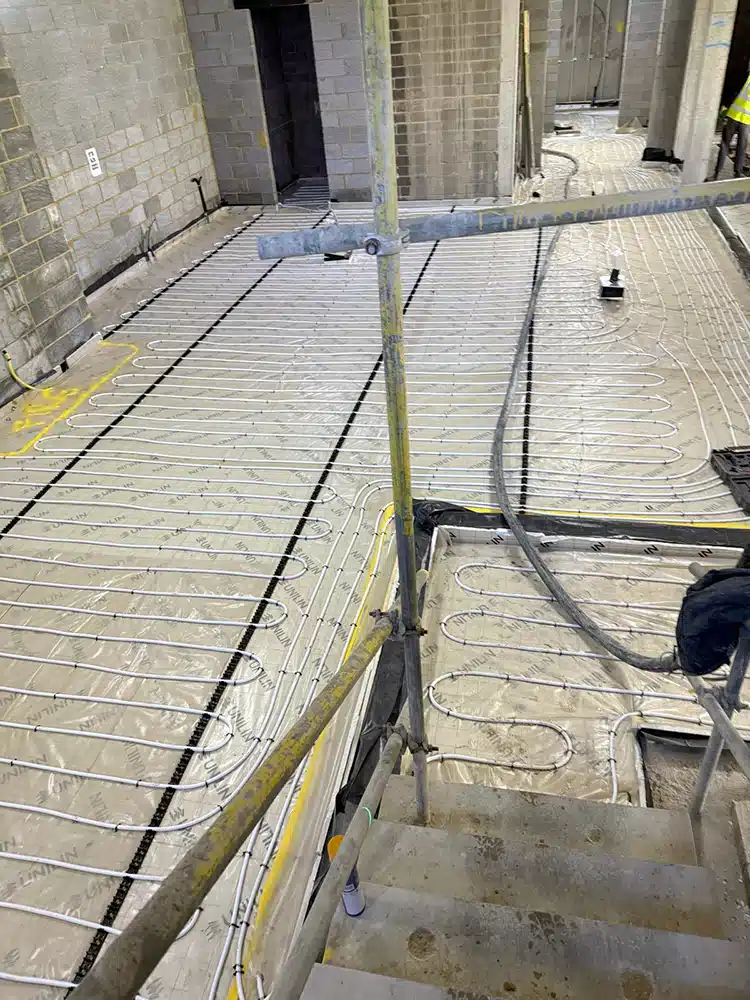
The screed choice decides how much room is left for insulation. Poured screed must sit 25mm or more above the pipes, normally giving 45 to 50mm overall. Sand and cement asks for roughly 45mm above them, and the total grows accordingly. On a tight retrofit, liquid often leaves enough depth for insulation that is actually worth having.
Encapsulation also favours a flowing screed. Flowing in around each pipe, it leaves no trapped air, so warmth reaches the surface evenly and fast. A hand-laid screed can achieve that too, but only with careful compaction around each run.
Floor height is not the only check. In a house where the old floor sat directly on the ground, the new membrane must be continuous and linked to the wall's damp course before any insulation goes down, or the heated screed will draw moisture from below. Fitting and testing the pipework stays with your heating engineer; the membrane, edge strip and insulation we can inspect or provide ourselves. Before booking, read our screed thickness guide, and for the pour itself, the liquid screed page for Reigate.
Heated rear extensions on the Rushetts Farm estate
On the Rushetts Farm estate and elsewhere in Woodhatch, the 1950s and 1930s houses tend towards rear extensions and knock-throughs. A new extension floor is the easiest place to add heating, because its levels can be designed from the slab up, and if the old kitchen floor is taken up at the same time the heating can run through the whole open-plan space.
After the pour, the heating waits. Gentle warmth can normally go into calcium sulphate at around 7 days, whereas sand and cement should be left a minimum of 21 days. From there the heating engineer begins with cool water and turns it up in small stages across several days, as set out in the written schedule we leave. Rushing to full temperature can crack the screed or break its bond around the pipes, and once the floor is commissioned gently, the heating becomes the fastest way to dry a calcium sulphate screed ready for flooring. Heated extensions also need a perimeter edge strip, so the screed can expand as it warms.
Expect published prices of £20 to £35 per m² for a pumped screed laid over heating pipes. The floor screeding cost guide covers what else affects the total.
Underfloor Heating Screed prices in Reigate
Liquid screed over underfloor heating: £20 to £35 per m² supplied and laid (trade2base, June 2026), so £700 to £1,230 for 35 m². trade2base gives these figures excluding VAT. See our floor screeding cost guide or screed calculator.
Who lays your underfloor heating screed in Reigate
K & B Screeding’s own team, led by director Donatas Bardisevicius. Founded 2019, company 12298780.
See what customers say in our Google reviews and on our testimonials page.
Underfloor Heating Screed from Slough to Reigate
As the crow flies, our yard in Slough is about 27.8 miles from Reigate, which lies to the south-east. Postcodes here include RH2, KT20 and RH1, and Redhill (1.5 miles), Horley (4.9 miles), Dorking (5.4 miles) and Caterham (6.3 miles) are close by.
More on underfloor heating screed, part of our screeding services.