
Breaking out pre-membrane floors in Wray Park and Doods Road
An old floor laid straight onto the ground tends to give itself away. Damp shows along the skirting, tiles lift or crack, and the surface sounds hollow when tapped. In a Victorian house there is often no membrane at all, and sometimes no proper base either.
The repair is a rebuild. We break out the old slab and dig the ground lower, so a damp proof membrane, insulation and fresh screed all fit in. The finished level is fixed by the doors, hearths and thresholds that are staying, so the depth of every layer is worked back from that point.
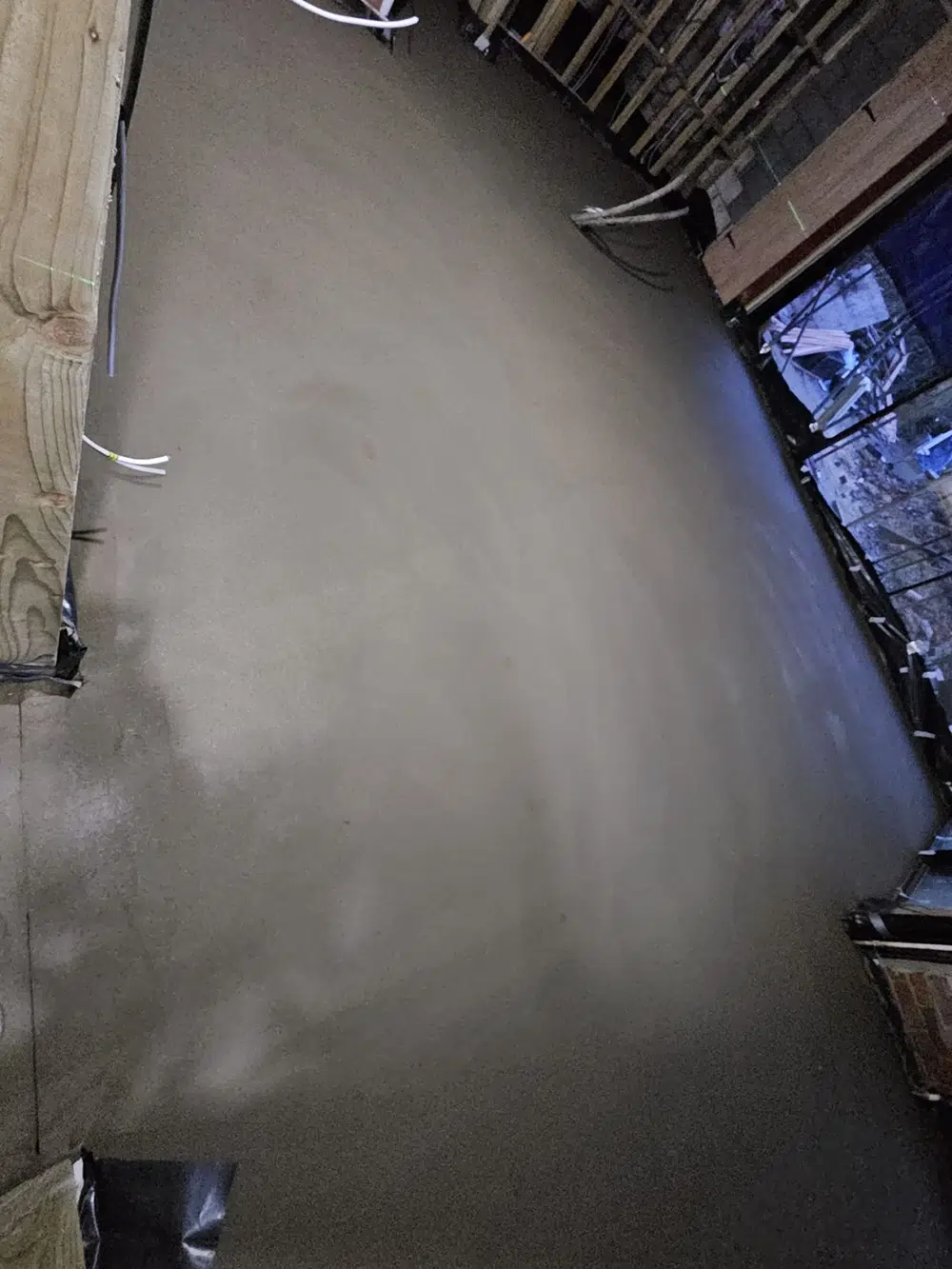
Hand-laid screed suits this. Victorian rooms are often divided by chimney breasts and alcoves, and the floor must finish flush with old joinery. Mixed in small batches and compacted by hand, a sand and cement screed can be taken to exact levels in each room, with no pump waiting outside.
Depth is not optional. A domestic floor floating on insulation needs about 65mm of sand and cement, and a commercial one about 75mm. Skimp on that over insulation and cracks follow. Where it can be bonded to a concrete slab that is still in good order, 25 to 40mm will do. Each case is covered in how thick screed should be.
Terraced homes make up 15% of Reigate's housing, and a small terrace is exactly where a hand-laid floor is often more practical than a pump.
Wet rooms, falls and stronger mixes in Reigate homes
Water does not harm a cement based floor the way it harms calcium sulphate. For a Reigate wet room or a level-access shower, where everything must drain one way, sand and cement is therefore the material to use, with the slope built into the screed itself. Your tiler then follows an accurate surface rather than packing adhesive to make up the fall.
Where a floor will carry heavier loads, or must be in use early, the mix can be changed. A high strength screed or a fibre reinforced mix suits garages, utility rooms and floors that will take heavy appliances. On a tight programme, a quick drying screed brings the flooring date forward.
It also dries more slowly than a pumped floor. Up to 40mm deep, each millimetre needs roughly a day; past that the rate slows, so 65mm takes patience. The published 2026 range runs from £18 to £25 per m², and fibre reinforcement adds £1 to £3 per m² on top. If you are weighing it against a pumped floor, see the liquid screed page for Reigate. For one small room, laying by hand often costs less in any case: nobody has to set up a pump, and we mix only what the floor needs.
Sand and Cement Screed prices in Reigate
Sand and cement screed: £18 to £25 per m² supplied and laid (MyJobQuote, August 2026), so £450 to £630 for 25 m². MyJobQuote does not say whether these figures include VAT. See our floor screeding cost guide or screed calculator.
Who lays your sand and cement screed in Reigate
K & B Screeding’s own team, led by director Donatas Bardisevicius. Founded 2019, company 12298780.
See what customers say in our Google reviews and on our testimonials page.
Sand and Cement Screed from Slough to Reigate
As the crow flies, our yard in Slough is about 27.8 miles from Reigate, which lies to the south-east. Postcodes here include RH2, KT20 and RH1, and Redhill (1.5 miles), Horley (4.9 miles), Dorking (5.4 miles) and Caterham (6.3 miles) are close by.
More on sand & cement screed, part of our screeding services.
