
Replacing tired screeds in Horley's post-war semis
A large share of Horley's houses were built after the war: 27% between 1945 and 1972, and more again through the 1970s, 80s and 90s. Only 8% predate 1919. So a hand-laid screed here is more likely to replace a screed that has reached the end of its life than to rescue a Victorian floor.
The warning signs are cracks that open across a room, patches that sound hollow when tapped, and a surface that crumbles when the old flooring is lifted. A hollow screed has lost its bond or was never compacted properly, and new tiles laid over it tend to crack along the same lines. The fix is to break out the failed area, check the base and membrane underneath, and lay a new screed.
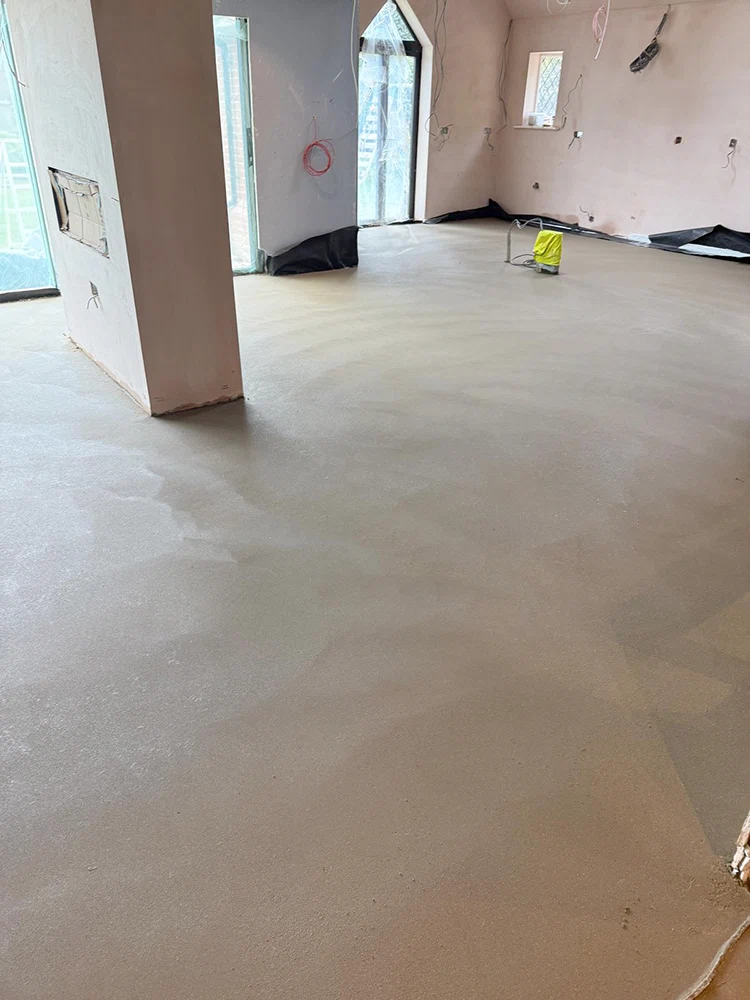
How it goes back depends on what is below. Where the new screed floats over insulation, it is laid at about 65mm in a home. If the concrete underneath is sound, the screed can be stuck down to it instead as a thinner bonded screed of 25 to 40mm, handy when the door thresholds leave no room for a deeper floor.
For floors that will carry heavier loads or need extra crack resistance, fibres can be mixed in, adding about £1 to £3 per m². Whether a Horley floor is worth that extra is covered on our screed with added fibres page. Hand-laid screed is also the material for wet rooms and showers, because calcium sulphate screeds do not tolerate prolonged wetting.
Horley garage conversions and smaller rooms
Turning a garage into a bedroom, office or playroom is a common change to a Horley semi, and the floor is usually the trickiest part. A garage slab sits lower than the house, often slopes towards the door, and rarely has insulation. To make it a habitable room, a membrane and insulation go down, and the screed brings the finished level up to meet the hallway.
That is a job sand and cement handles well. It can be laid to make up an uneven slab, and it can be mixed with a rapid drying additive if the programme is tight. For each layer from the slab up to the finished level, see screeding a converted garage.
What you give up is speed. Expect the floor to lose its moisture at around one day per millimetre of depth over the first 40mm, then at a slower rate, which means a 65mm garage floor will keep the timber or vinyl waiting for a good while. If the floor only needs smoothing rather than rebuilding, a levelling compound over a sound screed can be quicker. Up the road, the same work in Redhill has its own hand-laid screed page.
Sand and Cement Screed prices in Horley
Sand and cement screed: £18 to £25 per m² supplied and laid (MyJobQuote, August 2026), so £450 to £630 for 25 m². MyJobQuote does not say whether these figures include VAT. See our floor screeding cost guide or screed calculator.
Who lays your sand and cement screed in Horley
K & B Screeding’s own team, led by director Donatas Bardisevicius. Founded 2019, company 12298780.
See what customers say in our Google reviews and on our testimonials page.
Sand and Cement Screed from Slough to Horley
As the crow flies, our yard in Slough is about 32.5 miles from Horley, which lies to the south-east. Postcodes here include RH6, and Crawley (4.1 miles), Redhill (4.8 miles), Reigate (4.9 miles) and East Grinstead (7.5 miles) are close by.
More on sand & cement screed, part of our screeding services.
