
Replacing cracked screeds in Crawley's New Town homes
Cracked screed is a typical renovation problem in houses built in the decades after 1947. Once a screed has broken up, levelling compound will not hold over it, so the lasting fix is to take it out and lay a new one. That means breaking out the old layer, checking the slab beneath, fitting a membrane and insulation where height allows, then screeding back to the right level.
Hand mixed sand and cement suits a part-room or a hallway well. It is mixed in small batches and barrowed through the house, so it suits narrow hallways, single rooms and jobs where only part of a floor is being replaced. It can be laid bonded or floating. Floated over insulation, a house floor takes about 65mm of it, and a commercial floor 75mm. A bonded screed fixed to sound concrete can be 25 to 40mm, which helps when the existing finished level cannot change; our bonded screed page explains how the bond is made.
Single storey rear extensions on these houses need a floor that meets the original slab exactly. Hand-laid screed can be built up to the line of the existing floor, then any small difference at the join is taken out with floor levelling compound before the finish goes down.
In flats, where the floor is part of the sound separation between homes, the screed usually floats over a resilient layer rather than bonding to the slab, so the build-up is agreed first.
Garages, wet rooms and stronger mixes in Crawley
A few rooms want cement whatever is going in elsewhere in the house. Level access showers and wet rooms need their floor falling towards the drain, a slope we shape by hand in cement screed ready for the tiler's tanking. Calcium sulphate screeds are unsuitable where a floor may get wet, so bathrooms and utility rooms are usually done this way.
Turning a garage into a room works the same way. Its floor is brought up to the house level over insulation and a membrane, and cement copes with that depth and takes weight early. Our guide to garage floor screeds shows the layers that usually go in.
Strength can be raised where needed. Fibres add £1 to £3 per m² and reduce cracking risk, and higher strength mixes suit floors that carry heavy loads. In 2026 UK pricing, standard sand and cement runs from £18 up to £25 per m², and the fast drying kind from £20 up to £28.
The trade-off against liquid screed is drying. Budget roughly a day per millimetre up to 40mm and more beyond it, which leaves a 65mm Crawley floor waiting weeks for its vinyl or timber. If the programme is tight, compare it with liquid screed for Crawley homes, which is walkable sooner and often laid thinner.
Sand and Cement Screed prices in Crawley
Sand and cement screed: £18 to £25 per m² supplied and laid (MyJobQuote, August 2026), so £450 to £630 for 25 m². MyJobQuote does not say whether these figures include VAT. See our floor screeding cost guide or screed calculator.
Who lays your sand and cement screed in Crawley
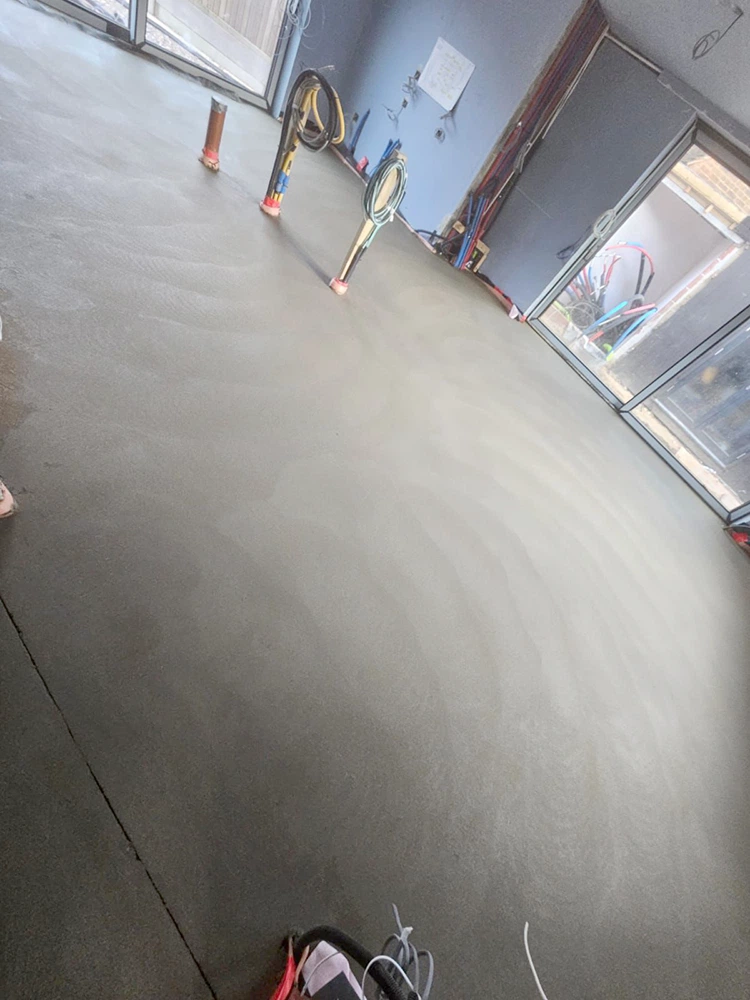
K & B Screeding’s own team, led by director Donatas Bardisevicius. Founded 2019, company 12298780.
See what customers say in our Google reviews and on our testimonials page.
Sand and Cement Screed from Slough to Crawley
Crawley is about 35 miles south-east of our Slough base as the crow flies, with postcodes including RH10 and RH11. The nearest towns to it are Horley (4.1 miles), Horsham (7.1 miles), East Grinstead (7.9 miles) and Reigate (8.5 miles).
More on sand & cement screed, part of our screeding services.
