
Rebuilding failed floors in older Haywards Heath houses
A solid ground floor in a house of the 1930s or earlier was often laid with no insulation and only a basic damp barrier, if any. Decades later it may have cracked, sunk at the edges or started to let damp through. Patching rarely lasts, so the better answer is to break it out, lay a new slab where needed, then add insulation, a membrane and a fresh screed.
That is a job hand-laid sand and cement handles comfortably. It is mixed in small batches, so a narrow hallway and two small rooms can be done without a pump on the street. It can be laid at different depths in different rooms to meet old door thresholds, and it gives a cement substrate that takes tiles, adhesives and early foot traffic without fuss.
Terraced houses make up 16% of the town's homes, and on a terrace with no front parking, a hand-laid screed avoids the need to park a pump in the street.
Lindfield is a separate conversation. Its High Street has over forty medieval and later timber-framed houses, and floor work there has to suit a historic structure. Before suggesting any screed we would want to know what the floor sits on now and what the building can take.
For wider spans or rooms that need extra crack resistance, the mix can include fibres, covered on our page on fibre reinforced screed. Where the old floor is solid and only uneven, levelling what is already there could be enough on its own.
Haywards Heath wet rooms, garages and screed depths
In a wet room, a cement floor is the one to have. It can be laid to falls towards a drain, and unlike calcium sulphate screed it is not harmed by water once tanked and tiled. Garages are similar: a garage being turned into a room, or one that still takes a car, needs a cement based floor. The garage floor screed guide covers conversions in more detail.
How thick it goes comes down to the method. Floated over insulation, it needs 65mm or more in a house and 75mm or more in a commercial building. Bonded straight onto good concrete with a bonding agent, it can drop to 25 to 40mm, handy in an older Haywards Heath house with little height to spare.
What you give up is speed. This mix dries more slowly than a pumped floor, around a day for each millimetre over the first 40mm and a slower rate after that, so leave a 65mm screed plenty of time before you lay timber or vinyl. Adding a rapid drying mix brings that down. For the same service about 9 miles away, see sand and cement screeding in Crawley.
Sand and Cement Screed prices in Haywards Heath
Sand and cement screed: £18 to £25 per m² supplied and laid (MyJobQuote, August 2026), so £450 to £630 for 25 m². MyJobQuote does not say whether these figures include VAT. See our floor screeding cost guide or screed calculator.
Who lays your sand and cement screed in Haywards Heath
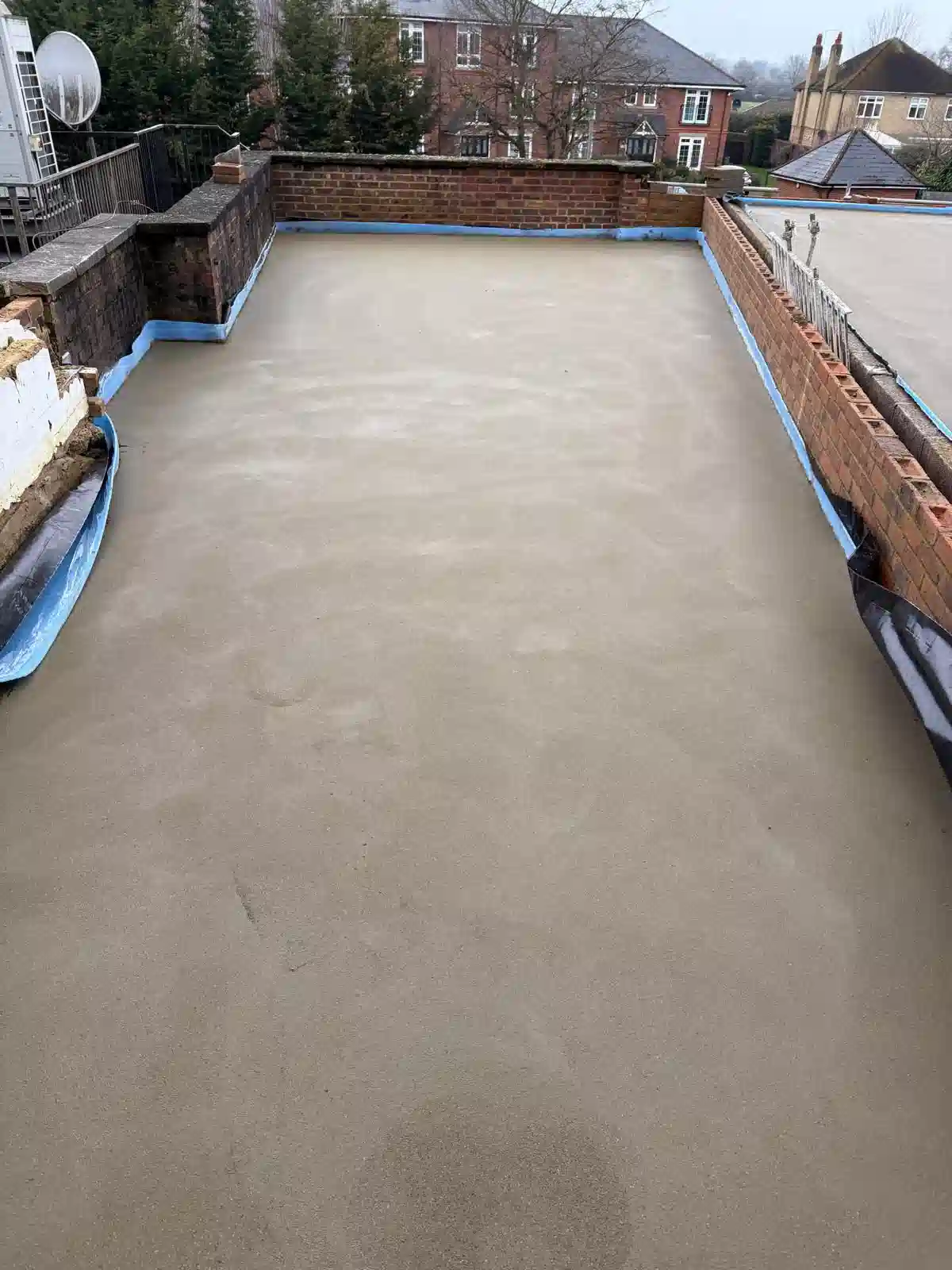
K & B Screeding’s own team, led by director Donatas Bardisevicius. Founded 2019, company 12298780.
See what customers say in our Google reviews and on our testimonials page.
Sand and Cement Screed from Slough to Haywards Heath
On the map, Haywards Heath sits south-east of Slough, about 43.9 miles from our base in a straight line (postcodes including RH16), next to Burgess Hill (3.1 miles), Uckfield (8.8 miles), Crawley (9 miles) and East Grinstead (9.7 miles).
More on sand & cement screed, part of our screeding services.
