
Relaying original floors near Uckfield High Street
A house built before the First World War usually has a ground floor laid long before damp proof membranes and insulation were standard. When that floor is lifted, the chance is there to rebuild it properly: excavate, lay insulation and a membrane, then put a floating sand and cement screed on top, typically about 65mm in a home.
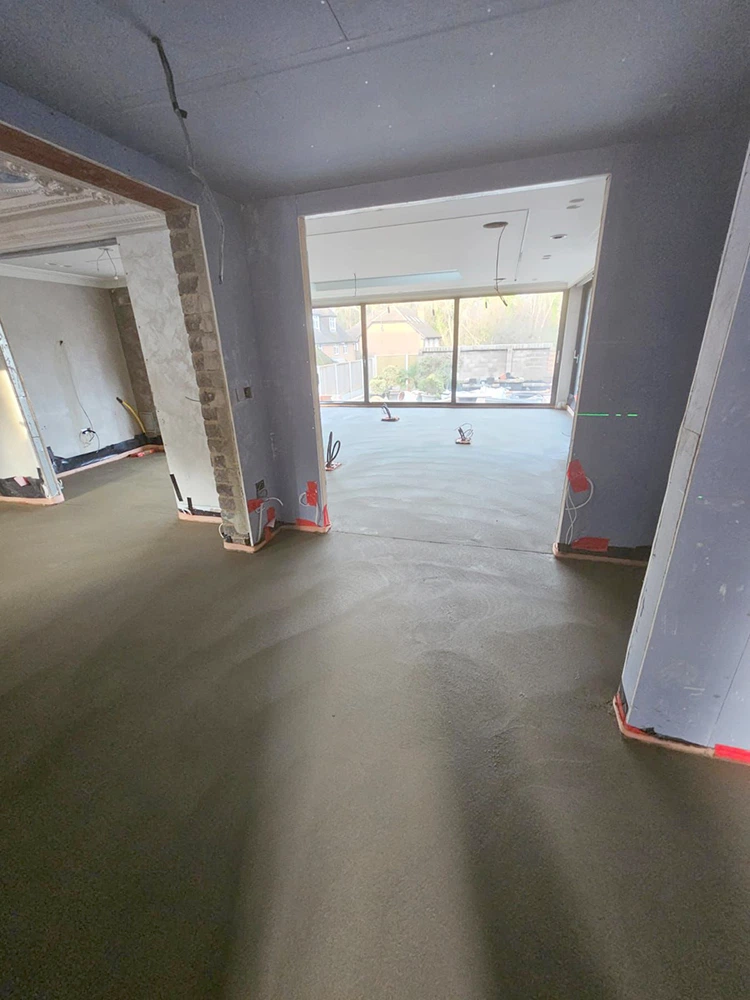
For an old house near the High Street, a screed mixed at the door and laid by hand makes sense. The depth can change from one room to the next to meet old thresholds, it copes with small rooms and awkward corners, and it is compacted and floated to a dense, level finish ready for any covering. If the slab underneath is sound and just needs raising, a bonded layer 25 to 40mm thick will do.
Of all Uckfield's homes, 22% are terraced houses. Where there is no side access, a hand-laid screed can be barrowed through the house in manageable loads, with no hose to run.
Replacement floors are not only an older-house problem. Estates from the 1970s to 1990s tend to need cracked or poorly insulated ground floors replaced, and the same dig-out and relay method applies. For a cracked floor that can be saved, screed repairs may be enough, and the screed thickness guide explains the depths.
Uckfield garage conversions, wet rooms and early-load floors
Garage conversions are one of the typical projects on Uckfield's 1970s to 1990s estates. The old slab sits lower than the house, so it is insulated, sealed with a membrane and screeded up to match the adjoining floor. Each layer is set out in our guide to screeding a garage floor.
A level-access shower or wet room has to sit on cement. Calcium sulphate cannot take getting wet, whereas a hand-laid cement floor can be sloped to the drain and tanked before the tiles go on.
Some floors need to take load early or face heavier use, such as a workshop, a utility with heavy appliances or a room that other trades need to cross soon after. Sand and cement gives a dependable cement substrate for this, and fibres can be added at £1 to £3 per m² for extra crack resistance. For more demanding areas, high strength sand and cement screed is available.
Drying is the main drawback. Allow about a day for each of the first 40mm and longer beyond, which means a house floor at normal depth keeps wood or vinyl waiting for weeks. A fast drying screed mix helps where time is short.
Bonded and high strength floors at Bellbrook, Uckfield
Bellbrook Industrial Estate, off Bell Lane, has about 145 units of mixed ages dating from the 1960s, and Ridgewood is the town's other main industrial area. A unit floor of that age may have been patched or worn over the years, and when a new occupier needs a level, hard wearing floor, sand and cement is one of the main ways to provide it.
Where the existing slab is sound, a bonded screed is usually the efficient fix. The slab is prepared back to clean concrete, often by grinding or shot blasting, a bonding agent is applied, and a thin layer is laid and compacted straight onto it. Because it is bonded, it does not need the depth of a floating floor, which helps where thresholds, shutter tracks or loading levels cannot move.
Where the slab is broken, or an office or showroom area needs insulation, a floating screed goes in instead, at about 75mm for commercial use. Bellbrook has some office space at the western end of the estate, and office areas like those are often treated differently from a workshop floor beside them.
Trade use also shapes the mix. A floor that will carry racking, trolleys or forklifts suits a high strength screed, and falls to a drain in a wash-down area can be formed by hand as the screed is laid. Structural power floated slabs, resin and polished concrete are outside our work, and a resin finish is laid by a specialist once the screed is ready.
Sand and cement screed prices in Uckfield
Sand and cement screed: £18 to £25 per m² supplied and laid (MyJobQuote, August 2026), so £450 to £630 for 25 m². MyJobQuote does not say whether these figures include VAT. See our screed cost per m³ and per tonne guide or screed calculator.
Who lays your sand and cement screed in Uckfield
K & B Screeding’s own team, led by director Donatas Bardisevicius. Founded 2019, company 12298780.
See what customers say in our Google reviews and on our testimonials page.
Sand and cement screed from Slough to Uckfield
As the crow flies, our base in Slough is about 50.4 miles from Uckfield, which lies to the south-east. Postcodes here include TN22, and Crowborough (6.9 miles), Lewes (7.6 miles), Haywards Heath (8.8 miles) and Burgess Hill (10.1 miles) are close by.
On Uckfield streets where the screed pump cannot park off the road, a suspension or dispensation comes from East Sussex County Council (dispensations and suspensions). We confirm on the quote whether it is needed. New floors in Uckfield extensions usually need building regulations approval, with Part L insulation rules in England; the East Sussex Building Control Partnership is the council building control service.
More on sand & cement screed, part of our screeding services. For every screed we lay locally, see floor screeding in Uckfield.
Further reading: screed thickness guide and sand and cement screed mix ratio.