
Heated floors in Uckfield's new homes and extensions
Homes built from 2015 onwards make up 8% of Uckfield's stock, and Ridgewood Farm has outline permission for 1,000 more. Floors in new homes like these are designed with heating in mind from the start, so the insulation depth, pipe layout and screed thickness all fit a set finished level. Changing one layer late in the build means rechecking all the others.
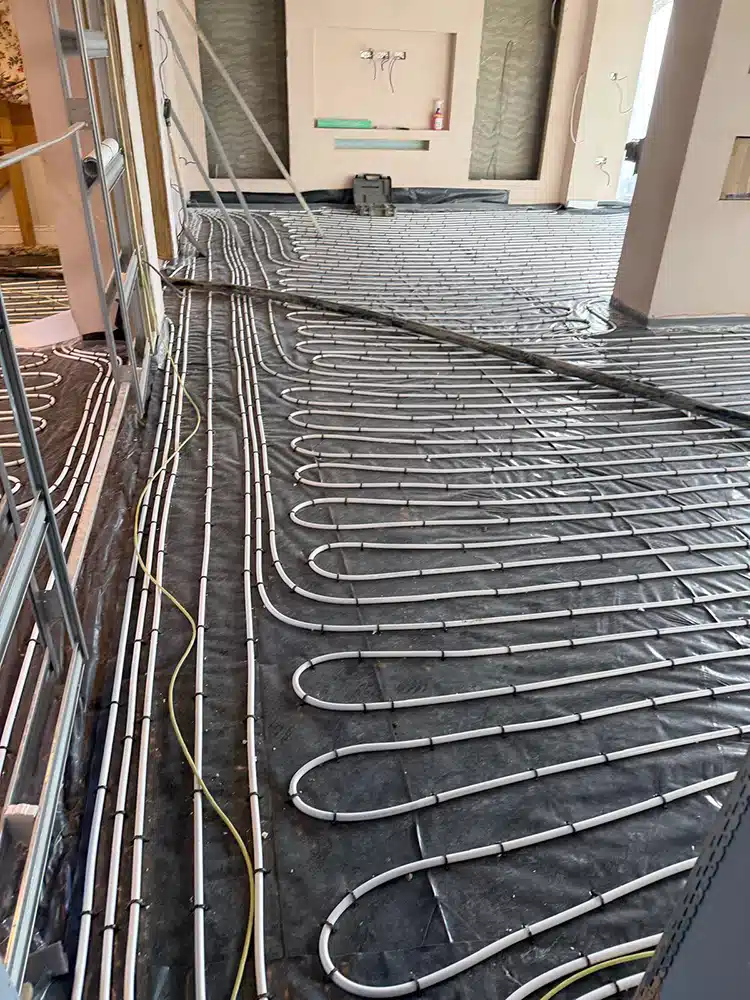
The screed's job is to hold the pipes and spread their heat. A flowing mix wraps each pipe without leaving air gaps, and with 25mm or more on top the layer normally ends up 45 to 50mm deep. A thin, dense layer like that responds quickly when the heating comes on. Sand and cement can be used instead with about 45mm of cover, compacted carefully by hand around the pipes, and is the choice for a heated area that may get wet.
On the 1970s to 1990s estates, a heated kitchen extension raises the usual question of levels. The new floor has to finish flush with the existing house, and the lower cover of a flowing screed often makes that easier. See liquid screed for Uckfield homes for how it is pumped and dried.
Fitting the pipework is not part of what K & B does. That job, along with the pressure test, falls to your heating engineer or plumber, and we look over the pipes, insulation and edge strip before pouring.
Commissioning heating and retrofits near Uckfield High Street
How the heating is first switched on matters as much as the screed. Calcium sulphate can normally be warmed from around day 7. With sand and cement, hold off for 21 days or more. After that the temperature goes up in small steps, is held, then comes back down before flooring. Putting a fresh floor on full heat straight away can crack it. You get those steps from us on paper.
Retrofitting underfloor heating in an older house is a different problem. Houses nearer the High Street may already need their original solid floors lifted and relaid, which is the moment to add insulation and heating. The difficulty is height: doors, stairs and skirting are fixed, so the build-up has to fit beneath them, and the reduced pipe cover of a liquid screed can make the difference.
The layers under the screed are just as important. Insulation keeps the heat going up, the membrane keeps moisture out and the edge strip lets the floor expand. The insulation and membranes service covers this where needed. Over in Haywards Heath, the heated screed page for Haywards Heath covers the same work.
Underfloor Heating Screed prices in Uckfield
Liquid screed over underfloor heating: £20 to £35 per m² supplied and laid (trade2base, June 2026), so £700 to £1,230 for 35 m². trade2base gives these figures excluding VAT. See our floor screeding cost guide or screed calculator.
Who lays your underfloor heating screed in Uckfield
K & B Screeding’s own team, led by director Donatas Bardisevicius. Founded 2019, company 12298780.
See what customers say in our Google reviews and on our testimonials page.
Underfloor Heating Screed from Slough to Uckfield
As the crow flies, our yard in Slough is about 50.4 miles from Uckfield, which lies to the south-east. Postcodes here include TN22, and Crowborough (6.9 miles), Lewes (7.6 miles), Haywards Heath (8.8 miles) and Burgess Hill (10.1 miles) are close by.
More on underfloor heating screed, part of our screeding services.