
Heating Seaford's single storey extensions from below
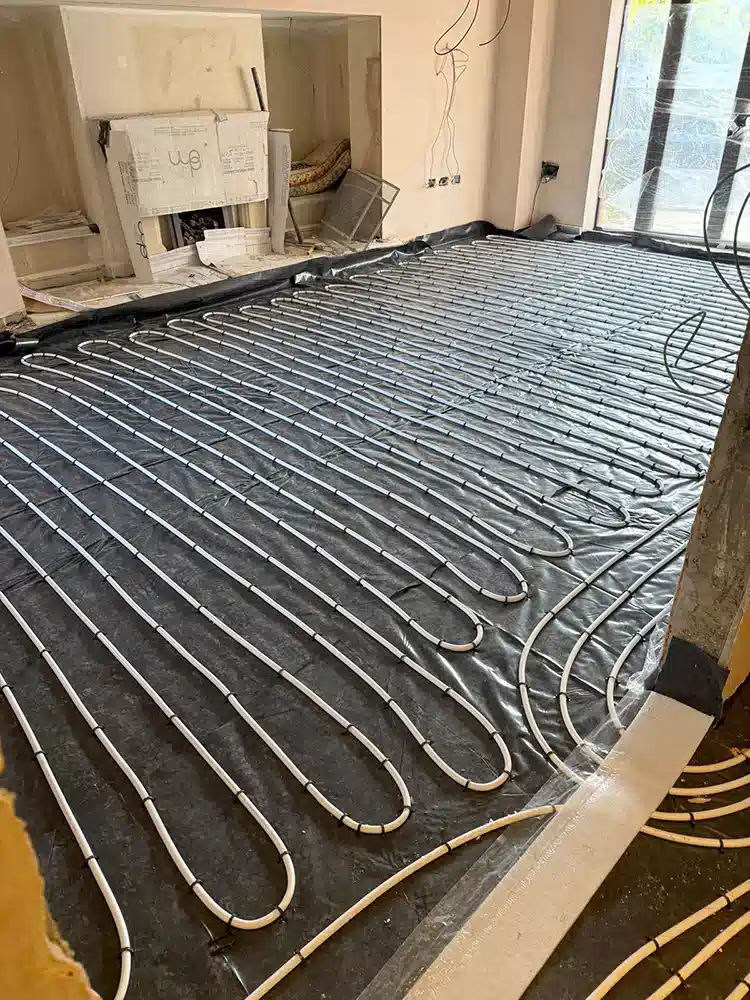
A single storey extension on a bungalow or detached house gives a clean slate for underfloor heating. The insulation goes down first, then the heating engineer fixes and pressure tests the pipes, and the screed goes on top as the layer that holds the warmth and passes it into the room.
Most Seaford extensions get a flowing screed here, since it wraps every pipe and leaves no trapped air to hold the heat back. Keep 25mm or more over the pipes and the layer comes out at about 45 to 50mm. That thin layer is quick to respond when the thermostat calls for heat. Sand and cement can do the same job with about 45mm of cover, laid carefully by hand, and it remains the answer for a heated wet room.
Only 8% of Seaford's homes date from 2000 onwards, so most heated floors here are being added to existing houses rather than arriving with new builds. That makes the join with the existing floor important. The finished level of pipes, insulation and screed has to match the rest of the house, and a thinner liquid screed often makes that easier to achieve. More on flow and drying is on our liquid screed page for Seaford.
The heated floor also shapes the flooring choice. Tiles, LVT and engineered wood can all go on top, as long as the screed is flat and properly dry.
Switching on the heating in a Seaford home safely
How the heating is handled in the weeks after pouring decides how long the floor lasts. On calcium sulphate, the system can generally go on from around day 7. Sand and cement should be left a minimum of 21 days with no heat at all. In both cases the system is commissioned gradually: low temperatures first, raised a little each day, then held, before being turned down again ahead of flooring.
Running the heating at full power on a young screed pulls moisture out too quickly and can crack it. You get the warm-up steps from us in writing, so the heating engineer and the flooring fitter follow one plan. For the timings, see our screed drying times guide.
Retrofits in older houses are trickier than extensions. Victorian houses near the seafront may need their original floors lifted anyway, which gives a chance to add insulation, a membrane and heating, but the finished height is fixed by doors and stairs. Every millimetre counts, and the lower pipe cover of a liquid screed can help.
Along the coast, the Eastbourne heated floor screed page covers the same service.
Underfloor Heating Screed prices in Seaford
Liquid screed over underfloor heating: £20 to £35 per m² supplied and laid (trade2base, June 2026), so £700 to £1,230 for 35 m². trade2base gives these figures excluding VAT. See our floor screeding cost guide or screed calculator.
Who lays your underfloor heating screed in Seaford
K & B Screeding’s own team, led by director Donatas Bardisevicius. Founded 2019, company 12298780.
See what customers say in our Google reviews and on our testimonials page.
Underfloor Heating Screed from Slough to Seaford
On the map, Seaford sits south-south-east of Slough, about 61.8 miles from our base in a straight line (postcodes including BN25), next to Newhaven (2.9 miles), Peacehaven (4.7 miles), Polegate (7.2 miles) and Eastbourne (7.8 miles).
More on underfloor heating screed, part of our screeding services.
