
Kitchen and bathroom refits in Seaford's post-war bungalows
A kitchen or bathroom refit is where latex screed earns its place. The old units come out, the floor covering is lifted, and what is underneath is rarely ready for a thin new finish. In a Seaford bungalow or post-war house, the base under a sheet vinyl kitchen may be concrete with old adhesive, a set of quarry tiles laid decades ago, or timber that a previous owner covered with plywood.
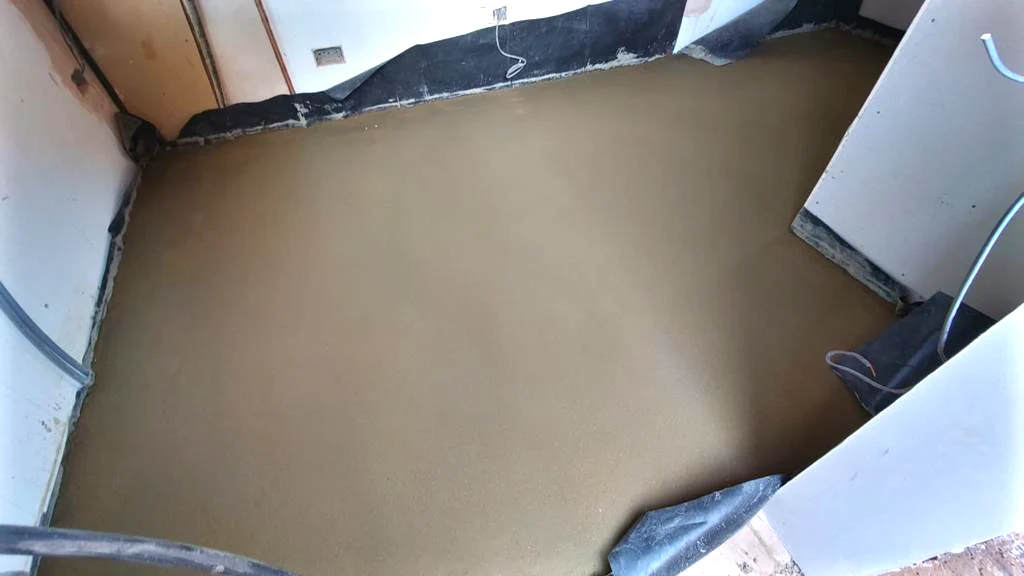
Latex screed suits these mixed surfaces. The powder is cement based and is mixed with latex in place of water, then spread a few millimetres thick. The latex gives it grip and a degree of give, so it holds onto firm tiles and plywood as well as concrete.
Each base is prepared differently. Firmly bonded ceramic or quarry tiles are cleaned and primed rather than lifted. Plywood overboarding must be flooring grade and fixed down tight, and latex is never spread straight onto bare boards. Sound old adhesive can sometimes stay, after a check that it is thin and firmly stuck; thick or soft glue is taken off first by grinding the Seaford floor back.
A bathroom brings its own checks. Safety flooring and sheet vinyl in a bathroom show every ridge underneath, so the base must be smooth. Where the room will have a walk-in shower, a cement based floor is the safer base, and the Seaford sand and cement screed page explains laying it to falls.
Damp, bounce and primers under Seaford latex floors
Latex covers a surface; it does not repair one. Before quoting, we look for the three faults that a thin layer cannot hide.
Damp comes first. In East Blatchington and close to the seafront, some older Victorian houses may still need their original floors relaid with a damp proof membrane, and moisture coming up through such a floor will push off a latex layer and the vinyl on top. A floor like that needs relaying with a membrane before any new finish.
Movement is the second. A suspended floor that flexes when you walk on it will crack latex, whatever plywood goes over it, so loose boards and weak joists are dealt with first.
The third is level. If a room drops away by more than a few millimetres, a thin latex layer is the wrong tool; the room needs a thicker levelling product or fresh screed first. Our levelling page for Seaford floors covers that choice.
Primer is the step that ties it together. Concrete, ceramic tiles and plywood each have a matching primer, and a calcium sulphate screed needs its laitance sanded away and a compatible primer before latex will hold.
How we price latex screed in Seaford
A fixed written price within 24 hours, once we know the area and the base. See our floor screeding cost guide.
Who lays your latex screed in Seaford
K & B Screeding’s own team, led by director Donatas Bardisevicius. Founded 2019, company 12298780.
See what customers say in our Google reviews and on our testimonials page.
Latex Screed from Slough to Seaford
On the map, Seaford sits south-south-east of Slough, about 61.8 miles from our base in a straight line (postcodes including BN25), next to Newhaven (2.9 miles), Peacehaven (4.7 miles), Polegate (7.2 miles) and Eastbourne (7.8 miles).
More on latex screed, part of our screeding services.