Anhydrite grades for Seaford apartments and new homes
Purpose-built flats are 16% of Seaford's homes, and 5% of all homes were built between 2000 and 2014. These are the floors where a designer will typically write a CA grade on the drawings.
The grade is a strength label set by the European screed standard. C stands for compressive and F for flexural strength, measured in N/mm2. A quiet domestic floor can be CA-C20-F4. Most flats, houses and offices are specified at CA-C25-F5. Busy shared corridors and other heavier use get CA-C30-F6. Where the drawings do not say, we suggest one to fit how the floor will be used.
Within calcium sulphate there is also a group of alpha hemihydrate products. They are chosen where a faster drying time or a thinner section is needed, and each has its own product sheet that sets depth and drying guidance.
Low shrinkage is the material's main practical advantage. It allows large bays with few joints, which is useful across a whole apartment level or a long open-plan ground floor. Doorways and changes in the structure still need joints, so the layout of bays is drawn up ahead of the pour.
Keep it out of anywhere that could get wet. A wet room or plant area takes a flowing screed based on cement, or hand-laid sand and cement, in its place.
Finishing anhydrite floors in Seaford before flooring
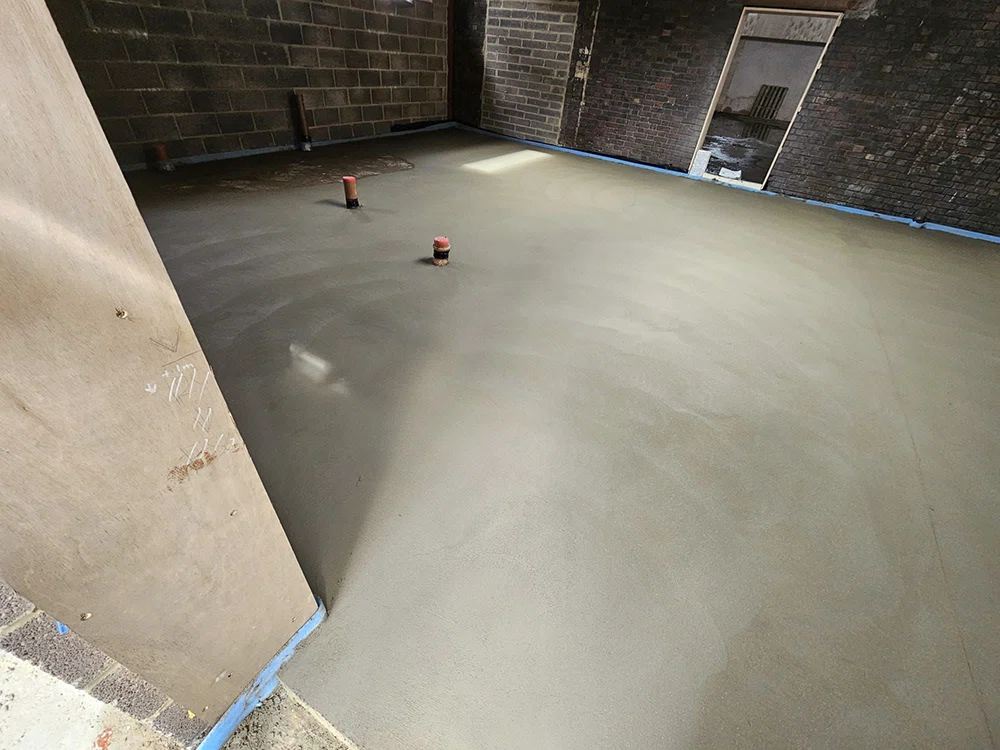
Pouring a calcium sulphate screed is half the job. While it cures, laitance forms on top, a thin skin with little strength that must be removed. When the floor has dried we sand that skin off, vacuum up the dust and prime with a product made for calcium sulphate. Cement based primers and adhesives are not automatically suitable, so the product choice matters.
Moisture testing comes before any flooring. Flooring makers often allow less moisture in calcium sulphate than in cement, so a reading that would pass for tiles on a cement floor can still fail here. A hygrometer test gives the answer, not a date on the programme. Where pipes are fitted, the heating can normally help dry the floor from around day 7.
On housing schemes, the written drying and laitance notes let the site manager and flooring contractor sign off each plot in turn. The floor preparation service covers any extra surface work, and our anhydrite screed explained guide goes into the material in more depth. For apartment schemes further along the coast, see anhydrite screed in Peacehaven.
Anhydrite in Seaford conservatory replacements and bungalow extensions
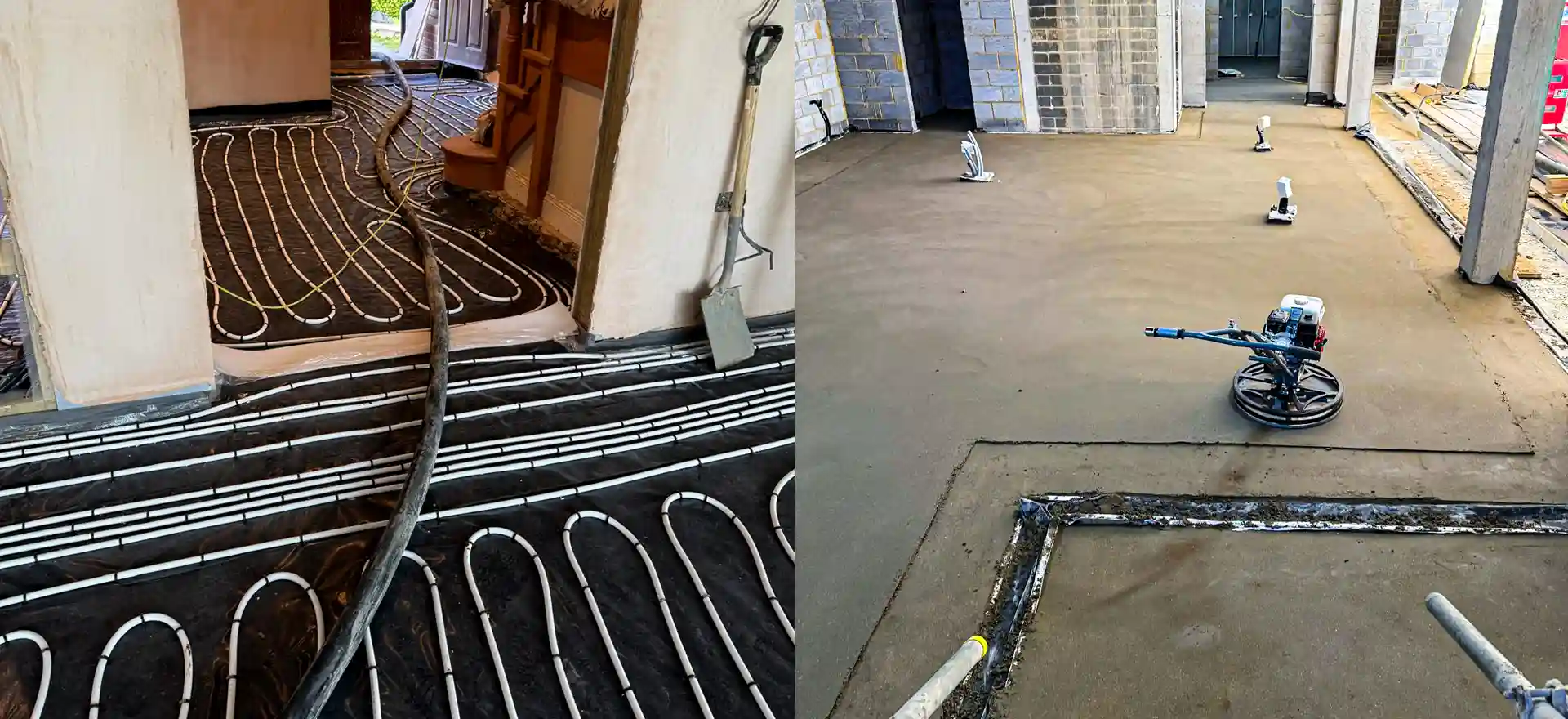
Post war detached houses and bungalows are the backbone of Seaford's housing, and they bring a steady run of single storey extensions, conservatory replacements and open-plan kitchens. Many owners take the chance to add wet underfloor heating, and where the screed over it is calcium sulphate, a few points apply to these rooms in particular.
Height is the first. A bungalow has its rooms on one level, so a new room has to finish flush with the existing hall or kitchen. A calcium sulphate flow screed over the pipes needs at least 25mm of cover, so it is thinner than a hand-laid screed would be, which leaves more room for insulation within the same overall depth.
A replacement conservatory or a heavily glazed extension needs care while the screed dries. Strong sun through the glass and draughts from open doors dry the surface unevenly, so the room is kept closed and shaded in the first days. When the heating does come on, it follows the written schedule rather than being turned up to make up for the weather.
The join with the house is planned too. A new heated floor meeting an older unheated one needs a joint at the opening, placed where the flooring can bridge or cover it, and the levels on each side are matched so the new floor covering runs through without a lip.
Anhydrite and flow screed prices in Seaford
Liquid flowing screed (which includes anhydrite): £24 to £31 per m² supplied and laid (MyJobQuote, August 2026), so £960 to £1,240 for 40 m². MyJobQuote does not say whether these figures include VAT. See our liquid screed cost per m² guide or screed calculator.
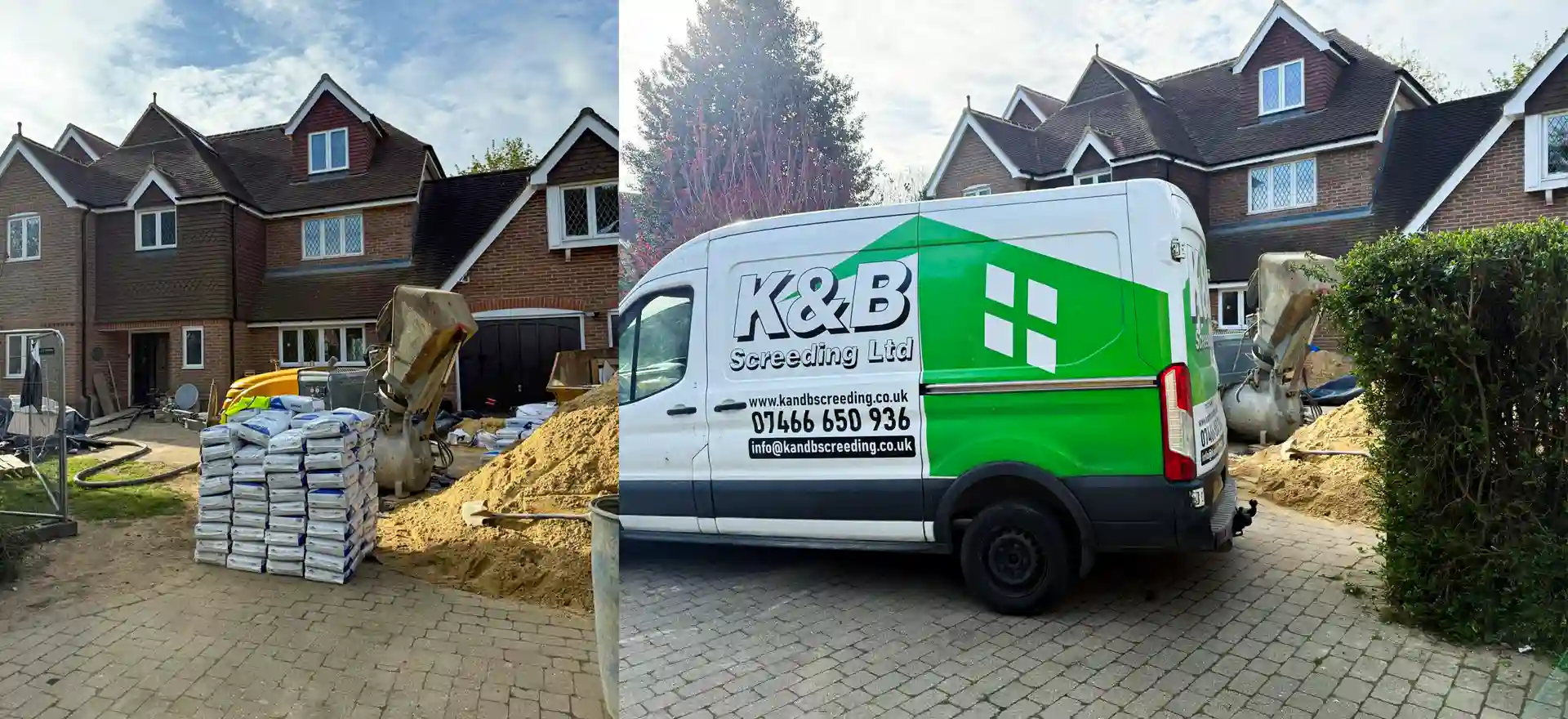
Who lays your anhydrite and flow screed in Seaford
K & B Screeding’s own team, led by director Donatas Bardisevicius. Founded 2019, company 12298780.
See what customers say in our Google reviews and on our testimonials page.
Anhydrite and flow screed from Slough to Seaford
On the map, Seaford sits south-south-east of Slough, about 61.8 miles from our base in a straight line (postcodes including BN25), next to Newhaven (2.9 miles), Peacehaven (4.7 miles), Polegate (7.2 miles) and Eastbourne (7.8 miles).
Where the anhydrite delivery must park in a marked bay in Seaford, a suspension or dispensation from East Sussex County Council (dispensations and suspensions) covers it; the quote tells you if it is needed.
More on anhydrite screed, part of our screeding services. For every screed we lay locally, see floor screeding in Seaford.
Further reading: calcium sulphate screed guide.