
Choosing a calcium sulphate grade in Newhaven
Calcium sulphate screed is ordered by code, not by name. Light domestic traffic calls for CA-C20-F4. The middle grade, CA-C25-F5, suits the majority of houses, flats and offices, while CA-C30-F6 is there for floors that take heavier wear. In each code, the figure after C is the compressive strength and the figure after F the flexural strength, measured in N/mm2 to the European screed standard. For new build plots, the grade comes from the engineer, and we pour exactly that.
In Newhaven, 14% of homes are flats in purpose-built blocks. Those floors are a good match for the material, since its low shrinkage lets a whole flat go down in big bays with hardly any joints. The joints that are needed, typically at doorways or where heating zones meet, are marked on a bay plan before any screed is poured.
You may also see an alpha hemihydrate product on the drawings. It is picked when time or floor height is short, because it dries faster or can go thinner, and since every product comes with its own sheet on depth and drying, we work to that sheet.
The build up below the screed is prepared by our own team: insulation, membrane and edge strip, checked and fixed before any screed arrives. Offices in the Enterprise Zone would follow the same system, with CA-C25-F5 the grade meant for most offices. If you want the background on calcium sulphate, our plain guide to anhydrite covers it. If the job is really about a quick, level pour rather than a specification, our Newhaven liquid screed page is the better starting point.
Sanding, priming and testing Newhaven anhydrite floors
Calcium sulphate forms a laitance as it dries: a thin, weak skin on the surface that adhesives cannot hold on to. It must be removed. When the screed has dried, the skin is sanded away to reach solid material, then a primer suited to calcium sulphate goes on. The wrong primer, or none at all, is how tiles and LVT come loose.
The moisture test comes next. A floor can feel dry to the touch and still be too damp for the finish, because flooring makers' limits for calcium sulphate are often tighter than for cement. A hygrometer reading is taken and checked against the limit your flooring maker sets. Where there is underfloor heating, it can normally be used to force dry the floor from about 7 days, cutting the wait when the build is on a tight timetable.
Wet areas are the exception. Calcium sulphate does not suit floors that may get wet, so shower rooms and utility floors on a new plot take a cement based flowing screed instead. Our anhydrite page for Seaford covers the same material in the neighbouring town.
Anhydrite & Flow Screed prices in Newhaven
Liquid flowing screed (which includes anhydrite): £24 to £31 per m² supplied and laid (MyJobQuote, August 2026), so £960 to £1,240 for 40 m². MyJobQuote does not say whether these figures include VAT. See our floor screeding cost guide or screed calculator.
Who lays your anhydrite and flow screed in Newhaven
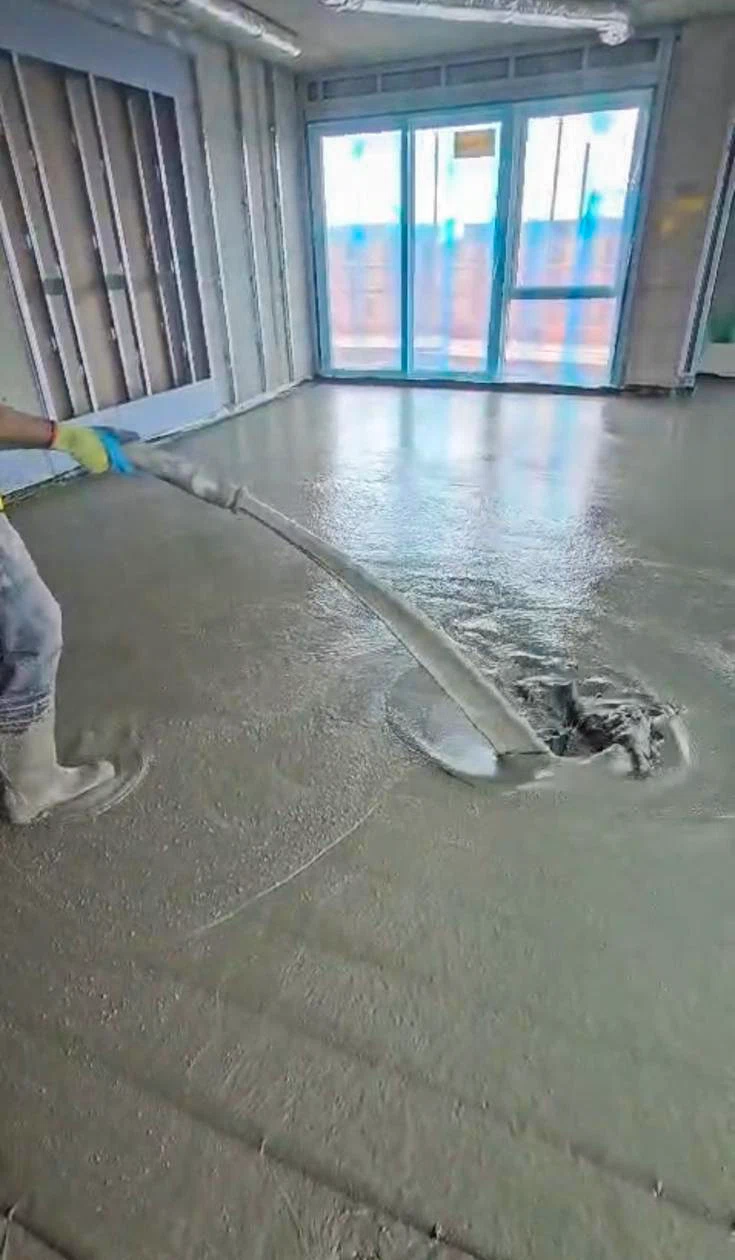
K & B Screeding’s own team, led by director Donatas Bardisevicius. Founded 2019, company 12298780.
See what customers say in our Google reviews and on our testimonials page.
Anhydrite & Flow Screed from Slough to Newhaven
As the crow flies, our yard in Slough is about 59.2 miles from Newhaven, which lies to the south-south-east. Postcodes here include BN9, and Peacehaven (2 miles), Seaford (2.9 miles), Lewes (5.7 miles) and Brighton and Hove (8.6 miles) are close by.
More on anhydrite screed, part of our screeding services.
