
Pipe cover for heated Newhaven extensions and garden rooms
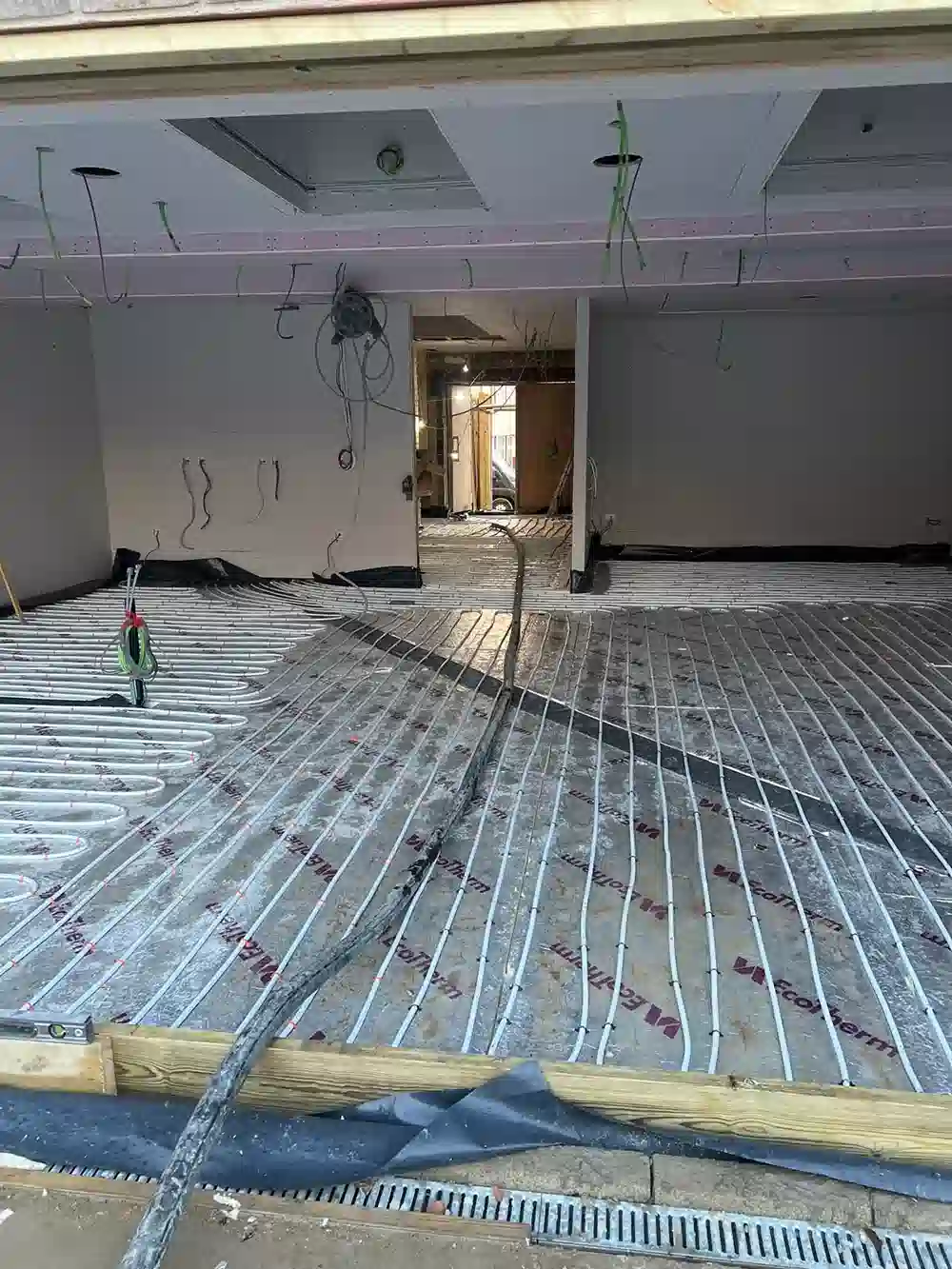
Without the right screed, underfloor heating does not perform. It spreads the warmth from the pipes, protects them and gives the flooring a solid base. Two rules set the depth. With liquid, a minimum of 25mm must sit over the pipes, which usually makes the layer 45 to 50mm deep. Sand and cement needs roughly 45mm above them, so the whole floor ends up deeper.
On a new extension there is normally room for either. The choice comes down to the room: liquid flows right around the pipes with no air pockets, heats up faster and suits large open floors, while sand and cement suits smaller rooms and wet areas. Our page on liquid screed in Newhaven covers the pumped option in detail.
Detached houses account for 18% of Newhaven's homes, and a detached plot is more likely to have space for a heated garden room. The same approach applies there on a smaller scale: insulation, pipes, then screed.
Everything under the screed gets checked first. Insulation must be continuous, the membrane lapped and taped, and an edge strip fitted round the walls so the screed can expand. Anything that is missing, we can provide. The heating engineer lays and pressure tests the pipes; our team pours the screed once that is done. Getting that order right is what keeps the pipes safe during the pour.
Warming up older Newhaven houses gradually
Older houses are harder. Near the harbour and the town centre, the Victorian terraces tend to have worn solid floors laid without a membrane, with not much spare height to build on. If the floor is being dug out anyway, the new level can be set with space for insulation, pipes and screed, and a hand-laid sand and cement screed for older homes can go over the pipes at the right cover.
In Newhaven, 20% of homes were built between 1973 and 1999. Whatever the age of the house, a heated extension joined to it has to finish level with the existing floor, so that height is measured before the depth over the pipes is set.
Whatever the house, the screed must be heated slowly. Calcium sulphate will normally accept warmth from about 7 days, whereas sand and cement must be left 21 days or more. After that the heating is brought on in small temperature steps, letting the floor dry out evenly without cracking, and we give you the plan on paper. Why hurrying this goes wrong is covered in how long screed takes to dry.
Underfloor Heating Screed prices in Newhaven
Liquid screed over underfloor heating: £20 to £35 per m² supplied and laid (trade2base, June 2026), so £700 to £1,230 for 35 m². trade2base gives these figures excluding VAT. See our floor screeding cost guide or screed calculator.
Who lays your underfloor heating screed in Newhaven
K & B Screeding’s own team, led by director Donatas Bardisevicius. Founded 2019, company 12298780.
See what customers say in our Google reviews and on our testimonials page.
Underfloor Heating Screed from Slough to Newhaven
As the crow flies, our yard in Slough is about 59.2 miles from Newhaven, which lies to the south-south-east. Postcodes here include BN9, and Peacehaven (2 miles), Seaford (2.9 miles), Lewes (5.7 miles) and Brighton and Hove (8.6 miles) are close by.
More on underfloor heating screed, part of our screeding services.
