
Heated extensions on Bexhill-on-Sea's post-war houses
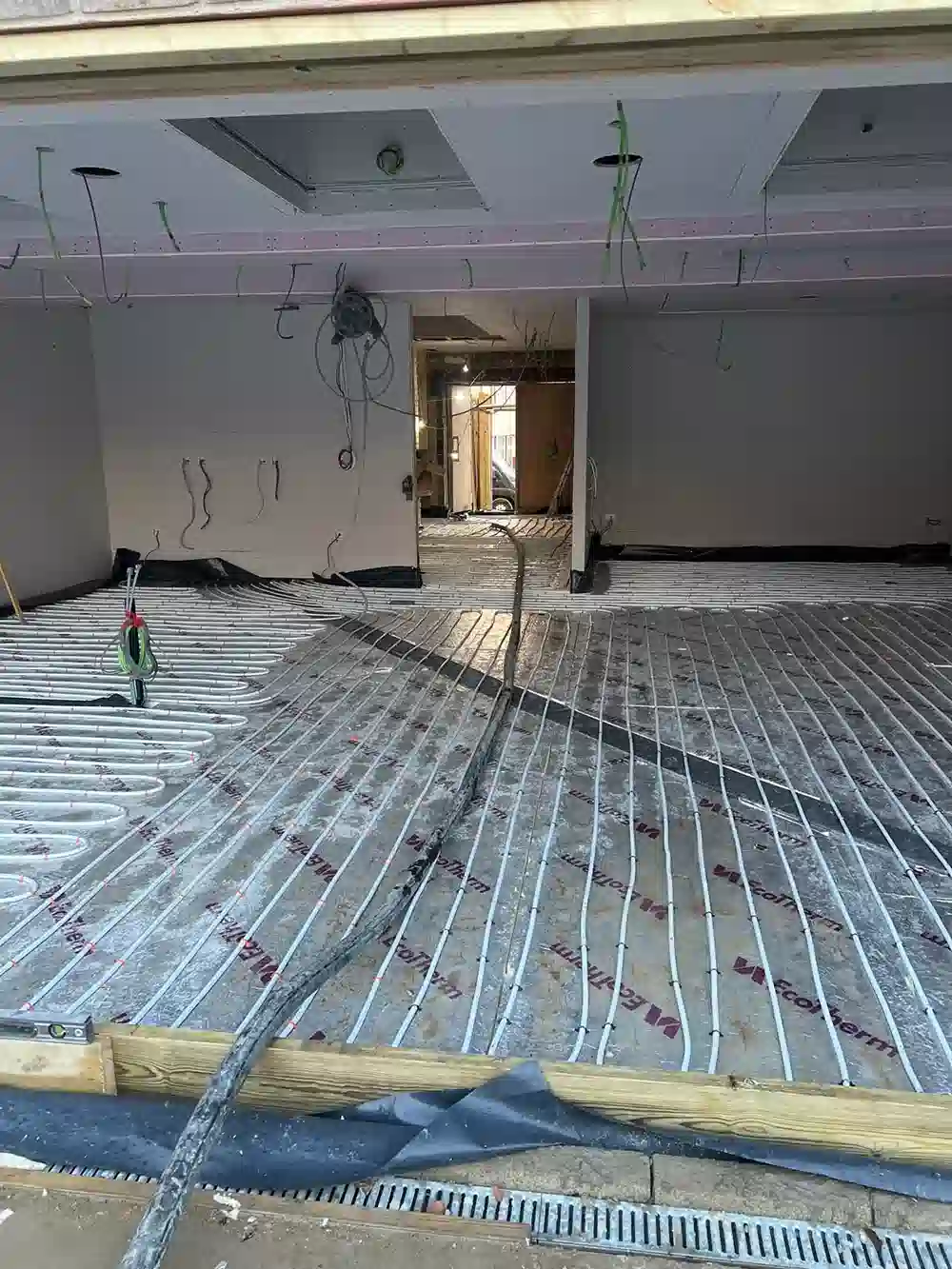
A heated extension has three parts that must work together: insulation below, pipes in the middle and a screed on top that spreads the heat evenly. The screed is the part that decides whether the floor warms quickly and evenly or leaves cold strips between the pipe runs.
Pipe cover is the first figure we fix on a Bexhill extension drawing. With a liquid mix that means 25mm at least, giving a finished build of 45 to 50mm in most rooms; a sand and cement floor needs nearer 45mm above the pipes alone. A liquid mix wraps itself round every pipe and leaves no air gaps, so the floor responds faster and heats more efficiently, and that is why it tends to be chosen under open-plan rooms. Our page on liquid screed in Bexhill-on-Sea covers pumping and access.
Floor height is the second. Where one of Bexhill's post-war bungalows or detached houses gets a new room that has to finish level with the old one, every layer from insulation up to screed must squeeze into whatever depth there is. Working that out early, before the slab is cast, avoids a step at the doorway.
Newer homes come into it as well. Of the town's houses, 21% went up between 1973 and 1999, and a kitchen refit or a new garden room is often when heating gets added to one of them. We look over the insulation, membrane and edge strip before screeding and can supply any of them that are missing; see insulation and membranes.
Retrofitting heating in older Bexhill-on-Sea floors
Putting underfloor heating into an older Bexhill house is a tighter squeeze than designing it into a new extension, because there is rarely spare height. Door thresholds, stair bottoms and kitchen plinths all sit at a fixed level, and a full build-up of insulation, pipes and screed may simply not fit on top of the old floor.
So the old floor frequently comes up first. Where an older Bexhill-on-Sea house has been converted into flats, ground floors on Victorian suspended timber or solid floors with no membrane may need to be dug out and rebuilt anyway, which creates room for insulation and heating. A thin liquid screed then keeps the finished floor as low as possible.
Warming up is the part people rush. Calcium sulphate will usually accept a little warmth once a week has passed (about 7 days); a cement mix must be left 21 days or more. Either way, the system starts cool and is stepped up a little at a time over several days, following the commissioning schedule. Turning the heat straight up on a new screed risks cracking and loss of bond. Our guide on screed drying times explains the difference, and for nearby jobs see underfloor heating screed in Hastings.
Underfloor Heating Screed prices in Bexhill-on-Sea
Liquid screed over underfloor heating: £20 to £35 per m² supplied and laid (trade2base, June 2026), so £700 to £1,230 for 35 m². trade2base gives these figures excluding VAT. See our floor screeding cost guide or screed calculator.
Who lays your underfloor heating screed in Bexhill-on-Sea
K & B Screeding’s own team, led by director Donatas Bardisevicius. Founded 2019, company 12298780.
See what customers say in our Google reviews and on our testimonials page.
Underfloor Heating Screed from Slough to Bexhill-on-Sea
As the crow flies, our yard in Slough is about 68 miles from Bexhill-on-Sea, which lies to the south-east. Postcodes here include TN40, TN39 and TN38, and Hastings (4.9 miles), Hailsham (9.5 miles), Eastbourne (9.9 miles) and Polegate (10 miles) are close by.
More on underfloor heating screed, part of our screeding services.