
Heated extensions in Hastings' twentieth century suburbs
About 20% of Hastings homes were built between 1945 and 1972. Suburbs such as Silverhill, West St Leonards and Bulverhythe hold much of the town's twentieth century housing, and post-war homes of this kind often gain an extension. A heated floor in a new extension is the easiest place to get underfloor heating right, because the depth can be designed in from the start.
The key figure is cover over the pipes. With liquid screed, allow 25mm or more over them, normally ending at 45 to 50mm overall. Sand and cement wants roughly 45mm of cover. Less than that risks cracks along the pipe runs, and more makes the floor slow to warm up.
Liquid screed is often chosen because it fills every gap around the pipes, leaving no trapped air to slow the heat. Sand and cement also works, especially in small rooms, but it is deeper and dries more slowly.
The insulation, the membrane and the edge strip around the walls all need to be down, and the pipes pressure tested, before any screed goes in. We check those when we arrive, and if the insulation layers are missing we can provide them. K & B does not install heating pipes, so the engineer and the screed are booked in sequence.
For liquid screed over heating, published 2026 figures range from £20 to £35 a square metre. Once the floor is dry and the heating commissioned, levelling for Hastings floors can prepare it for thin finishes.
Retrofitting heated floors in older Hastings houses
With 40% of Hastings homes built before 1919, a heated floor here often means an old house. That usually happens when a failed ground floor is being dug out anyway: the old floor comes up, and the new build-up includes insulation, a membrane, the heating pipes and a screed.
Height is the constraint. Doors, stairs and thresholds fix where the finished floor must sit, so the depth of each layer has to be worked out together. Liquid screed gives you a little more room, as the pipes need a thinner layer of it on top. The guide to screed thickness sets out typical build-ups.
Commissioning must be slow. Heat can normally go into calcium sulphate from around 7 days, while sand and cement needs 21 days or more. The temperature then rises a few degrees at a time, following the schedule we hand over in writing. Cracked screed very often traces back to heating that was turned straight up to full. Flooring then waits for a moisture test, however warm the room feels, because a heated screed can still hold water below the surface.
For heated floors nearby, see underfloor heating screed in Eastbourne.
Underfloor Heating Screed prices in Hastings
Liquid screed over underfloor heating: £20 to £35 per m² supplied and laid (trade2base, June 2026), so £700 to £1,230 for 35 m². trade2base gives these figures excluding VAT. See our floor screeding cost guide or screed calculator.
Who lays your underfloor heating screed in Hastings
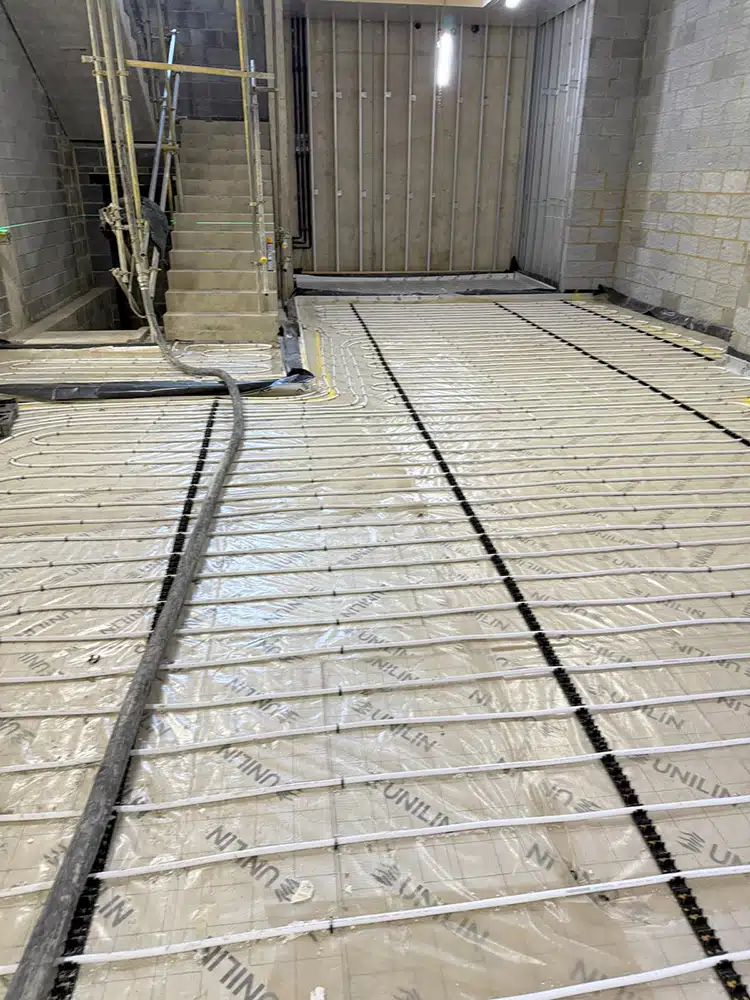
K & B Screeding’s own team, led by director Donatas Bardisevicius. Founded 2019, company 12298780.
See what customers say in our Google reviews and on our testimonials page.
Underfloor Heating Screed from Slough to Hastings
As the crow flies, our yard in Slough is about 70.8 miles from Hastings, which lies to the south-east. Postcodes here include TN34, TN37, TN35 and TN38, and Bexhill-on-Sea (4.9 miles), Hailsham (14.2 miles), Eastbourne (14.7 miles) and Polegate (14.9 miles) are close by.
More on underfloor heating screed, part of our screeding services.
