
Heated extensions and knock-throughs in Polegate homes
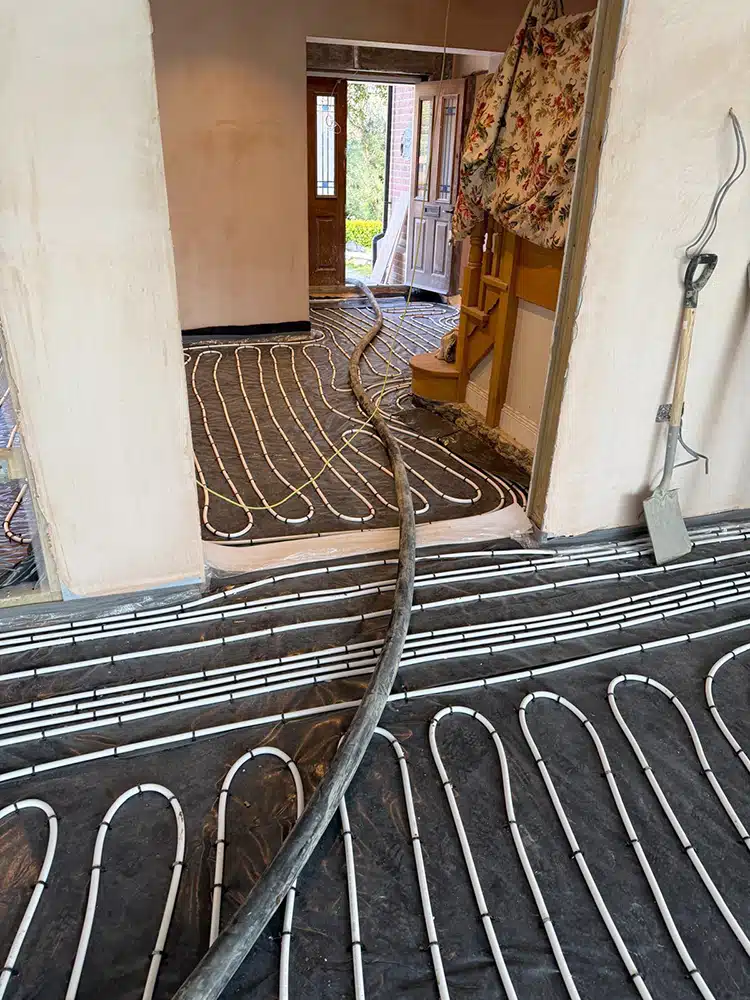
The typical heated floor in Polegate is a new rear extension or an opened-up kitchen, whether the house is one of the 22% that are detached or a semi or terrace. Once the room is heated from below, the screed becomes part of the heating system. It holds the pipes, spreads the warmth evenly across the room and gives a flat, stable base for tiles, LVT or engineered wood.
A flowing screed is the usual choice here because it runs around every pipe with no air pockets. Leave 25mm or more above the pipework and the full depth comes to roughly 45 to 50mm. That thinner, denser layer warms up faster than a thick traditional one. The liquid screed for Polegate floors page covers pumping and drying in more detail.
Sand and cement can also go over heating pipes, but it needs about 45mm of cover and must be compacted carefully around them. It still has a clear place in a heated room where a floor might get wet or where the rest of the extension is being laid by hand.
It is not only extensions that get heated floors, though. Some 7% of Polegate's housing was built from 2015 onwards, and heating in a new floor follows exactly the same rules for cover and commissioning as a retrofit or extension.
Retrofitting heating under older Polegate floors
Adding underfloor heating to an existing house is harder than heating a new extension, mainly because of floor height. Older properties near the High Street and Church Road have doors, skirting and stairs set to the original floor level, so every millimetre of insulation and screed has to be found by digging down. A liquid screed helps, because its pipe cover is thinner than sand and cement.
The build-up is worth getting right before anything is ordered. Insulation stops heat escaping into the ground, the membrane keeps moisture out, and the edge strip lets the screed expand at the walls. The insulation and membranes service covers that preparation if your builder has not done it.
The first heat-up is the stage that catches people out. On calcium sulphate the system can normally be started at around 7 days, whereas sand and cement wants 21 days or more. Either way the temperature is raised gradually, never turned straight up, and we hand over the schedule in writing. For similar work on the coast, see underfloor heating screed in Seaford.
Underfloor Heating Screed prices in Polegate
Liquid screed over underfloor heating: £20 to £35 per m² supplied and laid (trade2base, June 2026), so £700 to £1,230 for 35 m². trade2base gives these figures excluding VAT. See our floor screeding cost guide or screed calculator.
Who lays your underfloor heating screed in Polegate
K & B Screeding’s own team, led by director Donatas Bardisevicius. Founded 2019, company 12298780.
See what customers say in our Google reviews and on our testimonials page.
Underfloor Heating Screed from Slough to Polegate
On the map, Polegate sits south-east of Slough, about 62.5 miles from our base in a straight line (postcodes including BN26), next to Hailsham (3 miles), Eastbourne (4.1 miles), Seaford (7.2 miles) and Newhaven (8.9 miles).
More on underfloor heating screed, part of our screeding services.