
Fitting heated floors into Brighton and Hove's older homes
Retrofitting underfloor heating into an older house or flat starts with a tape measure. The finished floor has to meet door thresholds, the bottom stair and kitchen units, so insulation, pipes, screed and flooring must all fit in the space available.
Screed cover is fixed by the material. A liquid mix wants a minimum of 25mm above the pipes, so the screed itself tends to total 45 to 50mm. A hand-laid cement floor needs close to 45mm over the loops, so everything stacks higher. In an older flat with little height to play with, a slim pumped screed may be the one way to get heating in without lifting the floor, and because it surrounds each pipe without trapping air, the room warms up quicker.
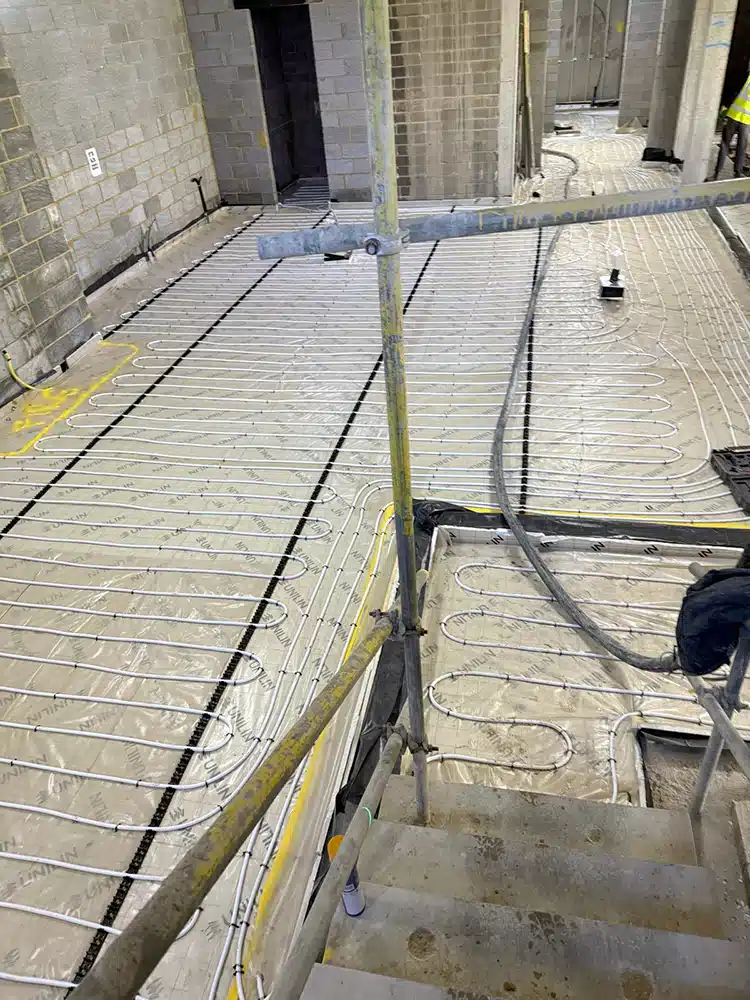
In ground floor and basement flats that are being rebuilt anyway because the old solid floor has no membrane, the dig out creates the depth needed. That is often the easiest moment to add heating: membrane, insulation, pipes and screed all go in as one build-up, and the finished level can be set to match the rooms either side.
Upper floors on timber joists are different again, and conversions there usually call for lightweight or acoustic screeds rather than a standard build-up. When we come to price, we look at the insulation, membrane and edge strip and can provide any that are missing; see our insulation and membranes page. For pump access, read liquid screed in Brighton and Hove.
Extensions and new schemes across Brighton and Hove
Brighton and Hove has built little in recent years, with 10% of homes dating from 2000 or later. Where it does happen, heating is usually part of the design. Mixed schemes such as Preston Barracks on the Lewes Road and Circus Street need screeds under offices, labs, retail units and corridors as well as homes, often with underfloor heating.
On the council built estates of Moulsecoomb and Whitehawk, a ground floor extension is the likelier setting, with heating running from the new room into the old kitchen. Have the loops down and pressure tested before our crew turns up, and leave them pressurised while we pour so a damaged pipe gives itself away straight away.
The heat-up needs patience. With calcium sulphate the heating can come on from roughly a week (7 days); with sand and cement, not until 21 days have passed. The commissioning schedule has it start cool and climb a notch at a time over several days. Rush that and the screed may crack or come loose. Our guide on how long screed takes to dry explains how heating and drying interact, and for a job in Lewes see underfloor heating screed in Lewes.
Underfloor Heating Screed prices in Brighton and Hove
Liquid screed over underfloor heating: £20 to £35 per m² supplied and laid (trade2base, June 2026), so £700 to £1,230 for 35 m². trade2base gives these figures excluding VAT. See our floor screeding cost guide or screed calculator.
Who lays your underfloor heating screed in Brighton and Hove
K & B Screeding’s own team, led by director Donatas Bardisevicius. Founded 2019, company 12298780.
See what customers say in our Google reviews and on our testimonials page.
Underfloor Heating Screed from Slough to Brighton and Hove
Brighton and Hove is about 53.6 miles south-south-east of our Slough base as the crow flies, with postcodes including BN1, BN3, BN2 and BN41. The nearest towns to it are Southwick (4.2 miles), Shoreham-by-Sea (5.7 miles), Peacehaven (6.7 miles) and Lewes (7.6 miles).
More on underfloor heating screed, part of our screeding services.
