
Matching screed to Brighton and Hove's old, dense housing
Census 2021 counted 277,096 people in the Brighton and Hove built-up area, living in a building stock that is old and tightly packed, with many houses divided into flats. That one fact steers a lot of floor work.
Conversion is the most common reason to screed in the city. Splitting a Regency or Victorian house into flats usually means lightweight or acoustic screeds over timber joists, so sound does not carry between neighbours, and levelling compound over sagging floors where two centuries of settlement have left them out of true.
Ground floor and basement flats in Kemptown and Hove are a separate problem. Under a lot of them is old solid concrete that was never given a damp proof membrane. Patching that rarely holds, so the old floor comes up and a membrane, insulation and fresh screed go down as one job. In small, awkward rooms that usually means traditional sand and cement screed, which copes with tight corners and can be laid to falls in a wet room.
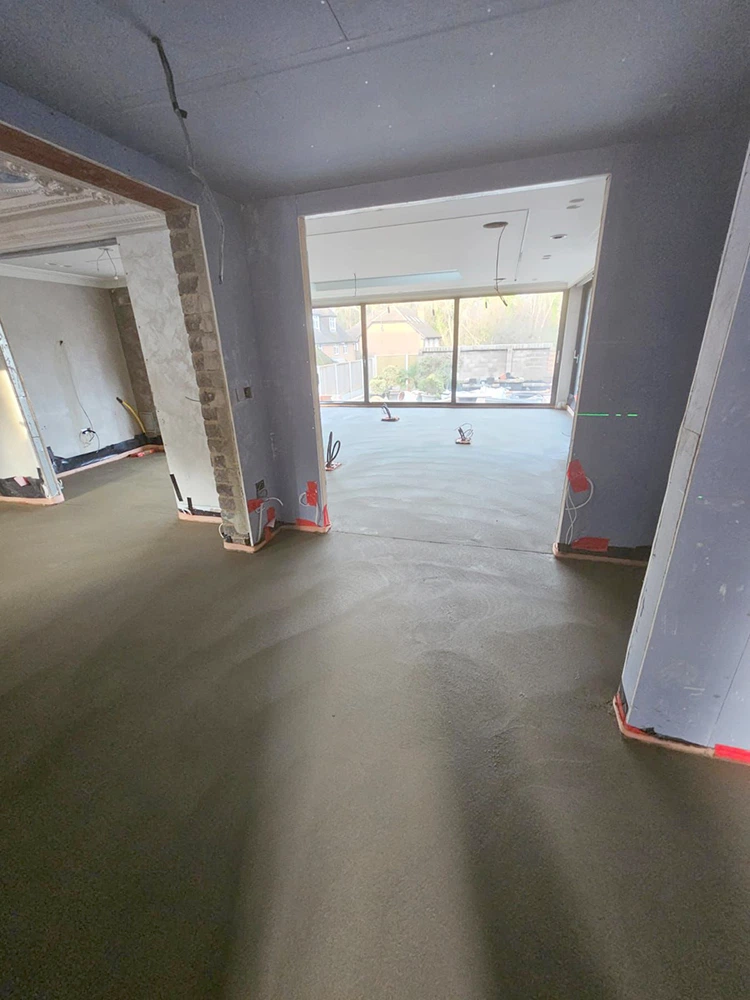
On the council built estates of Moulsecoomb and Whitehawk, kitchen and bathroom refits and ground floor extensions are the more common reasons to screed. A single storey extension with an open-plan floor suits pumped liquid screed, especially if heating is going in; read our page on screed over underfloor heating in Brighton and Hove for pipe cover and warm-up.
Homes in Brighton and Hove at a glance
Flats make up 49% of the 121,410 households in Brighton and Hove, followed by semi-detached houses at 20%. The largest share of its housing, 40%, was built before 1919, and 23% between 1945 and 1972.
| Homes in Brighton and Hove | Share |
|---|---|
| Detached houses | 10% |
| Semi-detached houses | 20% |
| Terraced houses | 20% |
| Flats | 49% |
| Built before 1919 | 40% |
| Built 1919 to 1944 | 16% |
| Built 1945 to 1972 | 23% |
| Built 1973 to 1999 | 11% |
| Built since 2000 | 10% |
House types from Census 2021 (table TS044); building age from the Valuation Office Agency council tax stock of properties, 31 March 2026 (table CTSOP 4.1). Figures cover the Brighton and Hove built-up area (E63006520).
Screeding services in Brighton and Hove
- Liquid ScreedPumped liquid screed in Brighton and Hove for purpose-built flats, estate extensions and open-plan kitchens, walkable in 24 to 48 hours.
- Sand and Cement ScreedSand and cement screed for Brighton and Hove basement flats, Victorian terraces and wet rooms, with a new membrane where needed.
- Underfloor Heating ScreedUnderfloor heating screed for Brighton and Hove extensions, flat refits and new mixed schemes, with correct pipe cover and heat-up.
- Anhydrite & Flow ScreedAnhydrite flow screed for Brighton and Hove apartment floors and mixed-use schemes, poured to the specified CA grade, sanded and tested.
- Floor LevellingFloor levelling in Brighton and Hove for sagging Regency and Victorian conversions and office refits, flat to SR1 for LVT and tiles.
- Latex ScreedThin latex screed for Brighton and Hove flat refits, laid over plywood, bonded tiles or worn concrete so vinyl and LVT sit smooth.
- Concrete Floor GrindingConcrete grinding with dust extraction for Lewes Road fit-outs, Preston Barracks space and Brighton and Hove extension joins.
We also offer fibre reinforced screed, quick drying screed, high strength screed, bonded screed, floor preparation, screed repairs, concrete floor repair, screed pumping, insulation & membranes, commercial screeding and residential screeding in Brighton and Hove.
Parking, access and timing a pour in Brighton and Hove
Access decides a lot in a dense city. For a pumped floor the mixer and pump have to stop somewhere the hose can reach, then the line is fed through the front door, down the hall or up the stairs. On a narrow terraced street with permit parking, the lorry position has to be arranged in advance, and a basement flat reached by outside steps needs the hose route planned before the day. Tell us about parking bays, restrictions and stair access when you ask for a price.
Where a pump cannot reach, a hand-laid screed mixed on site and barrowed in is the practical alternative, and that suits many small conversions anyway.
Timing sits alongside access. Before we pour, a Brighton room needs to be sealed against the weather, its wet plaster finished and any heating loops pressure tested; book the flooring fitter once you know how long the screed will take to dry.
Newer growth in the city is mostly brownfield. Preston Barracks on the Lewes Road and Circus Street, on the old municipal fruit and vegetable market, both mix homes with student rooms and business space. Schemes like these need screeds under offices, labs, retail units and corridors, often with heating, and where a specification names a calcium sulphate grade, our anhydrite flow screed page explains it. Our commercial screeding service covers larger non-domestic floors.
Screeding prices for Brighton and Hove floors
Sand and cement £18 to £25 per m², liquid £24 to £31 per m², supplied and laid (MyJobQuote, August 2026). MyJobQuote does not say whether these figures include VAT. See our floor screeding cost guide.
Who lays your floor screed in Brighton and Hove
K & B Screeding’s own team, led by director Donatas Bardisevicius. Founded 2019, company 12298780.
See what customers say in our Google reviews and on our testimonials page.
Reaching Brighton and Hove
Brighton and Hove is about 53.6 miles south-south-east of our Slough base as the crow flies, with postcodes including BN1, BN3, BN2 and BN41. The nearest towns to it are Southwick (4.2 miles), Shoreham-by-Sea (5.7 miles), Peacehaven (6.7 miles) and Lewes (7.6 miles). Neighbourhoods we cover in Brighton and Hove include Aldrington, Bevendean, Black Rock, Coldean and East Moulsecoomb.
See our screeding services for every screed type we lay.
