
Where liquid screed suits Brighton and Hove floors
Liquid screed is at its strongest on larger, open floors that would take a long time to lay by hand. A single storey rear extension that opens into the kitchen is a good example, and ground floor extensions are among the more common reasons to screed on the council built estates of Moulsecoomb and Whitehawk. Once the hose is running, the mix spreads itself out across the extension and the kitchen together, and an SR1 or SR2 finish is well within reach.
Brighton's many flats suit it just as well. Purpose-built blocks hold 28% of the city's homes, and a flat floor poured over insulation in one visit keeps a refurbishment moving. It moves very little while curing, so an open living space can be poured with only a few joints where a traditional mix would need many.
Depth follows the build-up. Floated over insulation, a domestic pour begins at roughly 35mm, and a commercial one at roughly 40mm. Where pipes run underneath, 25mm or more has to sit over them, so most heated floors come out at 45 to 50mm. Being slimmer than a hand-laid floor makes it easier to arrive at an old Victorian doorstep without a lip.
Two families of liquid screed exist: calcium sulphate, for most dry rooms, and cement based, for floors that may get wet. The specification side, including grades and sanding, is on our anhydrite flow screed page for Brighton and Hove. For a straight comparison with traditional screed, see liquid screed vs sand and cement.
Running the hose on Brighton and Hove streets
Every pour depends on where the mixer can stop. A house with its own drive keeps the hose run short and simple. On a terraced street in the inner city, the lorry often needs a suspended bay or a short window agreed in advance. We ask about parking, restrictions and the distance from kerb to room when pricing, because that sets the hose length and the crew needed on the day.
Stairs are the next question. The hose can be taken up a communal stairwell to an upper floor flat, provided the route is protected and the managing agent has agreed the date. A basement flat reached by outside steps is often easier than it looks, because the hose runs downhill.
Once poured, keep the room closed for the first day or two so draughts do not skin the surface too quickly, then ventilate to help it dry. Down to 40mm, a millimetre of depth clears roughly every day, then progress slows; what speeds or stalls that is set out in our guide to screed drying times.
If the mixer cannot get close, our screed pumping service explains how longer hose runs work. Just along the coast, there is a separate page for pumped screed in Shoreham-by-Sea.
Liquid Screed prices in Brighton and Hove
Liquid screed: £24 to £31 per m² supplied and laid (MyJobQuote, August 2026), so £960 to £1,240 for 40 m². MyJobQuote does not say whether these figures include VAT. See our floor screeding cost guide or screed calculator.
Who lays your liquid screed in Brighton and Hove
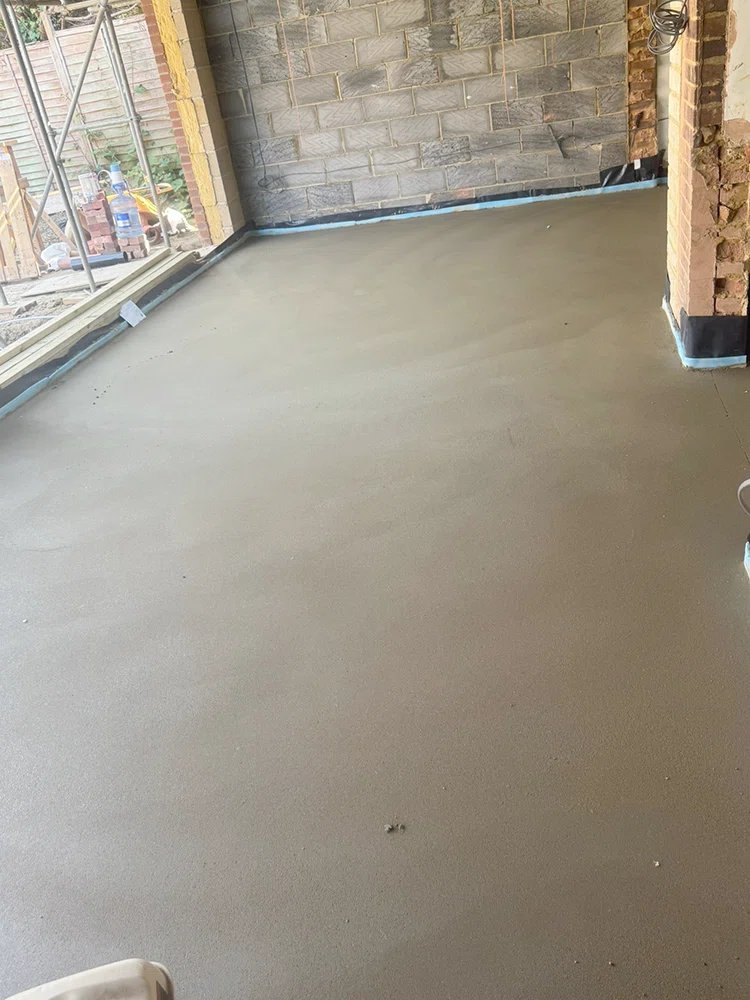
K & B Screeding’s own team, led by director Donatas Bardisevicius. Founded 2019, company 12298780.
See what customers say in our Google reviews and on our testimonials page.
Liquid Screed from Slough to Brighton and Hove
Brighton and Hove is about 53.6 miles south-south-east of our Slough base as the crow flies, with postcodes including BN1, BN3, BN2 and BN41. The nearest towns to it are Southwick (4.2 miles), Shoreham-by-Sea (5.7 miles), Peacehaven (6.7 miles) and Lewes (7.6 miles).
More on liquid screed, part of our screeding services.
