
Liquid screed on newer Burgess Hill homes
Where a newer house already has a flowing screed over insulation, perhaps with underfloor heating, and it is extended or the kitchen opened up, using liquid screed again keeps the floor consistent: the same depth, the same drying behaviour and the same surface for the flooring.
Liquid screed is pumped from the mixer, flows to a level surface on its own and fills fully around any pipes. SR1 or SR2 flatness is readily achievable, measured with a 2m straightedge. In a long open-plan room its low shrinkage counts too, because it needs far fewer joints than a sand and cement floor would.
A floating floor begins at about 35mm thick in a house, 40mm in commercial premises. It takes foot traffic 24 to 48 hours after the pour. Drying out is a slower business: each mm of the first 40mm takes roughly a day, and every mm past that takes longer, so the screed is tested before the flooring goes on. We can pour a calcium sulphate mix or a cement based one, depending on the room and what is going on top.
Purpose-built flats are 13% of homes in Burgess Hill, and liquid screed suits them for the same reason it suits big ground floors: the pump does the carrying and an apartment floor is poured in a single visit. For more on choosing between the two main screed types, read our guide to liquid and sand and cement screed compared.
Pump access on Burgess Hill streets and driveways
Our pump and mixer set up on your drive or the road outside, and the hose goes from there to the room. On most houses with a drive this is simple. On a terraced row with no side access, the hose may need to go through the front door and hallway, which is fine as long as the route is protected and clear.
On a new estate, parking can be tighter than it looks, with narrow roads and allocated bays. Mention any parking limits with your enquiry so we can work out where the pump will go. Upstairs flats work the same way, with the hose taken up the stairwell to the floor being poured.
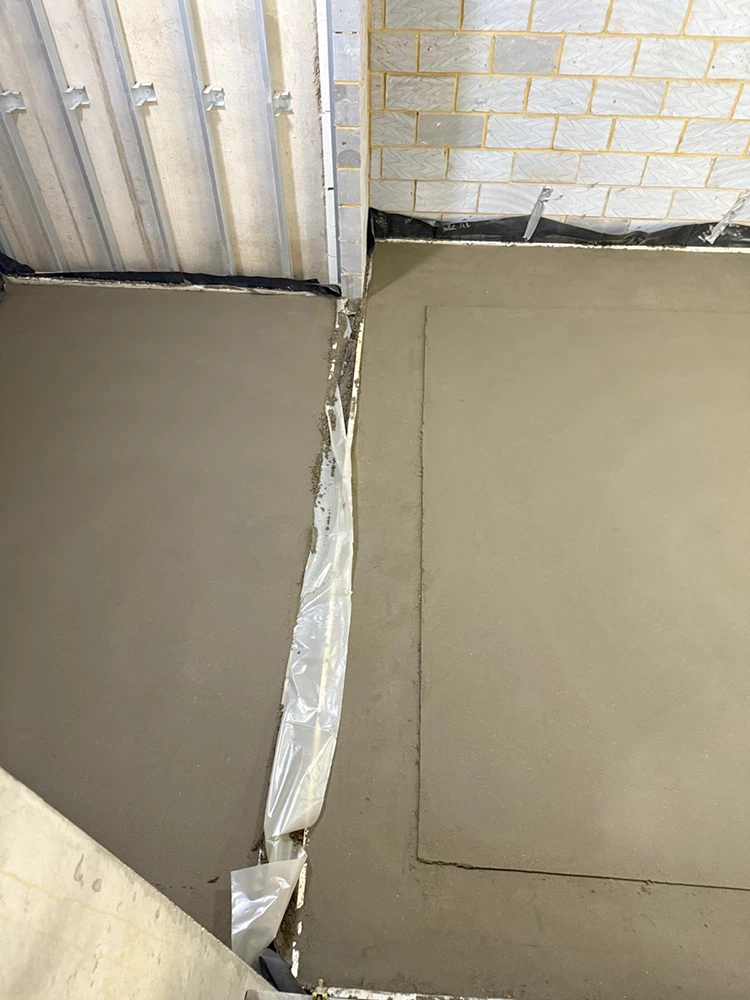
Ahead of pumping, the insulation boards are butted tight, the membrane is taped along every joint and lapped up the walls, and edge strip is fixed round the room. That stops the screed escaping under the boards. Where a project needs the pump on its own for a larger pour, see screed pumping. For a project in a neighbouring town, see liquid screed in Haywards Heath.
Liquid Screed prices in Burgess Hill
Liquid screed: £24 to £31 per m² supplied and laid (MyJobQuote, August 2026), so £960 to £1,240 for 40 m². MyJobQuote does not say whether these figures include VAT. See our floor screeding cost guide or screed calculator.
Who lays your liquid screed in Burgess Hill
K & B Screeding’s own team, led by director Donatas Bardisevicius. Founded 2019, company 12298780.
See what customers say in our Google reviews and on our testimonials page.
Liquid Screed from Slough to Burgess Hill
On the map, Burgess Hill sits south-south-east of Slough, about 45.5 miles from our base in a straight line (postcodes including RH15 and BN6), next to Haywards Heath (3.1 miles), Lewes (8.5 miles), Brighton and Hove (9.2 miles) and Southwick (9.6 miles).
More on liquid screed, part of our screeding services.
