
Where pumped screed pays off in Lewes homes
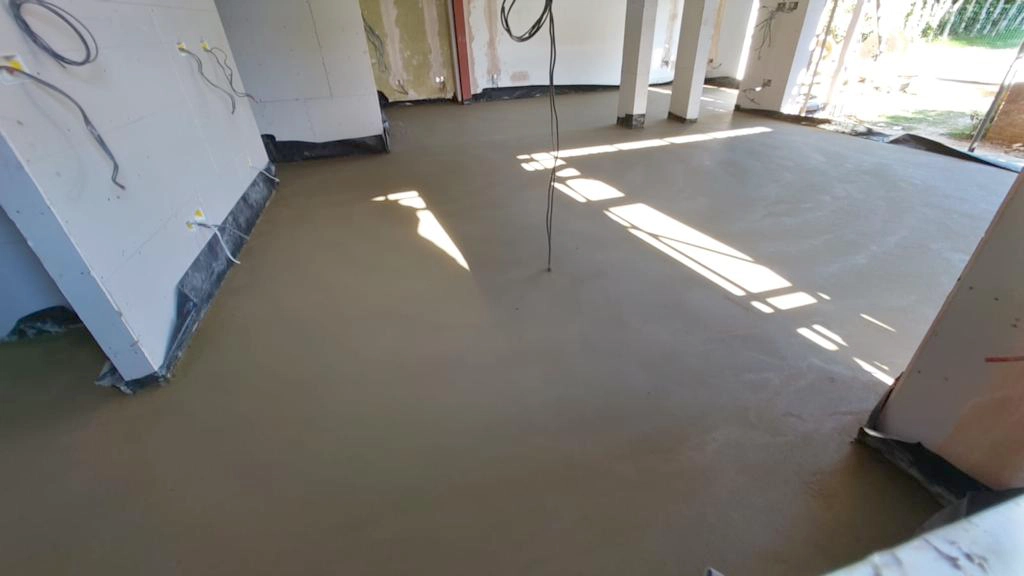
Pumping makes most sense when the floor is big and has few walls breaking it up. Semis make up 29% of the homes in Lewes, and a semi with a rear extension knocked through to the kitchen is a typical example: one continuous area, a sound slab underneath, and a client who wants the room back quickly. The screed is pumped in, flows to its own level and is finished in a single visit, so a large ground floor is covered in a day.
The second reason is how flat it ends up. Hitting SR1 or SR2 for surface regularity is straightforward with a liquid pour, and large format tiles, LVT and engineered boards all need that flatness underneath them. Because it shrinks very little, the floor needs far fewer joints than sand and cement, which keeps a long open-plan room looking like one surface.
Depth is modest. Laid floating in a house, it can go down from about 35mm; with heating pipes in the floor, allow 45 to 50mm overall so that at least 25mm sits above them. Because the mix runs right round every pipe and leaves no gaps, it is the usual partner for heated floors in Lewes extensions.
There are two broad families: calcium sulphate based and cement based liquid screeds. The choice depends on the room and the finish, and the wetter the area, the more likely a cement based mix is right. Still weighing it up against a hand-laid floor? Our guide setting liquid against sand and cement puts the two next to each other.
Getting the hose to a Lewes kitchen or flat
Nothing heavy comes into the house: the mixer and pump are parked in the street outside and a hose carries the screed in. Where a Lewes semi has its own drive, that part is easy. A terrace is different, because the hose normally has to come in at the front and down the hallway, so we cover the floors and door frames along that line first and walk the route with you before the day. The lorry needs somewhere to stand for a few hours, so parking is sorted before the day.
In Lewes, 24% of homes are flats, counting conversions as well as purpose-built blocks. On upper floors the hose is taken up the stairs or lifted through a window, and neighbours are warned about the lorry and the noise. Pump hire is quoted in the trade at £300 to £600 per day (trade2base, June 2026), which shows the equipment cost behind a pumped floor. None of our pumps or machines are available to hire on their own. If you want to know how the pump is set up and run, see how we pump screed.
Being able to walk across it after 24 to 48 hours is not the same as being able to lay a floor on it. Allow roughly one day of drying for each millimetre up to 40mm, keep the windows open where you can, and have the moisture tested before any tiles or wood are fitted.
Liquid Screed prices in Lewes
Liquid screed: £24 to £31 per m² supplied and laid (MyJobQuote, August 2026), so £960 to £1,240 for 40 m². MyJobQuote does not say whether these figures include VAT. See our floor screeding cost guide or screed calculator.
Who lays your liquid screed in Lewes
K & B Screeding’s own team, led by director Donatas Bardisevicius. Founded 2019, company 12298780.
See what customers say in our Google reviews and on our testimonials page.
Liquid Screed from Slough to Lewes
As the crow flies, our yard in Slough is about 53.7 miles from Lewes, which lies to the south-south-east. Postcodes here include BN7, and Peacehaven (5.4 miles), Newhaven (5.7 miles), Brighton and Hove (7.6 miles) and Uckfield (7.6 miles) are close by.
More on liquid screed, part of our screeding services.
