
Relaying damp solid floors in Kemptown and Hove
With no membrane under it, an old solid floor wicks damp up from the ground below. The signs are easy to spot: flooring that lifts, a musty smell, salts on the surface and skirting that rots from the bottom. Laying new flooring on top does not stop it. It only stops when the floor is broken out and built again.
A typical rebuild goes in layers. First the old concrete is broken up and carried out and the ground beneath made good. A damp proof membrane goes down next, turned up the walls, then insulation, then roughly 65mm of floating sand and cement on top. We can supply those lower layers too, through our insulation and membranes service.
Hand-laid screed suits these rooms. Basement flats often have narrow halls, steps, chimney breasts and bay windows, and the screed has to be laid in sections and compacted by hand. It is mixed on site to the depth each area needs, so a hall, a bedroom and a small kitchen can all be finished to one level even where the dig has varied.
Victorian terraces fill much of the inner city, and terraced houses make up 20% of homes across Brighton and Hove. The same approach works on their ground floors when a solid floor has failed, and the screed thickness guide shows how the layers add up.
Wet rooms, falls and bonded screeds in Brighton and Hove
Kitchen and bathroom refits are common reasons to screed on the council built estates of Moulsecoomb and Whitehawk, and bathrooms are where sand and cement is hard to beat. In a Whitehawk or Moulsecoomb wet room, the floor has to take water and run it to the drain. Calcium sulphate screed can do neither, while sand and cement can be ruled to a fall by hand so water runs to the gully.
Bonded screed is useful where height is tight. Stuck down to sound concrete with a bonding agent, the screed can be just 25 to 40mm thick, handy in a refit where the doors and kitchen plinths are not moving. Our bonded screed page explains when a base is sound enough.
Homes built between 1919 and 1944 are another 16% of the city's housing, and floors of that age can need the same attention. The catch is the wait. Reckon on a millimetre a day for the first 40mm and longer below that, which leaves a 65mm floor needing weeks before timber or LVT can go on. An additive in the mix shortens it, and if pipes are going in, read about screeding over heating pipes in Brighton and Hove.
Sand and Cement Screed prices in Brighton and Hove
Sand and cement screed: £18 to £25 per m² supplied and laid (MyJobQuote, August 2026), so £450 to £630 for 25 m². MyJobQuote does not say whether these figures include VAT. See our floor screeding cost guide or screed calculator.
Who lays your sand and cement screed in Brighton and Hove
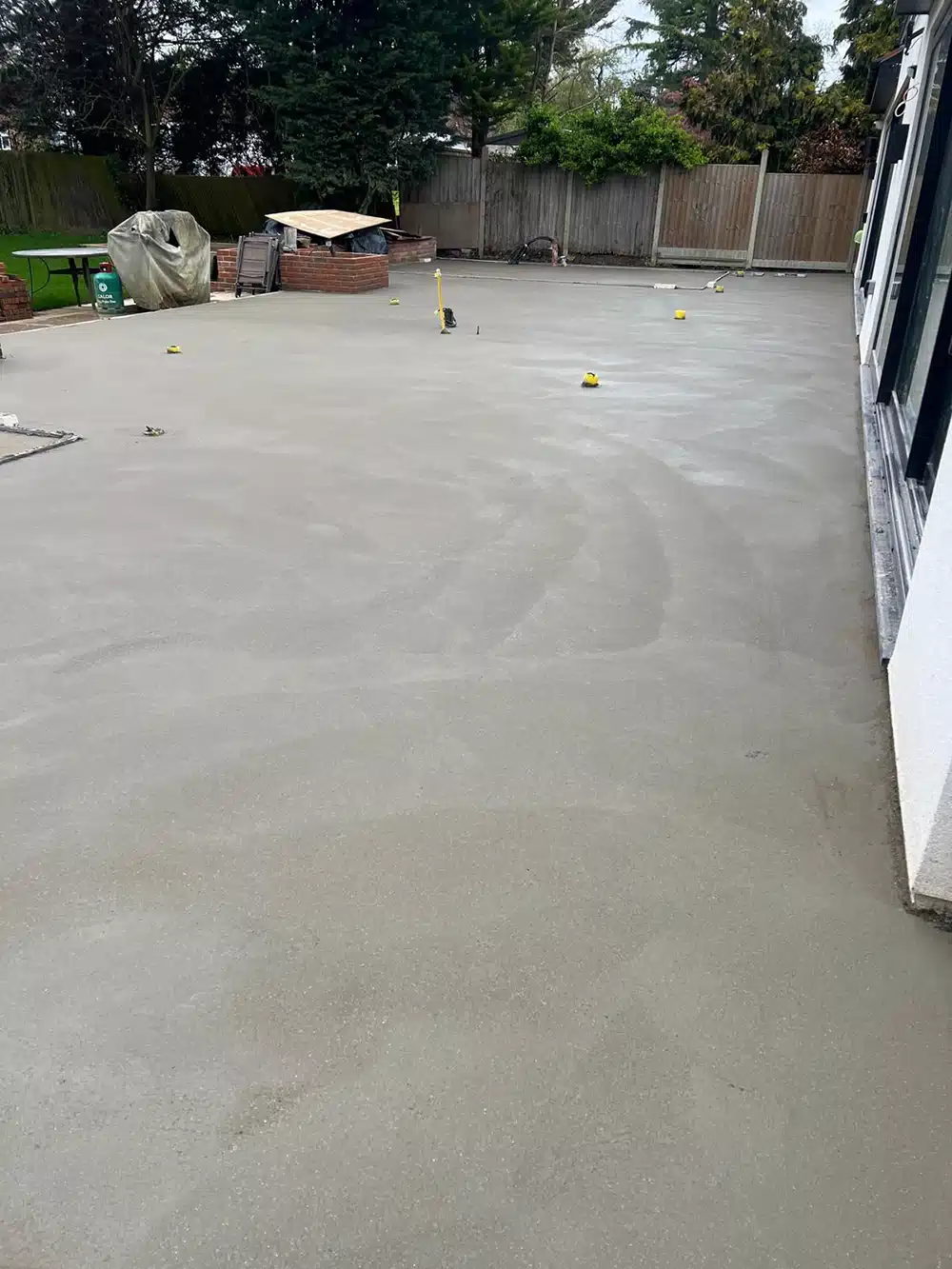
K & B Screeding’s own team, led by director Donatas Bardisevicius. Founded 2019, company 12298780.
See what customers say in our Google reviews and on our testimonials page.
Sand and Cement Screed from Slough to Brighton and Hove
Brighton and Hove is about 53.6 miles south-south-east of our Slough base as the crow flies, with postcodes including BN1, BN3, BN2 and BN41. The nearest towns to it are Southwick (4.2 miles), Shoreham-by-Sea (5.7 miles), Peacehaven (6.7 miles) and Lewes (7.6 miles).
More on sand & cement screed, part of our screeding services.
