
Older Worthing floors, from Liverpool Terrace onwards
Worthing kept a good deal of its resort era. Victorian and Edwardian developments such as Park Crescent and Liverpool Terrace survive, and many period buildings across the town have since been split into flats. Floors in buildings of that age were not laid to modern standards, and when one is opened up it is often lower, damper or weaker than expected.
Once an old solid floor here has given up, the fix is normally to break it out and start again from the ground, adding hardcore if needed, insulation, a membrane to stop damp and finally the screed. Sand and cement suits that job because it is mixed in small loads, carried through narrow halls and laid room by room around old walls and chimney breasts.
The interwar years add another large group, with 25% of the town's homes built between 1919 and 1944. Their solid floors may be sound but rough, or may need lifting where damp has got in.
Depth matters on all of these. Over insulation, a house floor of this type is laid about 65mm thick, and a commercial one 75mm. Sometimes the slab underneath is perfectly solid with just a crumbling top; then a bonded screed just 25 to 40mm thick is stuck straight down onto it. Mixing in fibres cuts the risk of cracks, and screed with added fibres is covered separately.
Wet rooms, garages and slow drying in Worthing
In a Worthing bathroom there is rarely a good substitute for it. Think of a converted Worthing flat getting a walk-in shower: the floor needs a fall towards the gully, and the base under the tanking must shrug off water. Calcium sulphate screeds do not, so in a converted Worthing flat with a new shower area, sand and cement is the usual choice under the tanking.
The garage beside a semi or bungalow is the other job it suits. Garage slabs tend to sit lower than the house, so insulation and a membrane go in first and the screed then brings the room up flush with the hall. Anyone converting one can read the garage floor screed guide for every layer in order.
The trade-off is time. A traditional screed dries more slowly than a pumped one, and heating cannot go on for at least 21 days. Plan the tiler or flooring fitter around that rather than hoping to shorten it. A floor that is firm but wavy may need no new screed whatsoever, because levelling compound over the existing Worthing floor is often the quicker route. We also cover nearby towns, including sand and cement screed in Littlehampton.
Sand and Cement Screed prices in Worthing
Sand and cement screed: £18 to £25 per m² supplied and laid (MyJobQuote, August 2026), so £450 to £630 for 25 m². MyJobQuote does not say whether these figures include VAT. See our floor screeding cost guide or screed calculator.
Who lays your sand and cement screed in Worthing
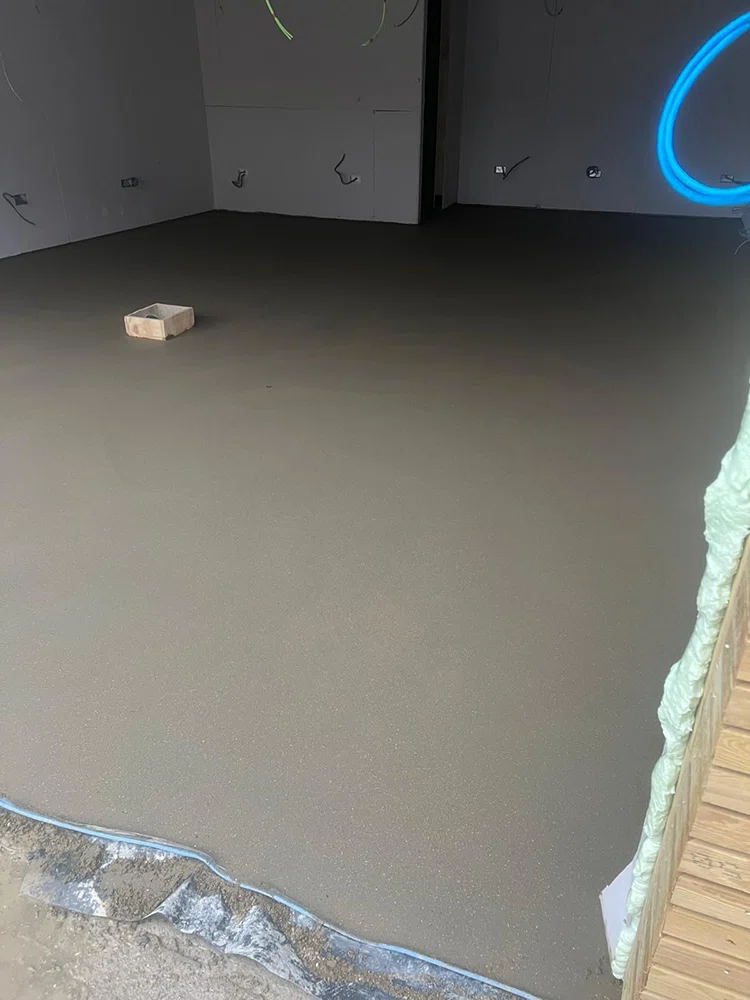
K & B Screeding’s own team, led by director Donatas Bardisevicius. Founded 2019, company 12298780.
See what customers say in our Google reviews and on our testimonials page.
Sand and Cement Screed from Slough to Worthing
Worthing is about 51 miles south-south-east of our Slough base as the crow flies, with postcodes including BN11, BN14, BN12 and BN13. The nearest towns to it are Shoreham-by-Sea (4.5 miles), Southwick (6 miles), Littlehampton (7.4 miles) and Brighton and Hove (10 miles).
More on sand & cement screed, part of our screeding services.
