
Heated floors in Bolnore Village and newer Haywards Heath homes
Building at Bolnore Village started in 2002, and homes there and elsewhere from the past two decades tend to need extensions that tie into existing screeds and underfloor heating. That brings two practical questions: what screed is in the house now, and what level the new floor has to finish at.
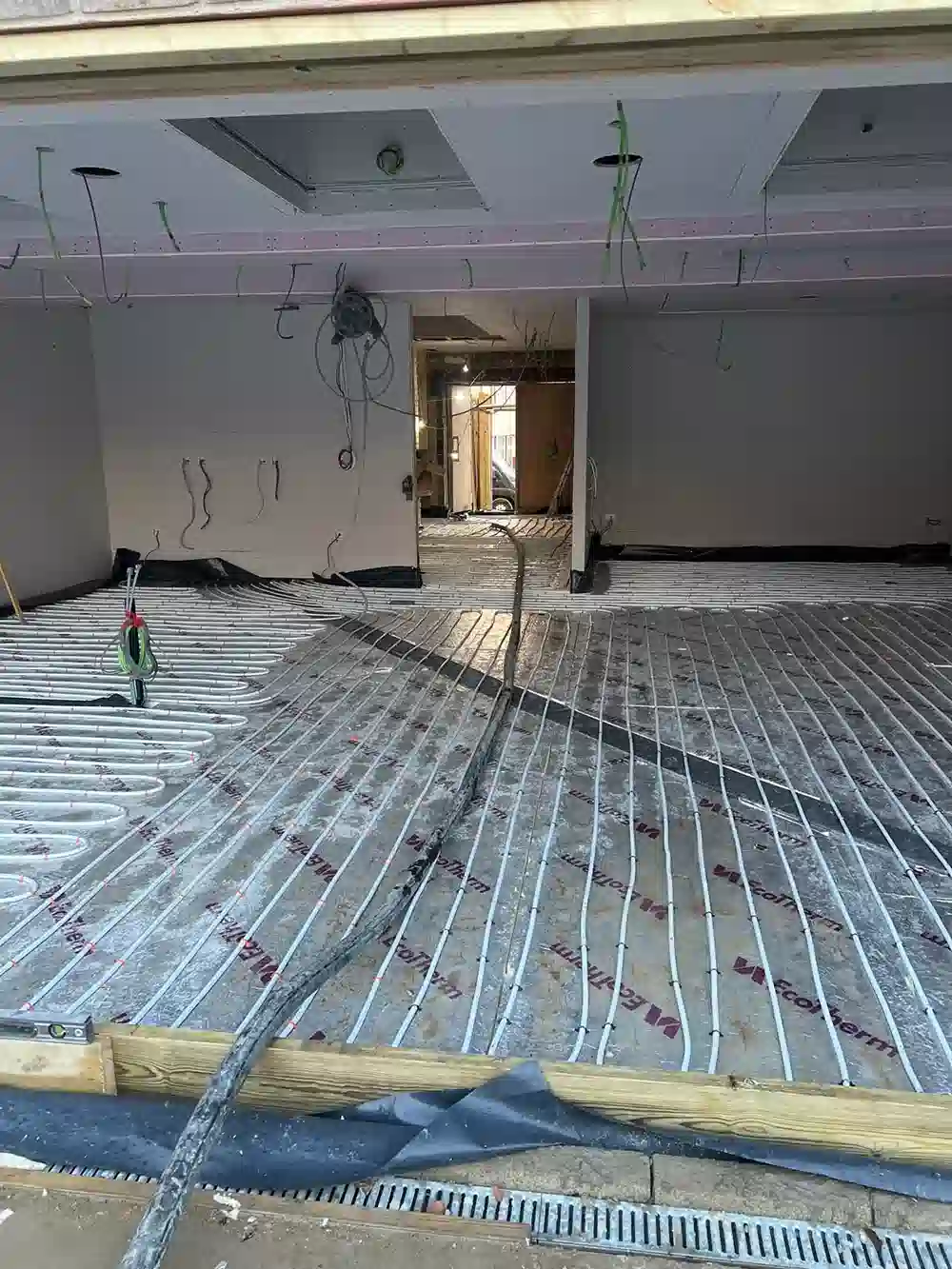
If the new extension shares a room with the old floor, the finished levels must match to the millimetre, and the build-up of insulation, pipes and screed has to be worked out backwards from that line. A liquid screed suits most of these floors. Poured liquid wraps every pipe without leaving voids, and with a minimum 25mm over the top the floor usually ends up 45 to 50mm deep. Hand-laid sand and cement wants around 45mm above the pipes, so the finished build-up is deeper.
Detached houses make up 28% of the town's homes, and larger rear extensions and garden rooms on those plots are the kind of space where underfloor heating makes most sense. A garden room built as a separate structure still needs the same care: insulation below, a membrane, an edge strip around the walls and the correct depth over the pipes. For the layers beneath, see our insulation and membrane work; the minimum depth for each screed is in our guide to screed thickness.
Retrofitting underfloor heating in older Haywards Heath houses
Older houses are harder. In a house from the 1930s or earlier there is rarely spare height to add insulation, pipes and a full screed without raising the floor above the thresholds. The usual answer is to dig the old floor out and rebuild it, choosing the thinnest build-up that still gives the pipes proper cover. Liquid screed often wins here simply because it needs less depth. In Lindfield's timber-framed houses the question is different again, because any floor work has to suit the historic structure.
Once the floor is in, the heating has to be brought up slowly. With calcium sulphate, the heating can normally go on after about 7 days. Sand and cement has to wait 21 days as a minimum. Either way, the flow temperature goes up a step at a time over several days on your installer's schedule, not straight to maximum.
Laying and pressure testing the pipes is down to your heating engineer, and we pour once that is done. A little under 10 miles away, there is a separate page on heated floor screeding in East Grinstead.
Underfloor Heating Screed prices in Haywards Heath
Liquid screed over underfloor heating: £20 to £35 per m² supplied and laid (trade2base, June 2026), so £700 to £1,230 for 35 m². trade2base gives these figures excluding VAT. See our floor screeding cost guide or screed calculator.
Who lays your underfloor heating screed in Haywards Heath
K & B Screeding’s own team, led by director Donatas Bardisevicius. Founded 2019, company 12298780.
See what customers say in our Google reviews and on our testimonials page.
Underfloor Heating Screed from Slough to Haywards Heath
On the map, Haywards Heath sits south-east of Slough, about 43.9 miles from our base in a straight line (postcodes including RH16), next to Burgess Hill (3.1 miles), Uckfield (8.8 miles), Crawley (9 miles) and East Grinstead (9.7 miles).
More on underfloor heating screed, part of our screeding services.
