
Haywards Heath offices and units between tenants
When an office or industrial unit in Haywards Heath changes hands, the old carpet tiles or vinyl come up and the floor beneath is rarely perfect. Adhesive residue, patched cable trenches, worn screed and small steps between rooms all show through thin new finishes.
Levelling compound deals with that. It is poured over a prepared, primed base and finds a flat surface, usually at about 2mm up to around 10mm deep, with some products going deeper. BS 8204 grades flatness with a 2m straightedge, permitting gaps of 3mm for SR1, 5mm for SR2 and 10mm for SR3. Thin sheet flooring often calls for SR1, so a refitted office getting vinyl or LVT will normally be levelled to that class.
Preparation decides whether compound stays down. Old adhesive and weak surface layers must come off, and the primer has to suit the base: a different primer goes on calcium sulphate screed than on concrete, and non-absorbent surfaces need their own. Using a quick drying compound lets the floor layer come in soon after us, which keeps an office refit on schedule.
The two light industrial estates date from the 1960s and 1970s, and floors of that age may also need cracks or broken areas mended before any compound goes on. Our screed repairs service covers that work, and a thin latex screed is an option where only a few millimetres are needed.
Where a Haywards Heath extension meets the old floor
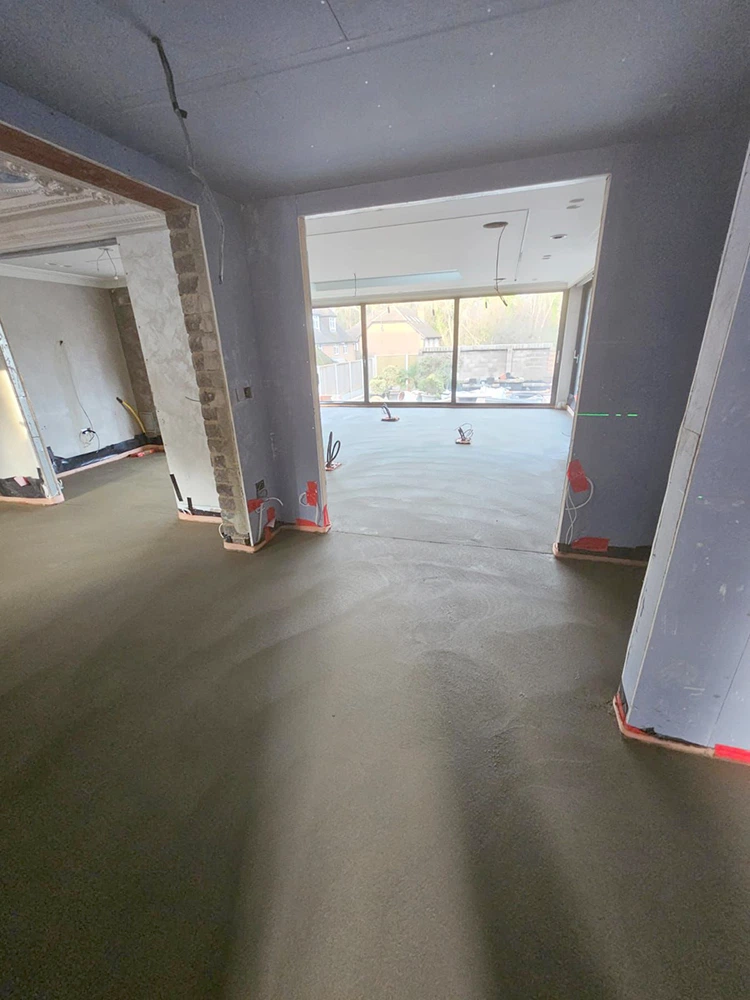
Homes built between 1973 and 1999 make up 20% of Haywards Heath, and houses of that era, like the newer ones at Bolnore Village, are often extended. Where the original floor meets the extension, trouble tends to show. The extension screed might sit a few millimetres proud, or the original floor might dip towards the back wall, and a continuous run of LVT or large tiles will show every step.
Compound can feather out a small difference across the join and bring both floors to one flat plane. What it cannot do is fix a floor that needs a screed. Deep pours of compound to correct a badly out of level or broken floor can crack and debond. Should the gap be too big for compound, or the base be breaking up, you will hear that from us along with a price for rescreeding, normally with hand-laid sand and cement in the older rooms.
This is not timber floor sanding, and we do not sell levelling products for DIY use. For the same service about 11 miles away, see floor levelling in Horsham.
How we price floor levelling in Haywards Heath
A fixed written price within 24 hours, once we know the area and the base. See our floor screeding cost guide.
Who levels your floor in Haywards Heath
K & B Screeding’s own team, led by director Donatas Bardisevicius. Founded 2019, company 12298780.
See what customers say in our Google reviews and on our testimonials page.
Floor Levelling from Slough to Haywards Heath
On the map, Haywards Heath sits south-east of Slough, about 43.9 miles from our base in a straight line (postcodes including RH16), next to Burgess Hill (3.1 miles), Uckfield (8.8 miles), Crawley (9 miles) and East Grinstead (9.7 miles).
More on floor levelling, part of our screeding services. Not sure whether you need a thin compound or a full flowing screed? See self levelling screed explained.
