
Heated extensions on Holbrook and similar Horsham estates
Semi-detached houses make up 28% of Horsham's homes, and a rear extension on a semi or a late 20th century Holbrook house is the classic heated floor. Knock through into the old kitchen and the two floors must end up flush with no step.
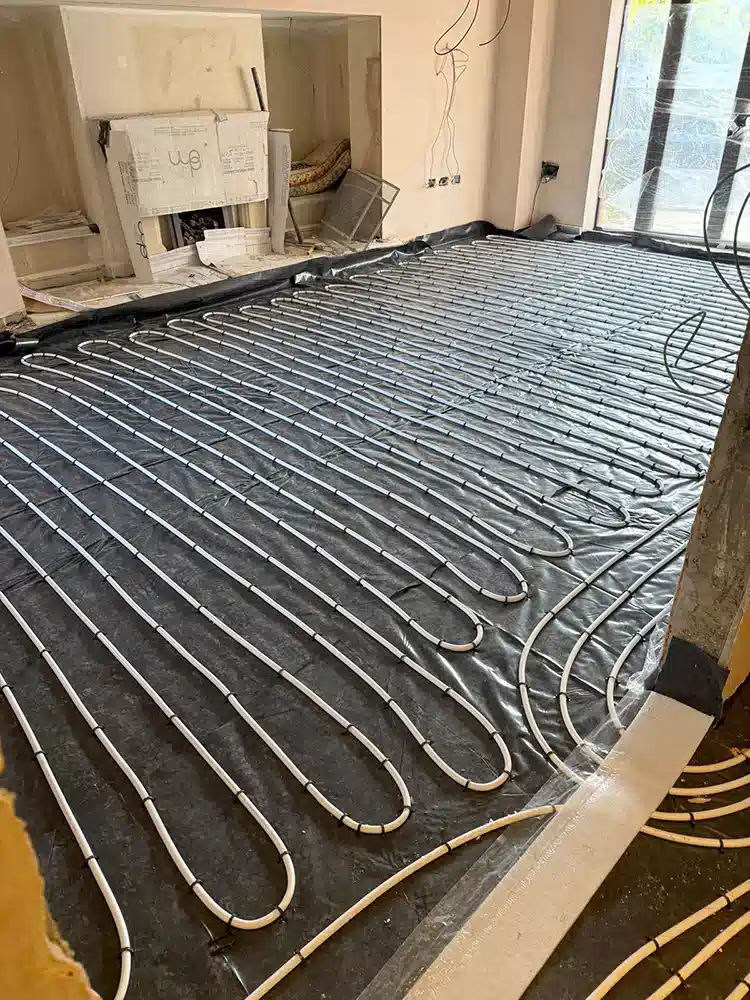
That sets the build-up. Starting from the finished floor level, take off the flooring, then the screed, then the pipes and insulation, and the slab has to be set to suit. A pumped floor makes the sums easier, needing only 25mm or more above the pipes for an overall depth near 45 to 50mm. With hand-laid sand and cement the cover rises to about 45mm, and the floor gets thicker to match.
Being runny, liquid screed surrounds each pipe completely without trapping air. So warmth moves evenly through the slab and the room heats up sooner. With sand and cement the screed has to be compacted carefully around and over the pipes to avoid voids.
The pipes need insulation underneath, an edge strip around the walls to let the screed expand, and a membrane to keep the screed off the insulation. We can supply and fit those if they are not already in place; see insulation and membranes for screed. Our guide to how thick screed should be lists the depths.
Newer homes are a small share of the town, with 9% built since 2015, and an extension to one of those has to match whatever floor build-up is already there.
Retrofitting and switching on heating in Horsham
Adding underfloor heating to an older Horsham house is a question of height. A post-war or older ground floor rarely has room for insulation, pipes and screed without lifting the floor above door thresholds. The usual approach is to remove the old floor and rebuild it, using liquid screed for the thinnest workable build-up.
Once the screed is in, patience pays. With calcium sulphate, the heating can normally come on at around the 7 day mark. Hold off for 21 days at the very least with sand and cement. The heating should start low and rise gradually over several days, following your installer's commissioning schedule, and should never go straight to full temperature. Commissioning slowly also starts drying the floor, and it lets the screed adjust to heat without stress cracks.
Tiles, LVT and engineered wood all go down well on a heated screed once it is dry and flat. Check the flooring maker's guidance on surface temperature and on heating settings while the floor is laid.
We leave the pipework to your heating engineer, who lays it and tests it under pressure before our pour. About 11 miles away, we also cover heated floor screeding in Haywards Heath.
Underfloor Heating Screed prices in Horsham
Liquid screed over underfloor heating: £20 to £35 per m² supplied and laid (trade2base, June 2026), so £700 to £1,230 for 35 m². trade2base gives these figures excluding VAT. See our floor screeding cost guide or screed calculator.
Who lays your underfloor heating screed in Horsham
K & B Screeding’s own team, led by director Donatas Bardisevicius. Founded 2019, company 12298780.
See what customers say in our Google reviews and on our testimonials page.
Underfloor Heating Screed from Slough to Horsham
On the map, Horsham sits south-south-east of Slough, about 35.3 miles from our base in a straight line (postcodes including RH12 and RH13), next to Crawley (7.1 miles), Horley (10.4 miles), Haywards Heath (10.9 miles) and Burgess Hill (11.2 miles).
More on underfloor heating screed, part of our screeding services.
