
Matching new heated floors to Watercolour homes
Adding a kitchen extension or a garden room to a newer house brings one firm rule: the new floor has to finish at the same level as the old one, and its heating has to work alongside the existing system. Homes such as those at Watercolour, built between 2008 and 2012, are the kind where that match matters, so the new build-up is designed around the existing floor, its level and its heating.
Start with the numbers. Poured liquid needs a minimum of 25mm over the top of the pipes, so the layer usually totals 45 to 50mm. Hand-laid sand and cement wants nearer 45mm above them, which makes the whole floor thicker. Insulation thickness is then whatever is left between the slab and the finished level, and it is worth keeping every millimetre of it, because thicker insulation sends more of the heat up into the room.
Encapsulation is the other reason liquid is often chosen. Because it flows, the screed wraps every pipe without leaving pockets of air, and warmth spreads through the slab evenly. A hand-laid screed can do the job, but it needs careful compaction along every run.
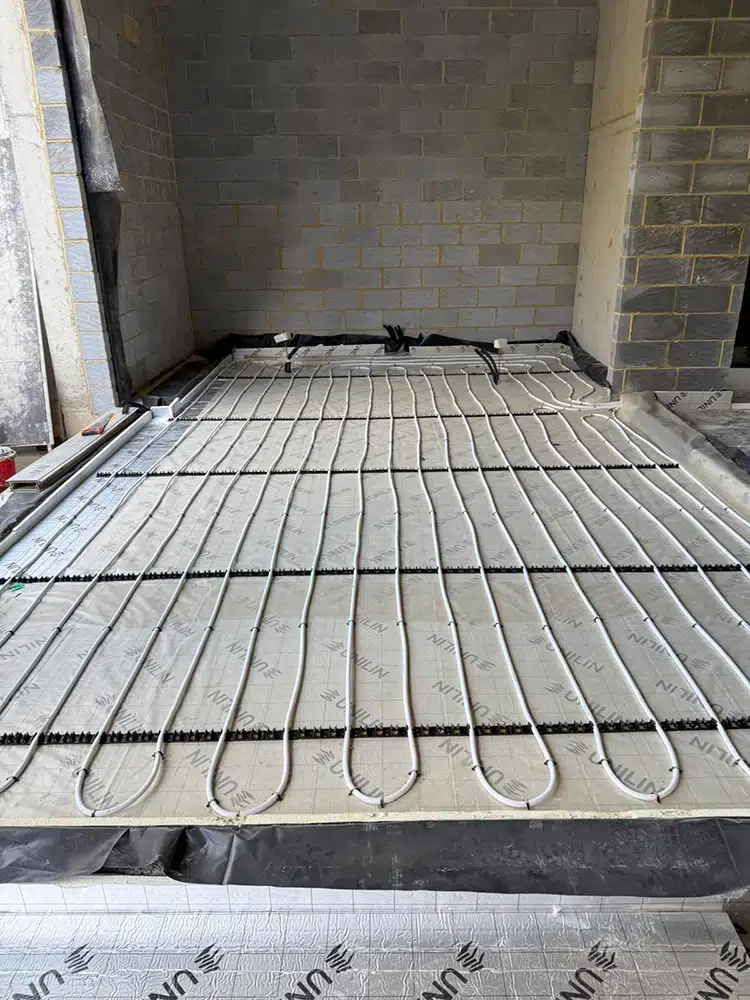
The pipes should be clipped, filled and pressure tested before we arrive, with edge strip and membrane in place. Our liquid screed page for Redhill describes the pour itself, and the thickness guide for heated floors goes further into build-ups.
Retrofitting heating in St John's period houses
When the ground floor of a Victorian or Edwardian house around St John's comes out for a new membrane and insulation, it is a sensible moment to add heating as well. The difficulty is height. The new build-up of insulation, pipes and screed must fit under the same front door threshold and the same bottom stair, so a thinner liquid screed often decides whether the insulation can be thick enough to be worthwhile.
Once the floor is down, the heating waits. With calcium sulphate, the system can normally start up after about 7 days; give sand and cement 21 days at the very least. Even then, bring it up slowly, starting with a low water temperature and stepping it up across several days. Rushing to full heat is a common cause of cracking, and a slow start also lets the heating engineer check every zone before the floor is finished. Run that way, the heating ends up speeding the drying of a calcium sulphate floor before the finish goes on.
For a heated floor in liquid screed, published prices sit between £20 and £35 per m². The floor screeding cost guide breaks down what moves a price up or down.
Underfloor Heating Screed prices in Redhill
Liquid screed over underfloor heating: £20 to £35 per m² supplied and laid (trade2base, June 2026), so £700 to £1,230 for 35 m². trade2base gives these figures excluding VAT. See our floor screeding cost guide or screed calculator.
Who lays your underfloor heating screed in Redhill
K & B Screeding’s own team, led by director Donatas Bardisevicius. Founded 2019, company 12298780.
See what customers say in our Google reviews and on our testimonials page.
Underfloor Heating Screed from Slough to Redhill
As the crow flies, our yard in Slough is about 28.7 miles from Redhill, which lies to the south-east. Postcodes here include RH1, and Reigate (1.5 miles), Horley (4.8 miles), Caterham (4.9 miles) and Dorking (6.9 miles) are close by.
More on underfloor heating screed, part of our screeding services.
