
Where pumped screed fits Redhill extensions and flats
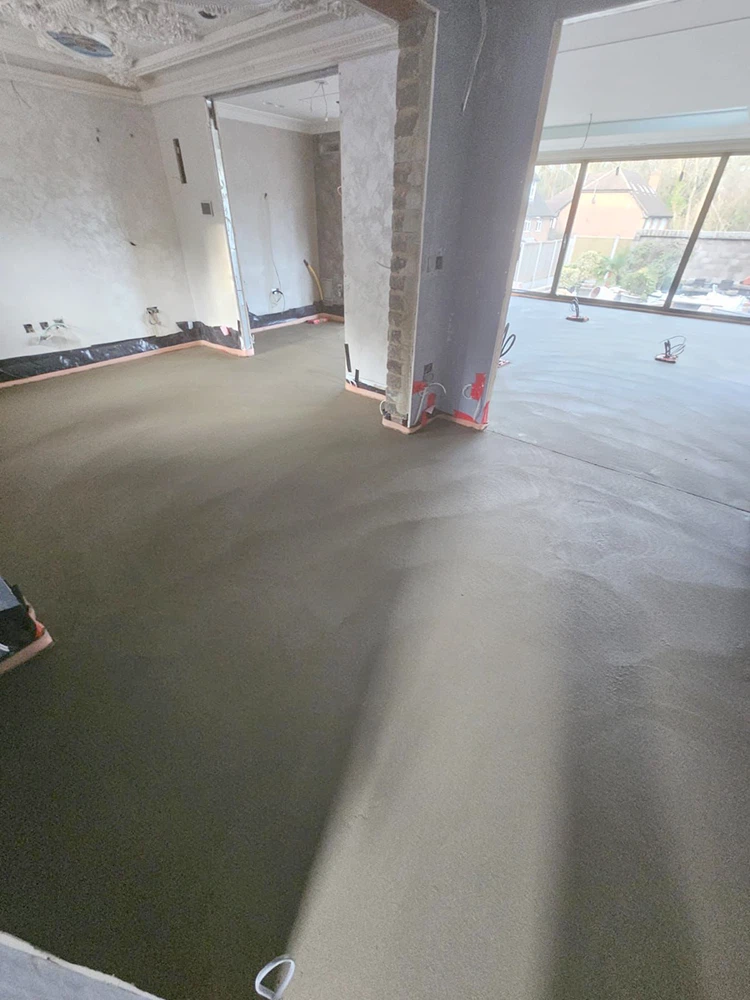
Big open-plan floors are where pumping earns its keep. Redhill's post-war semis are commonly extended at the back to make a kitchen and family room, and once the old rear wall comes out the new floor can run as one area. Pumped screed spreads across that space in a single pour, settles to SR1 or SR2 flatness without much effort, and shrinks so little that it needs far fewer joints than a hand-laid floor.
Homes of that age are a large group here: 26% of Redhill's homes were built between 1945 and 1972, and many semis from those years have room at the back for an extension.
Flats are the second fit. An apartment floor is usually a single level area with a clear route from the street, and a flowing screed covers it quickly without heavy loads going up the stairs. In a refurbishment, any acoustic layer under the screed has to stay in place, so we check the build-up before pricing.
Depth is modest. Laid floating over insulation, a domestic pour can be as thin as about 35mm (commercial floors start nearer 40mm), useful when the new kitchen floor has to line up with an old doorway threshold. There are cement based liquid screeds as well as calcium sulphate ones; for the calcium sulphate type, see anhydrite flow screed in Redhill. To weigh both methods, read liquid screed against sand and cement.
Getting the hose from a Redhill street to the room
On pour day the equipment stays outside, on your drive or by the kerb, and only the hose comes into the house. On a semi with off-street parking that is straightforward. Outside a block of flats, we need somewhere to stand the equipment for a few hours, and the hose route through communal areas must be protected and agreed with whoever manages the building. If parking is controlled on your street, say so when you ask for a price.
Inside, the preparation decides the result. We fit edge strip to the perimeter, tape every joint in the membrane laid on the insulation, and dam each doorway to hold the screed in. Our screed pumping service describes the equipment side of the job.
Being able to walk on it does not mean it is dry. You can cross the room after 24 to 48 hours, yet the floor finish waits for a moisture reading that passes. The rough rule of thumb puts a 40mm floor at around 40 days, with deeper floors slower still; screed drying times explained gives the reasons.
Liquid Screed prices in Redhill
Liquid screed: £24 to £31 per m² supplied and laid (MyJobQuote, August 2026), so £960 to £1,240 for 40 m². MyJobQuote does not say whether these figures include VAT. See our floor screeding cost guide or screed calculator.
Who lays your liquid screed in Redhill
K & B Screeding’s own team, led by director Donatas Bardisevicius. Founded 2019, company 12298780.
See what customers say in our Google reviews and on our testimonials page.
Liquid Screed from Slough to Redhill
As the crow flies, our yard in Slough is about 28.7 miles from Redhill, which lies to the south-east. Postcodes here include RH1, and Reigate (1.5 miles), Horley (4.8 miles), Caterham (4.9 miles) and Dorking (6.9 miles) are close by.
More on liquid screed, part of our screeding services.
