
One continuous floor for Woodhatch knock-throughs
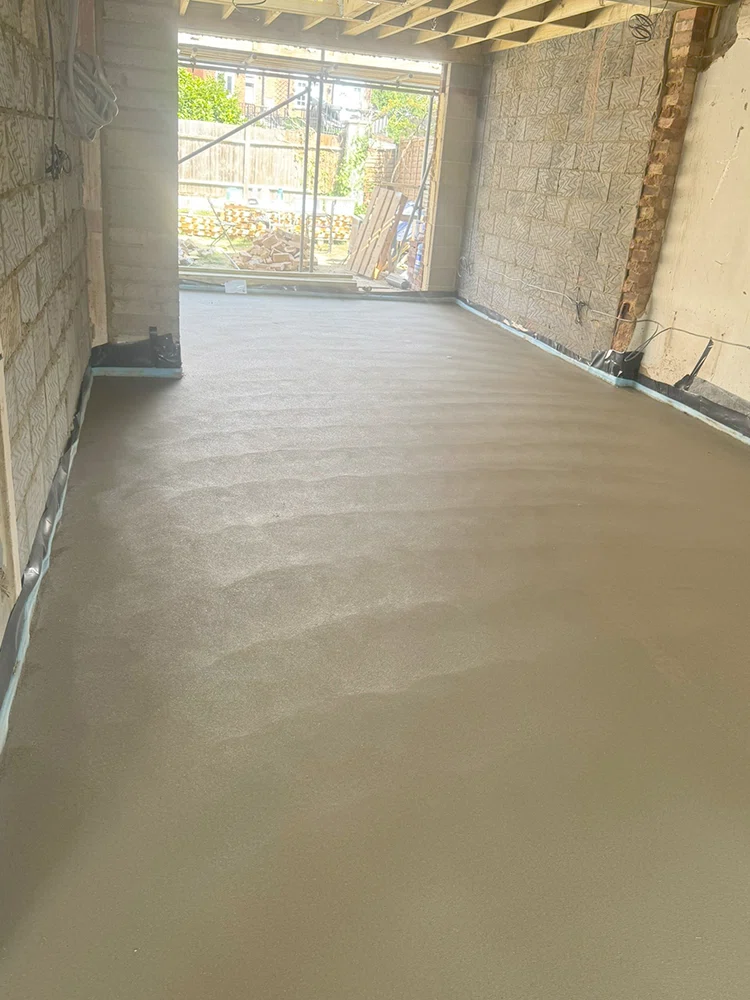
When a rear wall comes out, two floors of different ages meet. The original floor in a 1930s or 1950s house has had decades to settle, while the extension floor is new. A pumped screed poured across both, over a fresh layer of insulation, removes that join entirely and gives one level surface from the hall to the bifold doors.
That matters in Reigate because homes of this age are a large group: 30% of the town's homes were built between 1945 and 1972, and Woodhatch grew in the 1930s on Woodhatch Farm land, so pre-war houses add to the total.
Liquid screed suits the job for several reasons. It finds its own level across a large area, reaching SR1 or SR2 flatness readily. Shrinkage is minimal, which lets a long kitchen and family room be poured with far fewer joints than sand and cement would need. And it flows fully around underfloor heating pipes, which many owners add at the same time.
Depth is usually modest. Laid floating, a domestic pour can be about 35mm against roughly 65mm for sand and cement, and that thinner section makes it easier to meet the thresholds already in the house. You can have it as a calcium sulphate mix or a cement based one; calcium sulphate screed in Reigate goes into the former. For the full comparison, see liquid versus sand and cement screed.
Pump hose routes into Reigate houses and flats
Only the hose enters the house; the pump itself waits outside. On a 1930s house with its own drive, the run is short. For a mid-terrace house with no side access, the hose may have to come through the front door and along the hall, so floors and walls on the way are protected before we start.
Flats are well suited to pumping. With 22% of Reigate's homes in purpose-built blocks, many floors are one or more storeys up, and running a hose up a stairwell is far quicker than carrying heavy materials. The managing agent should know the date in advance, and someone needs to confirm where the mixer can stand for the few hours the pour takes.
Preparation is checked on the day: edge strip on every wall, membrane taped at every joint, doorways dammed. If you need the build-up supplied as well, our insulation and membranes service covers it.
Remember that walkable is not dry. Nothing goes on top until a moisture reading passes; our guide to screed drying times shows how much depth changes the wait. Planning the floor fitter's start date around a test, rather than a fixed number of days, avoids an expensive mistake.
Liquid Screed prices in Reigate
Liquid screed: £24 to £31 per m² supplied and laid (MyJobQuote, August 2026), so £960 to £1,240 for 40 m². MyJobQuote does not say whether these figures include VAT. See our floor screeding cost guide or screed calculator.
Who lays your liquid screed in Reigate
K & B Screeding’s own team, led by director Donatas Bardisevicius. Founded 2019, company 12298780.
See what customers say in our Google reviews and on our testimonials page.
Liquid Screed from Slough to Reigate
As the crow flies, our yard in Slough is about 27.8 miles from Reigate, which lies to the south-east. Postcodes here include RH2, KT20 and RH1, and Redhill (1.5 miles), Horley (4.9 miles), Dorking (5.4 miles) and Caterham (6.3 miles) are close by.
More on liquid screed, part of our screeding services.
