
Heated floors in older Caterham houses
In a retrofit the finished floor must still meet the doors, stairs and thresholds of the existing house. That is the usual constraint in Caterham, where 24% of homes were built between 1945 and 1972 and many more are older still. When a floor without a damp proof membrane is broken out anyway, the dig gives room for insulation, pipes and a new screed. The question is how deep that build-up can be.
Pipe cover drives the answer. A pumped mix must bury the pipes by 25mm or more, so the floor finishes at roughly 45 to 50mm. Hand-laid screed wants something like 45mm over them, which pushes the total higher. In an interwar house where the existing doors fix the finished level, that difference often settles it in favour of liquid. Where the room is small or will be tiled in stone, sand and cement can still be the right choice.
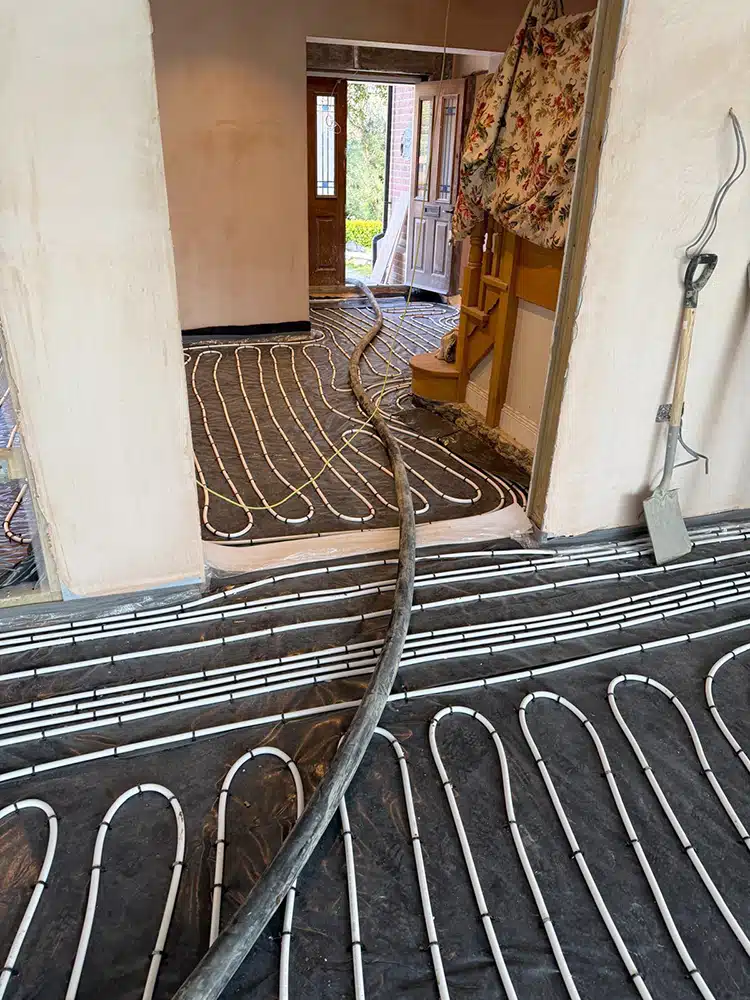
Full encapsulation matters just as much. Air trapped around the pipes slows heat getting to the surface. Pumped screed runs under and around the pipes on its own; with sand and cement we work it in by hand around each loop.
We inspect the insulation boards, the membrane and the edge strip ahead of the pour, and bring them if they are missing. The pipes must be clipped down so they cannot float, then filled and tested. The liquid screed vs sand and cement guide compares the two materials in more detail, and the sand and cement screed page for Caterham covers the traditional option.
Commissioning heated screed in a Caterham extension
Some 25% of Caterham's homes are detached, and a heated rear extension or garden room is a common way to add living space to a house. Once the screed is down, the timing of the first heat-up matters more than anything else.
With calcium sulphate, the heating can normally run from around a week after the pour. Sand and cement has to wait three weeks, 21 days, at the least. After that, commissioning is gradual. Keep the flow cool at first, lift it a little each day for several days, hold it there, then let it fall back. A floor blasted with full heat on day one can crack or curl at the edges. You keep our written warm-up plan, so you and the heating engineer are working from one sheet.
Heat is also a drying tool. On a calcium sulphate floor the system can help force dry the screed, which shortens the wait for the flooring fitter, although a moisture test still decides when finishes go down.
Pipework is not something we fit. Your builder or heating engineer supplies and lays the system, and our job starts once it is in. For projects in nearby towns, we lay underfloor heating screed in Redhill and heated floor screed in Reigate.
Underfloor Heating Screed prices in Caterham
Liquid screed over underfloor heating: £20 to £35 per m² supplied and laid (trade2base, June 2026), so £700 to £1,230 for 35 m². trade2base gives these figures excluding VAT. See our floor screeding cost guide or screed calculator.
Who lays your underfloor heating screed in Caterham
K & B Screeding’s own team, led by director Donatas Bardisevicius. Founded 2019, company 12298780.
See what customers say in our Google reviews and on our testimonials page.
Underfloor Heating Screed from Slough to Caterham
As the crow flies, our yard in Slough is about 30 miles from Caterham, which lies to the south-east. Postcodes here include CR3 and RH1, and Oxted (3.6 miles), Redhill (4.9 miles), Croydon (5.7 miles) and Reigate (6.3 miles) are close by.
More on underfloor heating screed, part of our screeding services.
